That was from the corklins thread.
If we’re really interested in this topic (which we should be), we should begin by looking at our basic assumptions. Where is the evidence (real evidence, not anecdote, “I had a wine with a bad cork once,” etc.) that storing bottles on the side is necessary, that it’s even beneficial? To my knowledge, there is no such evidence.
Furthermore, it doesn’t really make a lot of sense. The entirety of the cork, with the exception of one end (often covered by a capsule), is inside the bottle. Most of the cork is constantly exposed to a very humid environment, in other words.
Can a cork “dry out” at all? Take the next cork you encounter and cut it in half. Is the inside wet? Of course it isn’t. Cork is impermeable to water, which is why it’s used for things like floats, gaskets, flooring, and wine closures. If it can’t get wet, how can it dry out?
We might also do well to consider the flip side: can wine contacting the cork over long periods of time actually cause degradation of the closure? Acids, alcohol…there may well be some effects which haven’t been totally elucidated.
This is a fascinating debate. I’m curious as to your response to this, too, Tom. I will say, thought, that I’ll continue to store bottles on their side (outside of bubbly) if, for no other reason, than they look nice that way.
I’ve actually long subscribed to this belief, here’s why: no matter what you think of cork, it’s primary purpose is to protect the wine against air coming in (and, obviously, liquid getting out). Ultra low transmission of air through the cork implies the same for water vapor - after all, we value bottles with high fills, i.e., little wine has managed to evaporate through the cork. If air and water aren’t getting through a good cork, it makes little sense to believe that the cork actually needs moisture to retain its protective properties; the center of the cork ideally sees no moisture whatsoever, only the ends, and yet it does its job just fine.
Wood furniture, boats, fences, etc., do much better in dry environments than in high humidity environments. Wood furniture lasts just fine for decades, even centuries, and we don’t keep the legs of our tables and chairs sitting in a pool of water to maintain them.
A cork can’t simultaneously be a good seal against transmission of air and water vapor, and need moisture/humidity to retain that seal.
Edited: or, what Nate wrote above my post which I hadn’t read yet.
When I lay all my racking down it takes up too much room.
I guess I’ll just tip my LeCache over on its side now.
This is 100% true, unless the cellar has 70-75% humidity.
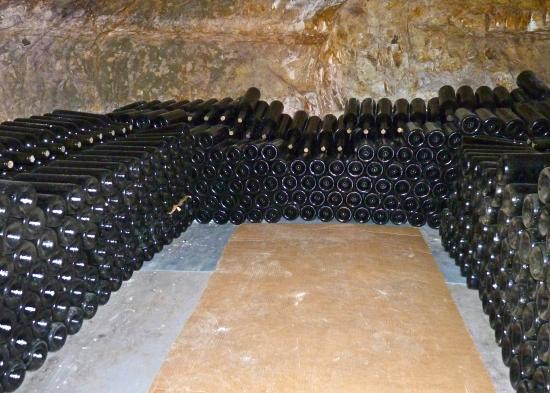
Storing bottles on their sides almost totally negates the impact of bottle height (…er, length) on storage space requirements, So, while in theory one could construct racking such that upright storage in no less efficient than sideways, nobody actually has any such racking. Also, as has been demonstrated by virtually every wienery I have visited, sideways storage allows virtaully unlimited vertical expansion when storing on the floor or large spaces.
Try this with bottles standing up:
If you lay it on its side, the bottles are still on their side. You must lay it on its back or its face.
If kept vertically at low humidity, especially for old bottles, cork will shrink and drop. All my 20 year old bottles have almost no gap to the cork.
I was kidding.
And Bob was serious.
Nope, Mel. I think the storage temperatures are important…but not as important as most people think.
We’re told that 55F is the “ideal” storage temperature. Why? Because that’s the temperature of the cellars in Europe.
What about 65F?? I suspect nobody could pick up the accelerated aging at that higher temperature.
I just think (anecdotal only) that wine is a more robust beverage than most people think.
What if it sets in a UPS van at 85F for a few hrs?? Most people would go ape-shit (Kansas colloquialism for berserk)
if they knew their wine did that. I’m not so sure the wine would be harmed.
I’m just more casual (as is Alan) on storage conditions and don’t obsess over it.
I think Lalou probably overreached on the humidity thing. But it was her money.
Tom
As a serious question - does anyone know if a LeCache even functions on its back?
As Eric Lundblad commented on facebook, Australian research showed more oxygen ingress into wines stood up than on their side. Not a huge difference. Would have to see the studies to know for sure, but it’s a pretty safe bet they’re shorter term and on young wines.
Put some bottles in the fridge (very arid) for 6 months and you will find some with dried out corks and likely a few that show a bit oxidized (and some that are fine).
That’s a good question, but he’s speculating based on an assumption. I’ve opened plenty of very old wines that were stored on their side, where the 10-20% that is saturated is the most sound and the rest crumbles to dust. A fully saturated cork could be the next stage after that - it certainly is in some cases, at least.
Firstly, with a sound (young) cork nothing is getting through it. It’s the imperfections in the seal between the cork and the neck where stuff can get by. Even in the extreme case of a fully saturated ancient cork that bubbles when you take off the capsule, 98-100% of those bubbles are coming around the side of the cork.
You don’t think there’s an optimal humidity range for wood, where both too low and high in humidity are harmful? I’d argue it’s a broader range than the conventional wisdom, which is just trying to replicate the cave environment, but the fridge test can prove a cork can fail under an arid environment over time.
Some people here are confusing an ambient dry with zero water content. I can pull a dry cured olive out of my fridge right now and it’ll be inedible. Tough, hard, overly bitter. Take some out to sit for 12 hours and they become chewy and rich, the flavors come out and all that puts the bitterness in check. That’s two different ambient moisture levels of the same “dry” product.
Get the guest room ready.
I’ll wear something short (and boring) ![[wink.gif]](/uploads/db3686/original/2X/0/04707e6a7bbb03e0153e349d8a9270d30e1e9525.gif "wink")
![[cheers.gif]](/uploads/db3686/original/2X/0/0ff9bfcdb0964982cd3240b6159868fbdf215b1a.gif "cheers")
Not sure about the furniture… of course we don’t sit it in pools of water… but we do polish. Also in dry climates you do get wood cracking. So my guess is it’s not quite that simple.
And likewise with the corks.
I’m sure that timeframe is key. I’d guess that over a short period like five years as long as temp stays below say 63F nothing too much can go wrong. At 60F any pre-isting faults may be a bit more pronounced after five years than at 50F and the wine a bit more advanced.
The real question is a medium term timeframe of say 10 years or longer and the seal becoming imperfect.
This is fascinating.
We need longer term study with sound methodology. And a study of reds as well as whites.
Could this be the analogue of the myth about searing meat to seal in the juices?
I think that’s true of most wines (more robust than people think… within limits). I do tend to believe (no controlled data) that continual temperature fluctuation can be more of a problem than the absolute temperature (within a broad range).