I tried to Google a pic of “Three Corkscrews One Bottle,” but it activates my computer’s safe search mechanism.
Here’s a “R” rated version…

I tried to Google a pic of “Three Corkscrews One Bottle,” but it activates my computer’s safe search mechanism.
Here’s a “R” rated version…
The only time I’ve had a failure with the Durand was on a 30+ year old bottle with a long cork whose bottom half was soaked through and very spongy. The Durand worm was not long enough to penetrate the entire length of the cork, which broke just below the end of the worm during gentle rotation and extraction.
I ordered a “Port” version of the Durand, with a slightly longer worm, and haven’t had a problem since.
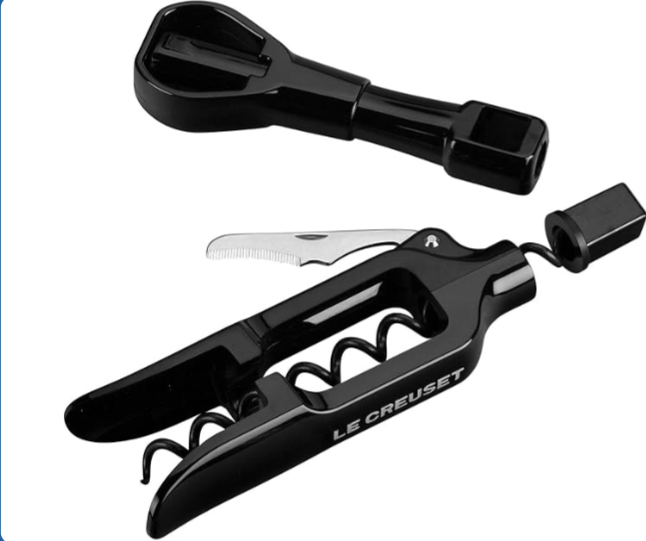
If you want a worm long enough to penetrate the longest corks, you can buy a pocket model Le Creuset:
Use the lever to insert the worm without the external shoulder piece. Remove the lever and insert the Ah So.
If your Ah So has short prongs, the cap at the top of the worm can be shortened with a Dremel so it will fit more snugly.
Can you post a picture of this? I literally cannot imagine how three corkscrews can be used on a single cork at the same time.
Looks like a couple people need to read the entire thread.
The Durand isn’t perfect but its more perfect than all other options.
I’ve used it correctly. I just don’t like it. Very old corks can be very long, as pointed out, and the Duran Duran doesn’t always go all the way through. Still, my main problem is that, with hand blown bottles (say pre-1945, as during the war there was a lot of reuse of old bottles), the neck is rarely straight, so you inevitably end up shredding the cork and often get fragments of it in the wine and/or transferring mould/dirt down the side of the cork. Using two or three corkscrews produces far better results. As long as you have long worms and narrow handles, it’s both easier and quicker than using a Duran Duran.
WAT
Are you crazy or something?
the port version of the durand should be long enough for most any corks. I’m not picturing how you’d shred corks with the durand. I opened a bunch of very old sauternes (1880-1930) with it recently and it was great.
Neal,
I use a screwpull for most wines because it is easier and faster to use than a Durand. Not really an expense as I bought my screwpulls (actually I have two of them) before I purchased the Durand.
My Screwpull and the Durand are in the same drawer. I will occasionally get to the former first and use it, but to me, the difference in time and effort between to the two is immaterial.
Wow. That looks like it could only be used by Florida Man, just before he puts his arm in an allegator’s mouth.
To be fair, with soft saturated corks I can see some of this damage from the tines of the ah so part of the Durand.
I agree with the 15 year rule, it seems to work generally well, but quite dependent on the producer. All my Neal and Karl Lawrence from the early 2000s have crumbly corks and absolutely require the Durand, while I can pull a 30 year old Barolo (Pio Cesare excepted, those corks ALWAYS suck) and extract the cork with a regular screw much of the time. I think US producers often cheap out on corks.
I agree, I’ve literally never had an issue with shredding the cork and i open older bottles fairly regularly. It made light work out of the 1875 Angelica cork i opened this past weekend
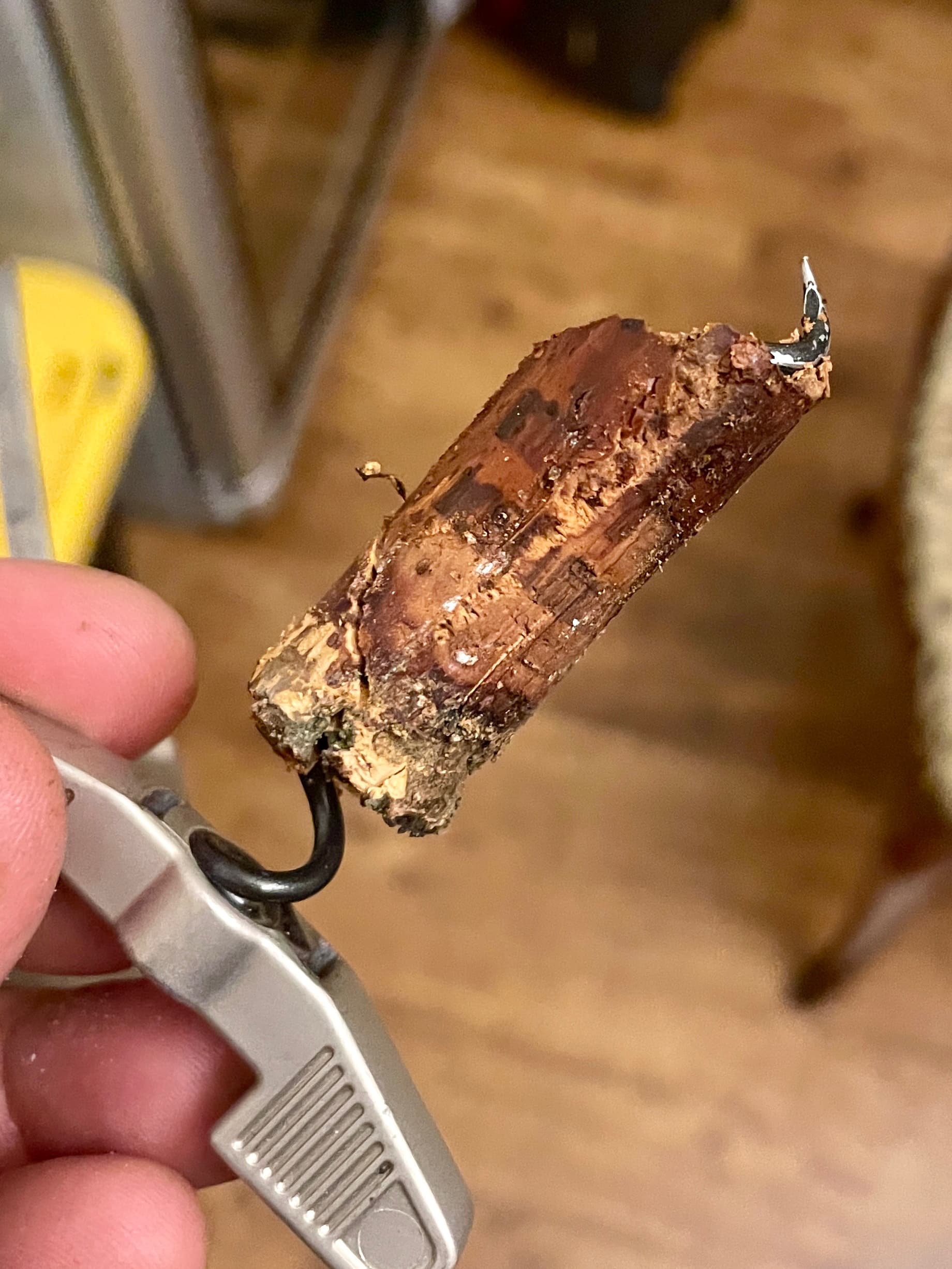
Opened this 1917 Clos de Vougeot recently. As you can see the cork is long and the prongs have cut up the side of the cork. It’s almost unavoidable with bottles like this, with uneven necks. As the cork was a bit soggy and long, the bottom of it ended up in the bottle. As the cork was clean it wasn’t really an issue, but where there’s mold at the top, I really don’t want to end up pushing that further down into the neck than I need to.
Eric, IME the damage to the outside edges of an old, soggy cork from the Ah So blades rarely causes cork bits to end up in the wine. And if it does, they’re just a few bits from the bottom and easy to fish out of the first few ounces poured. I agree that it does chew up the outer surface of the cork. That’s a non-issue for me other than the way the cork looks.
The risk of a few bits of cork in the wine with the Durand has been much lower in my hands than the risk of coring out the center of a cork using a worm to pull it out or causing the cork to break into multiple pieces with two worms. Never tried three worms.
I can’t think of any time since switching to the longer “Port” Durand that I’ve had an old cork like the one in your picture break up like that.
Then again, even though I’m opening 40 year old bottles, they aren’t 100 years old and don’t have irregularly shaped necks. Maybe Port tongs, major hassle that they are, would work better on those?
If the wine is good and clear, why do I care if the 50 year old cork is pristine?
The issue arises when the upper park has black mold or other build-up of nasty stuff that hasn’t transferred all the way through the cork (which is not infrequent). I don’t care about the cork itself but I’ve only used the Durian about a dozen times, only for old bottles. I think I’ve ended up with small bits of cork in the wine about 50% of the time (in and of instead not a problem, but then when it happens with such frequency, I don’t get how it’s any better than a couple of cork-screws). Twice have I had shredded fragments of a bad cork end up in the wine. When the nasty stuff from the neck is transferred along the side of the neck, this can end up pushing some of the nastiness in. It also means you have to clean the inside of the neck much lower down. I hardly ever have this problem with two cork-screws (I use a pair of different-length worms from screwpulls that work really well one on top of another). Port tongs are great, but while I appreciate the sense of ceremony, it is a bit of a hassle to use them frequently.
Some guy named Rudy has some cheap knock-off burgs that are not as ludicrouslt expensive as their real counterparts.
Different people have different experiences, but I have had good luck with older wines with a Durand. It has save very old wines like a 1959 Latour. I generally decant any old bottle where I am using the Durand (and most where I am using my screwpull) and have a screwpull decanting funnel (with filter) so that any small bits of cork, sediment, etc., are not in the wine when I drink it.
The corkscrew part is supposed to be screwed all the way in to where it touches the top of the cork. This allows it to penetrate all the way through most corks. It appears you are 1/2" from there and perhaps that’s why the bottom crumbled out.