Nope, I haven’t. I specifically stated “bioD grapes in conjunction with a particular set of wine-making practices.”
[/quote]
And I could quote right back at you a much more recent, 2013, snippet from Villaine, in which he says:
“Vignerons --among them some of the most advanced of the industry – find in biodynamics that link to the earth which is so essential for delivering the potential for terroirs which have been cared for by human hand for centuries.” His vineyards all remain Biod and his recent penning of the preface to the book “What’s so special about Biodynamic Wine” suggest that he is still comfortable not only practicing but promoting this form of viticulture .
I think it’s the height of hubris to assume that a wine-maker whose wine you feel is delicious is mistaken as to the reason. If they can’t explain it to you, so what? And if they are not sure themselves why it works, but just have sufficient proof in the bottle to keep on practicing, then who are you to demur? There’s no real explanation for much in wine – like for example the controversy over “minerality” and where it comes from (is it really from rocks?). It’s not like Biodynamics is the haunt of a fringe bunch of loonies any more. A list (from 2009, so would be much larger now) of biodynamic producers in burgundy is below. Do you really think you know better than this rather distinguished collection of bioD winemakers( hailing from one small region.)
Domaine d’Auvenay
Domaine de L’Arlot
Domaine Comte Armand
Daniel Barraud
Dom. de la Boissonneuse
(some vineyards)
Domaine de la Cadette
Chandon de Briailles
Domaine Bruno Clavelier
Dominique Cornin
Dominique & Catherine Derain
Domaine Dujac (org, bio-d methods)
Domaine des Epeneaux
Les Faverelles
Domaine Emmanuel Giboulot
Jean Grivot
Domaine Henri Gouges
Domaine Guillemot-Michel
Thierry Guyot
Domaine Jeandau
Michel Lafarge
Domaine des Comtes Lafon
Domaine Leflaive
Domaine Leroy
Sylvain Loichet
Les Champs de l’Abbaye
Château de la Maltroye
Didier Montchovet
Château de Monthelie
Pierre Morey
Jacques-Frederick Mugnier
Jean-Claude Rateau
Domaine Roblet-Monnot (converting)
Domaine Romanee Conti (DRC) (converting since 2007)
Rossingol-Trapet
Guy Roulot
La Soufrandière (org + bio-d methods)
Trapet
Laurent et Céline Tripoz
Cécile Tremblay (converting)
Domaine des Vignes du Maynes
Domaine de la Vougeraie
So basically what you are saying is that the vigneron believes in it and the wine tastes good, so what is there to question, correct?
Well, that’s certainly one view. One other would be to wonder if the grapes were grown differently, what would the outcome be? Could it be that the grapes and the subsequent wine would be better?
We’ll never know - and either will you. Every winemaker I’ve ever spoken to who has switched has believed that what happens in the vineyard will lead to a superior product. Does it? Without A/B comparisons we truly will never know . . .
My (very personal - I don’t expect others to feel the same) problem with Steiner is that I have a real difficulty reconciling the promotion of particular farming methods as part of an overall world when that world view was particularly anti-semitic.
Larry
I agree with you actually. All I’m saying is that until and when we get such A/B comparisons, I think an open mind is a better approach to the biodynamic issue than the kneejerk ridicule seen on this thread. All the more so since so much of what is captivating about wine is actually ineffable (and therefore, David, perhaps not yet susceptible to explanation by the scientific method).
But if biodynamic grape cultivation continues to spread in the world of fine wine, I have no doubt that answers (either way) will be forthcoming in the future. Untill then, yes, I trust the product in the bottle and the choices of the vigneron.
Well, ok. But just to state the obvious, if we were to abandon all contributions to knowledge made by individuals who were racist, sexist, antisemitic, homophobic, we would be left with a sadly diminished pile.
Why are you convinced ‘answers’ will be forthcoming? My point is that I don’t believe they will, and either you 'are convinced ’ or not. I hope I’m wring, but usually with stuff like this, the ‘believers’ just become more steadfast . . .
I’m not convinced of it. But there doesn’t need to be answers, though at some point there may be. The proof will be, or (is), in the spread of the practice, even in the absence of such answers. Just take another look at that list of bioD burgundy vigerons.
I do not think they are collectively misguided, or swayed by fashion, or impelled by cynical marketing motives.
I don’t think they are cynical. I think they are incredibly conscientious but lacking in scientific knowledge about what they are doing. Turns out you can make great wine that way.
So if the majority do it, it must be ‘right’? This is where the problem to me exists . . .
I really don’t care who is using it or not. I am not anti-biodynamics per se; I just can’t accept someone telling me it is ‘better’ just because . . .
If some of your favorite producers were ‘found out’ to use concentrators, would you feel that everyone should in order to achieve what your favorites do? And no, I am not implying this - just asking a ‘what if’ . . .
You missed the part where I said “And you feel the wine in bottle is indubitably delicious.” So, a spreading practice amongst the world’s top vignerons combined with some really great wine. This doesn’t seem to me to merit the collective merriment and cheap horn jokes found earlier up thread.
Anyway, the good part is no-one has to defend or proselytize the practice. It doesn’t need my bleatings in the wind. It is surviving and thriving on its own merits.
I’ll sign off now on this thread as I’m already repeating myself and have nothing new to add.
You missed my point. If Steiner had simply said “this is a better method of farming” and also had anti-Semitic views that would be one thing. But he wrote that biodynamics is part of a larger world view. That world view also included very prejudiced views toward Jews. I have difficult reconciling those two.
Some of it is good practices, so that part does make a difference, though it could be done without being biodynamic. If it helps people feel more spiritually connected to the vineyard, there may be some collateral benefits just from being more attentive. Then there’s the lure of superstition. There’s a certain lack of control that will always be there in farming which can play to that for some people. (See also: athletics.)
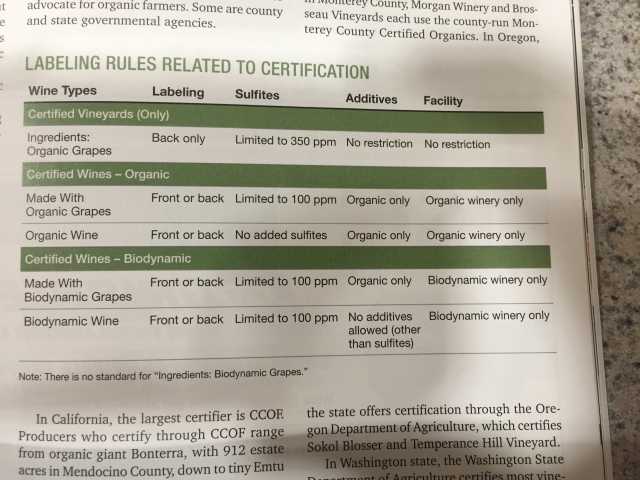
A few additional comments I thought of. First BioDynamic/organic grape growing are not the same as BioDynamic/Organic winemaking. Most wines are “made from BioD/Organically farmed grapes” and not actually BioD/Organic wines. There are separate rules for both in the vineyard and winery. At least in the US BioD winemaking does not allow yeast/acid additions but does allow So2. Organic winemaking does allow yeast/acid if they are organic but does not allow So2. The below picture is from a trade publication a year or so ago.
On the Demeter USA website they do list some studies that have been done. I first herd about one study that was up here in Mendo that Glenn McGourty our UCD extension Viticultural specialist was involved with.
I am not sure how many folks realize that only 2 of the preps are applied to the vineyard, horn manure and silica. The rest are applied to the compost. The best compost I have seen has been BioD though we have never used any just Organic cow based compost for us. I do like the idea of loads of microbes in the vineyard which is why we do seaweed/molasses compost tea a couple times a year and do not till our soil.
I tired to use the calendar a couple vintages with the promise of practitioners that it would lower the NTU’s/turbidity/sediment in our PN’s with no measurable results. It just so happened that when I made by topping, racking, bottling schedule that first year off the 12 times or so I was going to work with the wine only one day I chose prior to looking at the calendar was not a fruit day. I even tried using the tidal calendar one year for racking to get NTU’s lower with no measurable results. I even overlayed the BioD calendar over my POS sales (with help from a programmer friend) though there were no definitive results there either with 5 years of records.
I love the idea of a self sustainable farm with as little offsite inputs as possible as well as low to no chemical use in the vineyard as we live here and my father in law is the applicator of anything in the vineyard. Though to follow all the rules of BioD to me is not a path were on.
The thing I keep coming back to is that if it does work and the wine tastes better it would only do so on Fruit days. I drink every day so that aint gonna work for me
To me, vibrancy is a lifting acidity in a wine that plays well with it. Not too much, not the wrong acids, might not play well with heavier characteristics. Works well with pretty aromatics. A lighter body or expression doesn’t hurt.
So late picking and heavy oaking are usually at odds with it. Low SO2 use in reds naturally lends to this due to SO2 darkening fruit character and dulling everything else. A bretty wine isn’t likely to come across as vibrant, but good acidity helps inhibit brett development. The somm in question is probably linking the effects of low SO2 use with biodynamics.
I have read Steiner’s novel, though 20 years ago. Funny part to me, however, applicable to Burgundy, is how one Domaine can be biodynamic and someone w adjoining vines can spray the shit out of theirs. Anne Claude Leflaive used to bitch to Niellon because he’d spray his Chevalier vines and runoff went right onto her vines. Hard to be truly biodynamic if you don’t own the entire farm, or in this case, vineyard.
![[cheers.gif]](/uploads/db3686/original/2X/0/0ff9bfcdb0964982cd3240b6159868fbdf215b1a.gif "cheers")