Larry, I agree with most of what you said, except that I don’t think the concept makes the “problem” of subjectivity and differences in taste any more severe than it was before, nor does the concept claim to lessen those effects. What it does is help people to be aware of and describe, in their own terms, what they are tasting. Calibration of tannin sensitivity, etc isn’t important to the average wine drinker, and for those wishing to hone tasting skill, I think it’s something that can be done in conjunction with Tim’s technique.
I guess what I’m saying is that I don’t see how these methods are related to the problem you’re talking about in your second paragraph.
Hey Doug, I don’t have a blog so that link is just something I googled, which shows how to count taste buds and see how many one might have. What’s misinformation about it? I’d be curious to know.
Sorry, Dan, that’s my internet age reading comprehension failure. There’s more wrong than right about that article (I was stating it softly when I thought it was yours), so without getting into every point, I would suggest checking out Greg’s link and doing some searches for the terms he mentions, looking for articles by people who actually study the topic. It’s interesting stuff.
I’m reading through this PDF, and they mention supertasters, non-tasters, medium tasters… But I don’t see the criteria for what makes up each taster anywhere… Maybe I’m missing it?
Usually its PROP status (I think they call it PTS or PROP tasting status) - whether or not the compound 6-n-propylthiouracil tastes extremely bitter or not.
Hi Tom. Tim Gaiser here and apologies for coming to the party late as someone just alerted me to your post a few days ago. Would be more than happy to explain submodalities and how it figures into my tasting project and teaching. First, it’s helpful to know that the concept came out of my initial sessions with Tim Hallbom in November of 2009. We spent the better part of four hours in front of a film crew with my tasting about a dozen wines and him standing next to me tracking my eye patterns and language patterns the entire time. Between the two of us we were able to deconstruct what I do internally when I taste wine; literally my internal smelling/tasting sequence from A to Z; we were able to do so by him being able to get me to slow down and be consciously aware of what I normally do unconsciously and at light speed. Since that time I’ve done some 15-18 in depth interviews where I stand next to an MS or MW colleague and do the same thing–deconstruct their tasting strategies. Many of these are published on my blog with more to come. I’ve also informally interviewed dozens of other people—professionals and consumers—about the same thing. From these interviews I’ve put together a set of what I call best practices that separate top tasters from everyone else—and submodalities figure prominently in them. These best practices include the following:
Using a consistent starting eye position and a consistent way of holding the glass, especially the angle of the glass and if you rest the glass on your upper lip—or not. Wine is just like golf—you have to address the glass consistently if you want consistent results.
Why is the starting eye position so important? It’s the trigger and/or vehicle top professional tasters use to shut the world out and go into their zone. Really good tasters do so quickly and easily.
The olfactory image connection; practically* every top professional I’ve interviewed for my project (self included) generates internal images (or movies) for the aromatics they recognize in a glass of wine. All of us do so very quickly and unconsciously. These images are obviously based on one’s life memories and thus everyone’s experience of a given wine is indeed highly individual.
*I say practically everyone because about 5-10% of the people I’ve interviewed generate very singular movies of each aroma in sequence while a much smaller percentage—the true synesthetes—actually project a shape or flow of colors out of their head or body as their experience of a wine. Strange but very true.
These images of olfactory memories have structural qualities. Moda is the Greek term for the five senses. We think using these five senses or modalities internally but they also have structural qualities called submodalities. Thus internal images of aromatics all have a location, proximity, dimensionality, brightness and any number of other attributes. There are some 60+ submodalities for visual alone and many for auditory and kinesthetic. I think submodalities could be the most profound thing I’ve ever learned. Why? Because changing any of a handful of them, especially in visual, changes one’s experience and sometimes profoundly–and not just for wine, for everything.
Once generated all these images don’t simply go away but live in a map or arrangement and these maps are highly unique from person to person. Top tasters easily can keep more than ten things in their field of awareness either simultaneously or in rapid sequence.
The map will change from nose to palate as in the map of images will change with any increase or decrease in intensity of the aromas/flavors as one moves from smelling the wine to tasting it.
Top tasters use visual aids/constructs to calibrate structural elements in wine; that is we see something internally that helps us calibrate how much acid, alcohol and tannin we’re tasting in a given wine. These visual aids can be anything from scales to dials to other.
Finally, and much more work to do on this; top tasters use various visual patterns or sequences to help ID grapes, regions and countries. A lot of mine have to do with either labels of wines I’ve tasted previously or places I’ve been to—and more.
To my knowledge all this is new as I haven’t come across anyone else doing similar work. Why hasn’t someone done it before? Simple answer: it’s hard to be in two places at once. You need a guide standing next to you to help slow your unconscious processes down and make you aware of what you’re doing. More complex answer: no one has ever used the modeling tools—including submodalities—from NLP with tasting. I have quite a bit of training with NLP so am doing exactly that. The intent of my project is to come up with not only a set of best practices taken from professionals but also a set of strategies that anyone can use to learn how to taste wine regardless of their level of expertise. I’m about 70% of the way there with the latter.
Finally, I just did a seminar at the Society of Wine Educator’s conference in Seattle in August called “Tasting Mastery” based on all of the above. I would be more than happy to do it for a group in Santa Fe. It takes about 90 minutes or so but the question is when and where. I will ask Greg to see if it’s possible. We’d just need a room, one wine and some glasses. Will keep you posted.
Finally, all of this—and much more—is again on my blog. Check it out:
Thanks for responding, Tim. If you could get Greg to set up something in SantaFe in a few weeks, I’d love to do it.
I currently have no plans for SFW&CF, other than a few things w/ MarilynReisen & maybe pour some w/ her for Ridge.
I actually suggested to Greg last week that he have you do a seminar on the subject up in Taos at the Taos WWF.
But my suggestions for seminars are always rejected out of hand, so probably won’t happen.
I have been in contact w/ Erin & we’re planning to get together in Oct so she can explain to me submodalities as she understands it.
As you can tell from the tone of my OP (I presume), I’m highly skeptical of your techniques. The “breakthrough discovery” of
“enormous importance” sounded somewhat overblown. I wondered why I’d not heard about it in the wider wine community.
As you see above, only Doug had anything to say that lent support to your techniques. My inquiries on other wine boards
pretty much yielded a lot of skepticism to outright dismissal, mostly because of the NLP association. But Erin is a definite believer.
Plus, when I started looking into submodalities, in general, , everything directed me back to NLP, a psychotherapy technique that
was long ago discarded by the scientific/psychotherapy community as “New Age pseudo-science” and of no value. As best I can tell.
However, like phrenology or religion or any other such methodologies, if someone can find useful benefit from them…so be it.
So I’ve tried to keep an open mind on the subject and have not dismissed it out of hand. I am skeptical, but more than
willing to be convinced otherwise.
Thanks again for taking the time to come here to elaborate.
Tom
“1. Using a consistent starting eye position and a consistent way of holding the glass, especially the angle of the glass and if you rest the glass on your upper lip—or not. Wine is just like golf—you have to address the glass consistently if you want consistent results.”
OK. You lost me right there.
I don’t expect, or even want, consistent results. I want a pleasurable experience.
Glad I’m not a wine pro.
I’ve felt this way for forty years as friends got into the business, dropped out of the business, or stayed, and in many cases lost the joy.
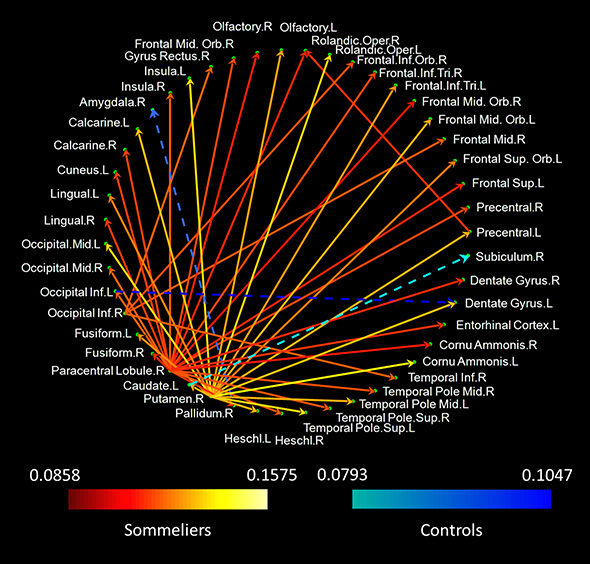
Olfaction Study in Sommeliers Uses Advanced fMRI Modeling to Uncover Brain Network Architectures
Findings support graph theory for describing network topologies
By Dietmar Cordes, PhD; Karthik Sreenivasan, MS; Xiaowei Zhuang, MS; and Sarah Banks, PhD, ABPP/CN
…According to the notion of brain neuroplasticity, the brain has the ability to change its neural pathways in response to changes in environment, thinking or behavior.5 Since Master Sommeliers acquire their knowledge in identifying wines over years of training, we speculated that the brain circuitry associated with identifying the type and quality of wine would differ in the sommeliers relative to controls who are not wine experts. Specifically, in sommeliers we expected changes in the network topology involving the following areas:
Olfactory cortex (involved in smelling and discriminating wine scents)
Medial temporal cortex (involved in episodic memory in recalling characteristics of typical wine features)
Visual association cortex (involved in associating wine color with quality)
Language areas (associated with describing characteristic features of wine)
…The findings of this new technique show that in addition to functional activation differences between sommeliers and controls, the effective connectivity networks significantly differed between the two groups (Figures 1 and 2). Furthermore, these directional connectivity measures can be used as features to accurately classify sommeliers from controls.
…
…Although the effective connectivity networks involve similar regions in the two groups, the complexity of these networks (strength of connection) was much higher in the sommeliers than in controls. Other graph-theoretic measures (global efficiency, small-worldness) are currently being investigated.
![[wink.gif]](/uploads/db3686/original/2X/0/04707e6a7bbb03e0153e349d8a9270d30e1e9525.gif "wink")