Santa Clara & San Benito Wine Heritage

My Notes from the Event,
Part #1: “Enz” & “Wirz”

Morgan Twain-Peterson (Bedrock):

  • “Under the Mountain Vineyard”
    · Once reportedly part of the larger (now uprooted) “Mary Carter Vineyard”; David Bruce bottled a varietal Grenache wine from this site in the early 1970s; only a total of 3 Grenache vines remain at “Under the Mountain”.
  • Marty Matthis (son of Kathryn Kennedy) - source of information on Hecker Pass vineyards
  • Filomena - winery started by Bedrock’s cellar master, Luke Nio: Rosé of Cabernet Pfeffer producer (from “Enz Vineyard”).

8:00 Official Start of Session

Emily Rasmussen of HVS
Mission statement of Historic Vineyard Society

  • California’s Central Coast includes 40 AVAs, ~90,000 acres

Ian Brand (I. Brand, Le P’tit Paysan, la Marea):

  • Early American winemaking in Santa Clara’s San José area had two main nurseries for grape vines:
    / Pierre Pellier (Mirassou) - major wine grape budwood importer and supplier through the 1870s
    \ William Pfeffer (and Theophile Vaché) San Francisco to San Juan Bautista/Cienega Valley

  • Three Valleys of San Benito County:
    · North - Eden Rift and DeRose (historically the oldest area of the three planted)
    · Middle - “Gimelli Vyd” (formerly “Gabilan Vineyard”) and “Wirz Vyd”
    · South - “Enz Vineyard”

  • 1960s-90s Almaden had 30-year leases on every vineyard in San Benito County; ultimately led to preservation of local old-vine sites, even though it temporarily deprived other producers of access to region’s fruit

  • “Enz Vineyard”:
    · Calcareous soils (limestone and granite) in an isolated valley, underground water accessible by vine roots
    · Zinfandel and Cabernet Pfeffer planted in 1890s; own-rooted, head-trained, basket-pruned, mostly dry-farmed
    · This site’s wines often are leaner, more angular, but very age-worthy

  • Cabernet Pfeffer: sometimes mistaken with interplanted Trousseau, Négrette, and other varieties; U.S. Cabernet Pfeffer almost is exclusive to the Cienega Valley in San Benito County

Nicole Walsh (Ser):

  • Walsh has produced Cabernet Pfeffer wines from “Wirz”, “Enz”, “DeRose”, and “Gimelli” vineyards

  • According to Pat Wirz, Cab Pfeffer was grown by Frederic Bioletti (“El Gavilan/Gabilan Vyds” and Davis, CA), William Pfeffer (SF/Santa Clara/SJB area), and Harold Ohrwall (El Gavilan Vineyards, Cienega Valley);
    · “Wirz Vineyard’s” oldest Cab Pfeffer vines date back to 1920s;
    · Ken Volk’s early submission of “Cabernet Pfeffer” plant material to UC Davis for DNA analysis returned w/ results for “Gros Verdot”; later determined to be Mourtaou.

  • Cabernet Pfeffer is lightly colored, with white pepper aroma, cranberry & pomegranate fruit and earthy flavors, delicate structure.

  • Walsh has worked with grapes from 4 of the 5 best-known Cabernet Pfeffer vineyards.

  • “Wirz Vineyard”:
    · Cabernet Pfeffer from ~1925, Riesling from 1960s;
    · Dry-farmed, granite, limestone, sandy loam.

Ian Brand:

  • “Enz Vineyard’s” Cabernet Pfeffer is more often expressed as a field blend of its “mother block”: Cab Pfeffer, Cab Sauv, Malbec, Grand Noir, Alicante Bouschet, Trousseau.

  • “Enz” and “Wirz” grapevine components: genetic make-up from area cuttings, shared locally, but generally isolated;
    · Mataro/Mourvèdre: distinct from other Californian examples

Morgan Twain-Peterson and Ian Brand:
Biotypes, morphological differences in grape varieties in “Wirz” and “Enz” vineyards

Nicole Walsh:

  • “Wirz Vineyard”: ~45 acres of vines, 40 acres of white grapes (Riesling, Sylvaner, Chenin Blanc, Chardonnay) and +5 acres of red;
    “Rayas” Clone Grenache was planted by Walsh and Randall Grahm, but became diseased and performed very poorly
  • Randall Grahm of Bonny Doon began working with Pat Wirz in the early-to-mid-1990s
    · Riesling was used for Grahm’s Pac Rim label until 2009, when label was sold; 2009-2012: transition period of different buyers of Wirz’s grapes.
  • 1948 Pat Wirz’s father bought the vineyard; in 1983, Pat took over working the site.

To Be Continued in Part #2 of My Notes…

Chris Cottrell of Bedrock Wine Company interviewed winemaker Ian Brand on the most recent Bedrock Conversations podcast episode.


Bedrock Wine Conversations podcast
Episode #16: “Ian Brand

April 21, 2021

“Chris sits down with Ian Brand, Owner/Winemaker of I. Brand & Family Winery.”

I. Brand & Family Winery website:

Bedrock Wine Conversations podcast: Homepage

This article on the Besson vineyard hit my inbox this morning. In Santa Clara Valley, 111-Year-Old Vines Lie Just Beyond the Outlet Malls | Wine Enthusiast

Sorry if this has already been posted.

Thanks for sharing this, Sean!! [cheers.gif]


Wine Enthusiast magazine
“In Santa Clara Valley, 111-Year-Old Vines Lie Just Beyond the Outlet Malls”

by Matt Kettmann
May 24, 2021


I particularly find these statements fascinating…

"…‘It’s just incredibly humbling to hold berries that come from a vine that was planted over 100 years ago,’ says Osborne, who claims that she heard recent vineyard work revealed roots that went down 60 feet. ‘That just blows me away.’

"That the vineyard still exists may be the most magical thing of all.

“‘We’re so fortunate that they haven’t sold out that land,’ says [Alex] Krause of the Bessons. The fifth generation of the family lives in the middle of the vineyard and makes a tiny bit of its own wine. ‘That corridor of [Highway] 101 has largely become a bedroom community of Silicon Valley, but they want to hold onto that tradition.’"


I certainly would be surprised if those roots had been discovered probing that far into the earth! I attributed the phenomenon of deeply rooting vines to specific soil profiles (no hardpan) and super-dry climatic conditions. I am no plant biologist, however.

As mentioned in the article, the Besson family cultivates two separate plots on Hecker Pass Hwy in Gilroy, CA: the Grenache planting, as well as a parcel of Zinfandel vines a short distance away. The Grenache vineyard is older.


Historic Vineyard Society profile:
· “Besson Vineyard” (Grenache)
· “Besson Vineyard” (Zinfandel)

Birichino website:

A Tribute to Grace website:

Harrington used to buy grapes from a vineyard nearby Besson, including a number of Italian varieties (Fiano, Teroldego, Charbono). Not sure about the age of the vines and some of the vineyard land was slated to be pulled out for housing.

-Al

1 Like

Thanks for sharing, Al! [cheers.gif]

I was going to ask whether the “Fratelli Vineyard” was a Siletto Family property. I knew that they grew a diverse number of grape varieties in San Benito County; I was unaware they had any plantings in the Santa Clara Valley. An older thread post had the answer: Solis Winery owns the “Fratelli Vineyard” in Gilroy.

The Teroldego vines were converted to Merlot after Harrington’s 2011 bottling. The Fiano sourced by Harrington also was replanted to a more commercially viable variety.


Sarah’s Vineyard and Satori Cellars previously used grapes from the “Fratelli Vineyard” bottlings.

Some internet sources asserted that the vineyard, near Uvas Creek, is located along the slopes of the Santa Cruz Mountains. Every wine label I could find listed the AVA as “Santa Clara Valley”.

Trivia: The Santa Clara AVA is not restricted by county lines, btw.

We got Fratelli grapes (incl. Teroldego) from 2011-2013. Lagrein we only got the first year, switching to a Paso source.

Hecker Pass is the southern end of the Santa Cruz Mountains range. Most of the vineyards are below the elevation requirement to be in the AVA. I gather the R-Bar-R Ranch is down there, near Watsonville somewhere, and is in the SCM AVA. Berserker Day participant Betwixt, as well as Comartin Cellars source from there. Add Sandler, beginning in 2019. If you can find exactly where it is on the map, I’d like to see.

The Vannis own and manage other sites. It’s my impression they ripped out the entirety of the Fratelli site, but not entirely sure. They did plant another site after that, which includes Merlot and Fiano (which they continue to make). We got some old vine Merlot from them in 2017. Washed out river bed site along the Uvas Creek, similar to the best section of Fratelli. (It was fantastic, very promising, early on, like when we pressed it. Then lackluster at bottling, but seemed to be coming back a year and a half ago. Looks like I have a single bottle buried somewhere. Thought/wish I grabbed more.)

1 Like

I found a podcast episode from Wine Enthusiast that focuses on the Central Coast heritage vineyards being celebrated by the newer wave of California’s winemakers. Matt Kettmann interviews Ian Brand


Wine Enthusiast magazine
“Wine Enthusiast Podcast: Old Vines and New Blood on California’s Central Coast”
July 8, 2020
Lauren Buzzeo, Matt Kettmann, & Ian Brand

Podcast begins @ 3:10

Below is the Alcohol, Tobacco Tax and Trade Bureau (TTB) roster of wine producers and blenders for counties in California’s Central and South Coast, including Santa Clara:

https://www.ttb.gov/images/pdfs/foia_xls/frl-wine-producers-and-blenders-ca-santa-barbara-to-yuba.htm

This tool can assist map nerds in determining the location of specific wineries, which producers are found in a certain town, etc.

I have found that it is easiest to perform a “Find In Page” internet browser search to locate wineries of interest.

For example, I will select “Find In Page” from my Chrome menu (on the top-right corner of the browser) and type in “Gilroy” or “Redwood Retreat”.

List of Counties in this roster: Santa Barbara, Santa Clara, Santa Cruz, Shasta, Siskiyou, Solano, Stanislaus, Tehama, Trinity, Tulare, Tuolumne, Ventura, Yolo, Yuba


*** EDIT ***

I am adding another resource. The TTB roster names only wine producers. Below is a tool for identifying South Coast vineyards.

The following list provides the names of all irrigated vineyards (and other agricultural properties) under the auspices of the Central Coast California Water Board:

https://www.waterboards.ca.gov/centralcoast/water_issues/programs/ag_waivers/docs/StayHearingAttachments-Part3rev.pdf (downloadable PDF:)

This roster is organized in alphabetical order by the name of the orchard, cropland, or vineyard. Searching the document by the name of the nearest city will assist efforts in identifying the vineyards of Santa Clara, Santa Cruz, San Benito, etc.

This list is limited to viticultural properties under irrigation, therefore dry-farmed sites may not be included. However, many dry-farmed vineyards receive a bit of water after harvest, so I could be wrong.


My Notes from the Event, Part #2:
“Under the Mountain”, “Besson”, and “Hoffman Mountain Ranch (HMR)”

Morgan Twain-Peterson (Bedrock):

  • “Under the Mountain Vineyard”

  • currently owned by Dick and Seth Gregory;

  • vineyard was once much larger, encompassing the southern side of Mt Madonna, where the famous “Mary Carter Vyd” Grenache fruit was grown;

  • planted 1910s - only Zinfandel, Petite Sirah, Carignan, and mixed blacks remain;

  • Bedrock Wine Co., Storrs, & Nathan Kandler’s Precedent Wine currently source grapes from this vineyard.

Ian Brand (I. Brand & Family Wines): Surviving old Santa Clara vineyards include:

Nicole Walsh (Ser):

  • “Besson Vineyard”:

  • Walsh has worked with fruit from “Besson” for 11 years; Bonny Doon formerly sourced Grenache from this site for its “Clos du Gilroy” bottling: Grenache from this old-vine planting is much lighter.

  • Birichino started sourcing fruit from “Besson” around 2011.

  • planted in 1910s, 10 acres of old-vine Grenache.

  • Besson family’s smaller Zinfandel vineyard is farther down Hecker Pass Hwy (planted w/ Zin & Mission); possibly part of former “Mary Carter” property.

  • “Besson Vyd” is ripened later, with lower brix, on granitic loam soils.

Jeremy Weintraub (Adelaida Vineyards):

  • “Hoffman Mountain Ranch Vineyard”:

  • located in San Luis Obispo’s Adelaida Gap area; only vyd on Pacific Plate in California (Farallon Plate subducted);

  • “HMR Vyd” was planted in 1964 by John and his son Mike Whitener to Pinot Noir, “Gamay Beaujolais”, and Sylvaner from Almaden vine material.

  • “HMR’s” one-acre of Gamay Beaujolais (Pinot droit) was misidentified, instead being an upright-growing, warm weather tolerant Pinot Clone (vs Pinot tendu): Adelaida Vineyards’ “Gamay” was bottled for many years and a Nouveau celebration was conducted on premises.

  • “HMR” is planted on limestone: soil pH is 8.0 - 8.4.

  • Adelaida’s work with the old-vine Pinot Noir fruit has been taken much more seriously in recent years.

Other Producers using fruit from Historic Vineyards Mentioned:

· Sante Arcangeli Family Wines:Vineyard Under the Mountain” Zinfandel bottling

· Jaimee Motley Wines:Massa Vineyard” bottling

· Hubba Wines:Enz Vineyard” bottling


Historic Vineyard Society Vimeo video
“Virtual Vineyard Tour - Central Coast”

Hey Wes,

R bar R Ranch is just south of Hecker pass. I was told it was grandfathered in to the AVA despite being on the wrong side of the boundary. I guess David Bruce used to buy the fruit back in the day.

1 Like

Thanks!

If I may ask, what made you specifically think of the “R-Bar-R Ranch”?

Here’s what I was able to find about this vineyard:


· Prince of Pinot website
Vineyard profile for “R-Bar-R Ranch”


· Wines of the Santa Cruz Mountains
Map of Santa Cruz Vineyards
(includes “R-Bar-R Ranch” @ grid J-14)


· Betwixt Wine website
Vineyards: R-Bar-R Ranch

"On the Pacific Side of the Santa Cruz Mountains, the R Bar R Ranch vineyard sits high above the towns of Watsonville and Santa Cruz at an elevation of around 1500 ft, We love this site but it is really on the edge for growing grapes as it is a very cool and wet site, totally exposed to the weather coming off the Pacific Ocean. As a result we are not always able to get fruit from the vineyard, but when we do the acidity is electric.

"DETAILS:
Appellation: Santa Cruz Mountains
Elevation: 1200 ft
Varietals: Chardonnay
Clones: Clone 4 "


· Comartin Cellars
Wine Shop: “2016 ‘R-Bar-R Ranch’ Chardonnay”

"R-Bar-R Ranch is perched at 1,200 ft at the southern point of Santa Cruz Mountains. The elevation and cold Pacific Ocean fog produce world class Chardonnay.

Tasting notes: citrus notes, lemon, baked bread, crisp acid and layers of minerality, with a soft finish with balanced notes of French oak.”

If I may ask, what made you specifically think of the “R-Bar-R Ranch”?

Tim is Betwixt. I’ve bottled the Betwixt R-Bar-R Ranch Chard and recently bottled Sandler and Con Spirito Chards from there. I just popped the '19 Sandler with some friends, and after 1/2 hour air it was singing!

TomHill posted a tasting note of Broc Cellars’ Cabernet Pfeffer recently here.

In the same thread, Ken Zinns, Ian Brand, and Wes Barton shared several details about the recent history of producers working with this singular grape variety.

Wes also posted a cool 10-year-old Vimeo video of Ken Volk (of Ken Volk Wines) describing the “Enz Vineyard’s” Cabernet Pfeffer which, at the time, was thought to be Gros Verdot:


“Ken Volk: Cabernet Pfeffer & Gros Verdot - DNA Testing”

Mr William Pfeffer, grapevine/rootstock nursery owner and grape grower, was attributed with proliferating the Cabernet Pfeffer variety throughout California. He delivered speeches at various conferences, including the Farmers Institute at Cupertino, and assisted in the testing of Phylloxera-resistant rootstock. He even oversaw the replanting of George Yount widow’s Napa Valley vineyard.

· Here is an felicitous encounter involving two figures in California’s wine history. Mr Pfeffer (NOT the namesake for “Cabernet Pfeffer”) submits a question in a newspaper that is, in turn, answered by Eugene Hilgard:

Pacific Rural Press, Vol. 17, #1
“Time for Pruning”
January 4, 1879

I found a couple of older sources on the history of wine in Santa Clara County.


Wines and Vines
“Mirassou Saga Continues”

by Phillip Hiaring
October 1, 1991
archived at The Free Library website

"There is no chance at all that any time soon the oldest winegrowing family in America – the Mirassous – will run out of generations. The Fifth Generation – Jim, Dan and Peter – is operating the California enterprise now. And two members of the Sixth Generation have joined the business. Plus the Seventh Generation already has two members, with a third on the way.

"Wines & Vines published a cover article on the Mirassou tradition in the March, 1979, issue with Fourth Generation patriarch Ed Mirassou on the cover. The family first planted vineyards in 1854. In 1979 the American Society for Enology and Viticulture recognized Ed as the recipient of its highest honor – the Merit Award – given him for his myriad good works both in the wine industry and in his Santa Clara County community. Example: Ed Mirassou was the first chairman of the now defunct but the hugely successful Wine Advisory Board and held the post a quarter-century.

"…The home estate in San Jose is on Aborn Road. In 1989 the Mirassous leased the former Novitiate of Los Gatos winery and converted the buildings and grounds into a handsome Mirassou Champagne Cellars (the '89 earthquake almost put a damper on that development, but more on that later).

"The 750 acres of vineyards owned by the family are in Monterey County except for 35 acres adjacent to the home winery. All the top cultivars are grown, including Cabernet Sauvignon, Chardonnay, Pinot blanc, Riesling, Zinfandel, Gamay Beaujolais and Chenin blanc. Merlot was planted as recently as 1989 in Monterey at Soledad and additional Chardonnay as recently as last year. Current wine production is about 225,000 cases of which 25,000 are methode champenoise champagne.

"…The Mirassou story begins with Pierre Pellier, who in 1854 planted varietal cuttings he had brought from his native France. Pellier was the great, great grandfather of the Fifth Generation and is credited with being the first to import the classic French cultivars of Pinot noir and Colombard.

"In 1881 Pellier’s oldest daughter, Henrietta, married a young Frenchman and neighbor vintner, Pierre Mirassou. He joined his father-in-law in the winemaking business, resulting in some of the best early California wines. Pierre Mirassou died suddenly at age 33, leaving Henrietta and three young sons, thus Mrs. Pierre Mirassou became the first woman in America to run a vineyard and winery singlehandedly.

"Phylloxera destroyed almost all the vineyards in California in 1894 and force Henrietta and her sons to replant with American disease-resistant rootstock. Even during the dry 18th Amendment years her oldest son, Peter, continued to grow grapes. He taught his Fourth Generation sons – Norbert and Edmund – how to make wine although most of the grapes were shipped East by rail for home winemakers (it was legal in most states to make wine for home use during prohibition). With repeal in 1933, Norbert and Ed resumed the family tradition of making wine for sale.

“The Aborn Road winery, built in 1937 and since expanded several times, once was surrounded by the family’s Evergreen vineyards. This land now is almost covered with houses. When urban sprawl overtook Santa Clara County in the 1950s, the brothers began to search for other areas to grow wine grapes. After three years of research into soil and climate Norbert and Ed, along with Ed’s eldest son, Peter, became the first to plant a major vineyard in Monterey County…”.

  • The Free Library: Browse archived Wines & Vines issues here


    SF Chronicle
    “Houses to Replace Mirassou Acreage / La Rochelle”

    by W. Blake Gray
    June 2, 2005


    How did Santa Clara County’s San José corridor come to lose its vast swath of prized agricultural land in a short span of time? Washington Post author Leonard Downie, Jr, spoke with former county planning official Karl Belser to find the answers.

The Alicia Patterson Foundation:
Washington Post article
"The Santa Clara Valley’s ‘Appointment with Destiny’”

by Leonard Downie, Jr.
San Jose, California
October, 1971


*** EDIT * New Book Release**

Mercury News
“Book Traces ‘Lineage’ of 6 Generations of Local Winemakers”

by Laura Ness
September 5, 2021

"…[Steven Kent] Mirassou founded the Steven Kent Winery, a primarily Cabernet house in Livermore that gained renown for its elegant, restrained and supple style. Success with Cabernet Sauvignon, Cabernet Franc, Merlot, and Petit Verdot led him to launch Lineage, a Bordeaux blend made exclusively from Livermore Valley grapes.

"…It was this passion project that led to the writing of his first book, [u]Lineage: Life and Love and Six Generations in California Wine[/u], recently published by Val de Grace books.

"…He’d been working on the manuscript for a while—mostly late at night—but the pandemic, coupled with father Steve Mirassou Sr.’s encouragement, forged its release.

WGR-L-LINEAGE-0910-1_87687497.jpg
“…The book pays homage to the family’s long history in the wine business, beginning with the Pellier brothers, Pierre and Louis, who emigrated from La Rochelle, France. They were carrying with them cuttings of Pinot Noir and Mourvèdre, which they used to establish a winery in the Santa Clara Valley in 1854. In 1881, French émigré and vigneron Pierre Mirassou married Pierre Pellier’s daughter, Henriette, producing five heirs, whose progeny include Steven and his children…”.


Steven Kent Winery website:

Google Books overview of Steven Kent Mirassou’s Lineage: Life and Love and Six Generations in California Wine link:

The Online Archive of California:
“Collection on Santa Clara County’s Agricultural Past”

Description: These items were selected from the collections of the California Room to give an overview of life in Santa Clara County before it became known as Silicon Valley. The materials cover the years 1847-1952, with most dating to the late 19th and early 20th centuries. Materials include photographs, postcards, letters, maps, pamphlets and other ephemerae. The emphasis is on the portrayal of rural and small town life in Santa Clara County including farms, orchards, canneries, streets, transportation, education, recreation and everyday activities.”


Online Archive of California
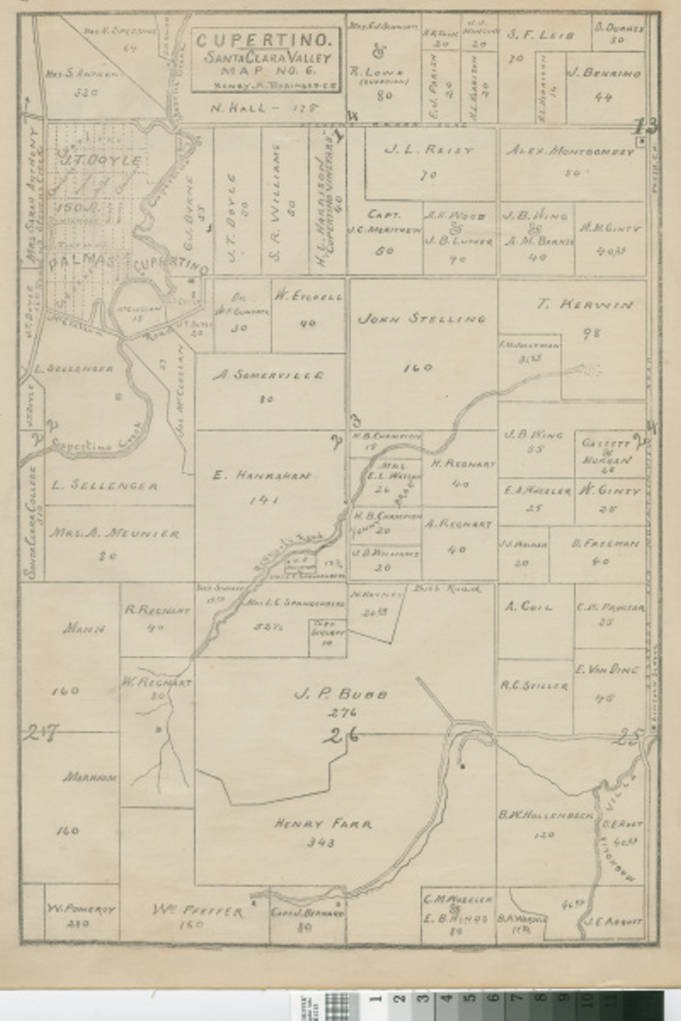
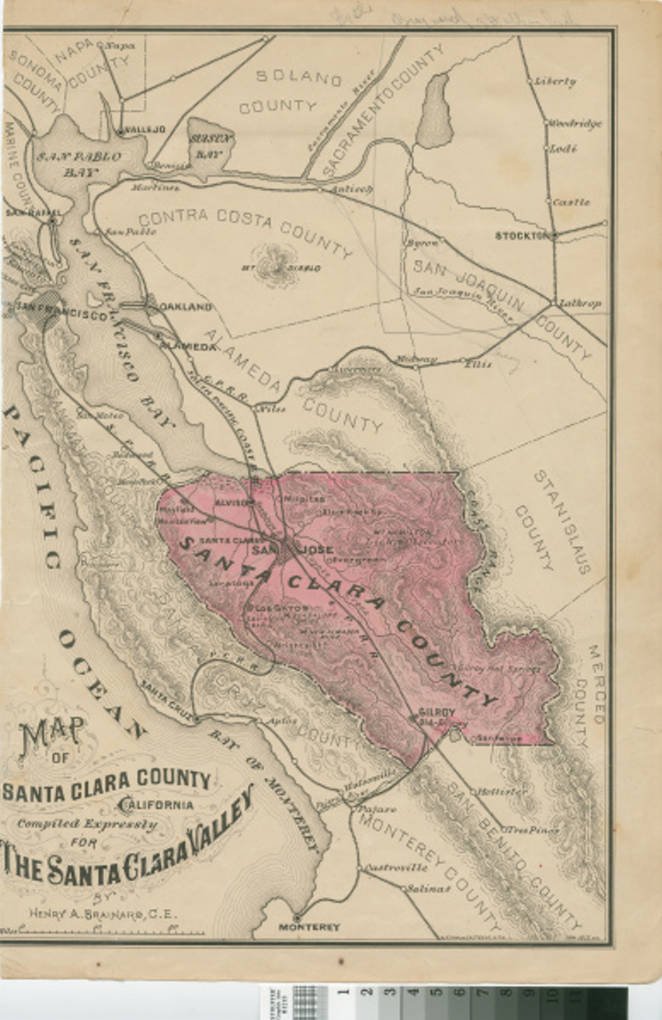
Brainard Agricultural Atlas
54 viewable pages
1885-1890

Atlas of the major agricultural regions of Santa Clara County in the 1880s. This atlas does not cover urban areas, nor agricultural areas in the southern part of the county. Each regional map shows property lines, number of acres, and the name of the property owner. Some of the regional maps have supplemental information, describing the area in general and giving the kinds of crops grown on each property. The maps and supplemental information were originally published in issues of Pacific Tree and Vine Magazine.”


At the bottom-left of this map image of the Cupertino area, William Pfeffer’s land parcel can be found.


*** EDIT ***

I am including a book that lists many grape-growers and wine producers (by county and city) at the end of the 19th Century. Some of the entries list the specific varieties cultivated by individuals.

Google Books
Directory of the Grape Growers: Wine Makers and Distillers of California, and of the Principal Grape Growers and Wine Makers of the Eastern States (1891)
Board of State Viticultural Commissioners
A.J. Johnson, Superintendent
254 pages

That Cupertino map is cool. I grew up there in a small development that was once part of John Stelling’s property.

Thanks, Sean! Apparently John Stelling owned a lot of land in the area.

I find it fascinating that you were able to determine where your home was on this old map. Locals probably can easily understand these +130-year-old parcel maps in relation to landmarks (town centers, streams, rivers).

I’d need to print out the individual pages of the Brainard Ag Atlas and lay them beside one another to make much sense of them.


IF anybody can determine which Map page would include the Redwood Retreat/Little Arthur Creek area, please let me know!


*** EDIT *** Clarification

From the California Online Archive’s description of the Brainard Ag Map:

“Atlas of the major agricultural regions of Santa Clara County in the 1880s. This atlas does not cover urban areas, nor agricultural areas in the southern part of the county. Each regional map shows property lines, number of acres, and the name of the property owner. Some of the regional maps have supplemental information, describing the area in general and giving the kinds of crops grown on each property. The maps and supplemental information were originally published in issues of Pacific Tree and Vine Magazine.”

Therefore, no details are available of the Redwood Retreat/Little Arthur Creek area.

The woe and the sorrow! [cry.gif]

Hey Drew it was relatively easy as I grew up next to Regnart Creek and went to Regnart Elementary school across the creek. The Stelling property had been broken up into smaller farms/orchards sometime after that map was made. A local contractor brought a few acres of orchards and built two or three homes a year over about 10 to 15 years. He kept a few trees from the original orchard on each lot when he built the homes. We and my close neighbors had apricot trees. Other neighbors had walnut or cherry trees.

1 Like