Resalte offers a solid value for sure.
Just stay in Rioja! ![[cheers.gif]](/uploads/db3686/original/2X/0/0ff9bfcdb0964982cd3240b6159868fbdf215b1a.gif "cheers")
1 Like
I am very far from an expert on the region, but my favorite has been the Cillar de Silos. Though I haven’t tried the last few vintages.
That’s basically RDD in a nutshell though. Use of French oak is part of the DO regulations and it is a very dry area that is at altitude. There are some producers that coax more elegance out of RDD, but that’s not what Mother Nature is really giving the region.
I don’t know how you go about defining modern though on a region as young as RDD. It was made a DO in 82 and many producers have started making wine in the last 25-odd years. Or are you saying that ripe fruit and new oak=modern? If so, given your predilection for Washington wines, I’m rather surprised that you are looking down on RDD.
1 Like
I love Aalto and am on the hunt for more producers in this thread. I really like the French oak and altitude of the region. I tend to like the Riojas with altitude.
Not that I have exhaustive experience in the DO, but I’m hard pressed to think of any that are not modern and wood armored.
Separately, I would throw some caution on Finca Villacreces and/or Pruno. Various (good) years of that I’ve cellared do not seem to keep well, turning hot/pruney over time.
Exactly. I doubt that anyone would really care for the “traditional” RdD, whatever that may be. Of the new bodegas, one of the most “traditional” would be Pesquera, which is characterized by a lot of oak, much like Rioja.
What else does “modern” mean? Aalto is made from organic grapes, natural yeasts, no filtering, so it’s modern in that way. I’ve tasted a fair bit of Tempranillo from WA and I daresay they’re using Aalto as a model.
Dominio de Atauta is really nice for ~$30-40.
1 Like
Wines by Perez Pascuas (vina Pedrosa, El Pedrosal and Perez Pascuas Gran Riserva). The 2018 El Pedrosal Crianza is $16.99 at my local New Jersey Bottle king. Great QPR.
Still can’t beat older Vega Sicilia or Pingus, even Flor de Pingus for taste delights. Haven’t tried any modern ones but from the descriptions, maybe not and certainly not at the prices they want now.
1 Like
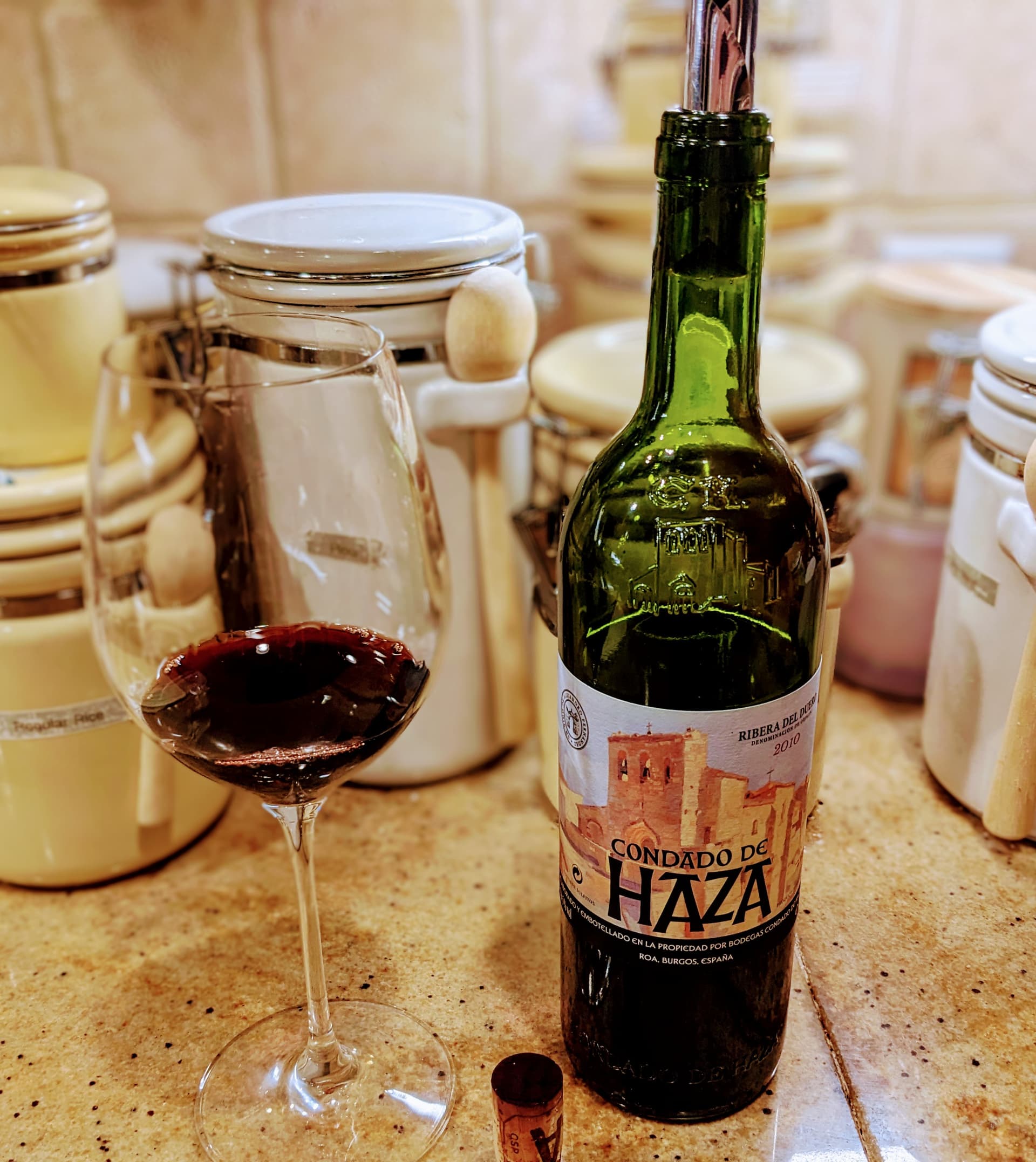
Over a couple nights, I enjoyed the 2010 Condado de Haza [Ribera del Duero] and my thoughts are similar to a prior bottle from two years ago. This RDD is a husky, chewy 14.5% abv tempranillo showing fennel, cocoa, and licorice flavors. The tannin is resolved but there still some footprints of the wood treatment. For my tastes, it is low acid, and ‘internationally styled’ but of high quality, and ought to be versatile in the WBer cellar rack as it can be served casually, or to oenophiles, as long as they are not militantly AFWE. This 2010 is holding well but at age 13 has faded a bit on day 2 so I would suggest consumption, even if it’s not urgent. B+ over a 2 day scorecard, but one of those first glasses about an hour in was really singing, at the A- level. Natural cork, light sediment.
Rioja/RDD are difficult for me to pour into the ideal stemware – other than Georg Riedel’s suggestion to just buy them all – but I tried today’s Condado de Hazo out of 3 different styles from less heralded manufacturers, and I think this showed the best out of a (not pictured) taller, narrower more Tuscan / Chianti / Zin stem. Generalizing, I like older tempranillo out of bigger Burgundy bowls, but 2010 is at the cusp where it defies easy categorization as to whether it’s clearly young or old.
1 Like

I’ve been gnawing on a 2010 Hacienda Monasterio [Ribera del Duero] the last couple of nights, which is a thick, meaty 15% abv internationally styled red. It’s pretty good after aeration of 24 hours, when the heavy prune, licorice, sur maturite aspects shake out, and some brightness emerges. I’ve had a lot of this, in many vintages, since their initial US imports but I don’t buy their output anymore. Prices feel much higher, and the ‘uniqueness/singularity’ is less so, as others have aped a winning formula. (Current releases are $70 I think?) For my palate the bouquet shows anise, licorice and then plums, prunes, currants on the palate. Tannin is soft now, but the body/structure is apparent. The wood feels resolved, and the acid is (initially) low, but brightens up with air. The color suggests youthfulness, but given my consumption over the years, I’ve found H-M better on the younger side for ‘fine wine’ thus a decade or so after harvest is my preference. Light sediment, brown bottle, conventional closure.
Overall: I’m going to give this a B+, a rating more simpatico with WB or AFWE palates. This would be great for fans of California Big Flavor. I don’t mean any of that in a negative connotation; I have lots still and enjoy them.
1 Like

Doing my best to keep this thread alive, I have been sipping on the 2019 Pago de Carraovejas [Ribera del Duero] over a couple of lazy afternoons while on holiday. As Otto observes in another in depth note from a few years ago, the typical RDD has ‘tons of oak, alcohol, and extraction’, which I would concur that this 2019 also offers, but I like it nevertheless. There is a suprising brightness that draws the taster back in for a second sip (or glass) that the 15% abv would not impute. My observations are that it’s still young, ruby robed, with cloves and cocoa on the nose. I find the the palate to have black cherries, with somewhat resolved tannin, a bit of zip and lots of flesh. According to the back label it’s mostly tempranillo, hand harvested, with native yeasts from a family of restauranteurs that launched the project in 1987. I like it and would slot it into the A- zone; this bodedga has managed the tension between ripeness and verve well, which seems hard in our warm climate era.
I don’t see this often so not sure if it will really replace my regular RDD’s…but I’m not buying much in this DO anyways, as I feel like Rioja is more my preference.
1 Like
I second the Dominio de Atauta recommendation by @Matt_Mauldin and I will add a few others which are less well known but top-quality (although I am unsure if they are available in the US).
- Dominio de Calogía - slightly over your price but really worth it
- Tomás Postigo - former wine-maker of Protos and one of the founders of Pago de Carraovejas, now independent. His 3-year wine falls well within your range but he has a 5-year which is even more mind-blowing
- Dominio del Águila Reserva - this is 65 euros; they have a cheaper one…but go for this and you won’t regret it. Prices rocketed after Jorge Monzón (owner and winemaker) got his first 100RP for his top-of-the-range wine.
- Pago de Valtarreña - from the living legend Carmelo Rodero; some will find this one too oaky, but the fruit is outstanding
- PSI - if you want to know what a litlle Pingus tastes like (owned by Sisseck and produced with outstanding quality regularity)
- Mauro - from another living legend: Mariano García. Again, the superior Mauro VS will slightly exceed your limit (about 63 euros in Europe) but it is totally worth it
Many wines from Ribera de Duero went through a phase of over-oakyness but most are coming back to terms. Come to think of it, one of the ones whose recent wines are phenomenal and not so oaky are Arzuaga’s. Try Arzuaga Reserva Especial.
Good luck!
2 Likes