Yup…ordered a mixed case.
Hi Larry,
We had tanks large enough to combine all the 2011 barrels into one tank, homogenized, and then split into the smaller individual tanks for each day’s bottling. Taking that out of the equation for why the 2011MB could taste so variable from bottle-to-bottle, assuming it was even within bottles from the same case…usually that would be caused by something like cork taint or microbial issues. Either of those could explain what was going on. We didn’t yet have the new technology of TCA testing on individual corks to assure that there was no cork taint present. Also, the wines at Ridge were never filtered to sterility. With natural winemaking comes accepting that the wild microbial population of yeast could include brettanomyces. Much of my time at Ridge was doing research on how to control its growth within the 100 year old cellar of Monte Bello Winery. The main cellar of the winery was below ground, dug into the mountain and lined with limestone rock. It is porous, covered in mold, and made a great place for these wild yeast to hide out and wait to infect barrels. The Monte Bello was aged in a new wing built in the early 90’s. It was brettanomyces free until 1995. Equipment shared between cellars allowed or it to makes its way into that cellar. It became something we had to monitor for. Our use of brand new barrels for Monte Bello was always considered a safe way to age wine so as to avoid brettanomyces spoilage since the vast majority of outbreaks would happen from using previously filled barrels that could have been contaminated. What I learned is that brettanomyces comes in with grapes, lives within the winery walls, drains, ceiling, and crush equipment. It will generally always be present in low concentration. If the finished wine is left slightly sweet, it gives it fuel to grow. It loves growing in high pH conditions. Fortunately, Monte Bello fermented completely dry leaving no six carbon sugars in the wine. The typical pH of MB was 3.40-3.5 and that is acidic enough to prevent brettanomyces from an easy time growing. Unfortunately, it loves wood sugar of american oak. Brettanomyces can ferment five carbon sugars of oak. Some of our worst outbreaks where discovered in new american oak barrels. Since we don’t sterile filter MB, all it would take is just a few cells to reach a bottle. As soon as the sulfite preservative naturally decays to zero concentration, those brettanomyces cells can multiply and slowly convert the flavors towards wet earth, forest floor, mushroom. I actually love many wines where this is a flavor profile combined with fruit and oak, Chateau Pichon-Lalande is a great example of the added complexity of brettanomyces. Chateau Beaucastel in the Rhone is another. It doesn’t always have to lead to an ‘off flavor/aroma’ and the heavy-handed winemaking to prevent it damages the wine in the process. Many wines that would otherwise be microbial habitats-like high pH and sweet Napa Cabernet would require sterile filtation and velcorin treatment. Velcorin, what Paul called “death star” is a nasty chemical…basically a pesticide for wine. We would never use such a chemical at Ridge or go to sterile filtration. Once we got PCR technology and ozone barrel washing equipment, along with steam, we irradicated brettanomyces from ever becoming an issue. Really the last vintage where brett seemed to leave a stronger flavor imprint was the 2007.
Now onto 2019-I don’t doubt the final bottled wine is excellent. My only issue with the vintage was the stress it caused me. It was a year of sleepless nights worrying about the barrels. The primary fermentations would not go dry, malolactics finished ahead of the alcoholic fermentation-likely by lactobacillus. Lactobacillus is an awful malolactic bacteria that out-competes the yeast by secreting inhibitory compounds that attack the yeasts’ glucose/fructose uptake membrane protein. Basically, lactobacillus kills off saccharomyces and stops the fermentation. It leads to conditions that promote acetic acid / vinegar formation, brettanomyces, and other spoilage microbes to flourish off the unfermented sugar. So we had all that going on with 2019, plus thousands of barrels to worry over due to the serious increase in production. I felt the over-production of non-MB vineyards that came to MB winery during the harvest impacted our bandwith and ability to adequately clean tanks, crusher, press, and to deal with all the stuck and sluggish fermenations. I just simply didn’t have enough time and energy to give every wine its attention. There was also no breathing room in the winery, every tank was full. It seemed the facility came unraveled that year, including when the boilers ran out of fuel due to nobody watching how fast we were burning it. It took days to refill and that meant fermentors cooled down, sluggish tanks only became more sluggish. Let’s just say that was a vintage that went too far in the direction of volume and compromised quality. Again, I had to spend a solid year struggling with the fallout and keeping the wines on a straight and narrow path, getting them to finish sugars, avoid spoilage. It took a lot out of me. Of couse, Covid began and shut down any sales travel so that was a positive, I was at the winery full time during that stressful period. I will one day taste it, hopefully someone will brown-bag it and pour me a glass so I have no prejudice. I would love to taste it honestly and see how it turned out.
23 Likes
I remember all the great visits with you, Tom, up at Ridge. We’d always wait until you scheduled a visit to open up some crazy bottles from the library. The wildest dinner was the one up in Taos the first year I went there to pour wine for Ridge. You were so kind to invite me to Laura and Larry’s place and we had such an amazing meal paired to '71 MB vs '71 Ridge Eisele. I also brought a rare bottling of '79 Monte Bello Essence. Such good times.
Will went north to Napa before I left Ridge. He was missed there, but had a great opportunity to work for the Heitz family and it was good for him to be home and closer to his parents. I then went north and got to work close with Will as I purchased some of his best fruit from Trailside and Ink Grade to use in my Napa Valley blend. Those wines were incredible. He is such an awesome viticulturist and really in tune with nature, soil, the vines and has a deep understanding of farming’s impact on wine quality. Well, in 2022 he left Heitz. It became another megacorp/soulless operation and he had to get out of there. The megacorp I went to work for, the billionaire and I had been working close on his latest Napa Valley acquisition, and felt like the increased acreage required a top talent viticulturist. So we hired Will and I was really looking forward to working closely with him on all my projects, but then it all started to fall apart on that front and I left Napa. I don’t think Will stayed either and now is doing consulting I think. I’ve chatted with his Dad mostly the last few years. I’ll find out and let you know. He’s a really brilliant guy and anything he’s doing, I’m sure he is very successful with it.
7 Likes
Thanks, Tom. Appreciate your support in ordering my wine. I hope they delight you. All the best, Eric
Thanks for that thoughtful and illuminating answer (that applies to your other posts in this thread!).
None of the bad '11s had a TCA issue. They just seemed thin, lacked any palate texture that one typically associates with MB. As I mentioned, when we found an off-bottle, several people would taste it before rejecting it.
I’ve got a decent stash of '19, both through my Collector membership (four 375s) and the employee purchase. Although not confirmed yet, a couple of different gatherings are planned in the Summer. One, for sure, will be similar to the pre-pandemic MB Component events at the winery where a bunch of us would open some 30-40 old Ridge wines from our cellars. I was part of that group. We can’t do that at the winery anymore which is fine. It’s an invitation-only thing, but I’m sure there would be no objection to you attending! If that happens, I’ll bring 2019.
I’m still a MB Collector, but sell my allocation at cost to a friend. At my age (71), it’s just plain silly to purchase it for myself. 2019 was my final vintage. I did return my 2020s to the winery.
We’re all looking forward to his notes!
And folks…there’s a very good chance Eric will be joining us next BerserkerDay…just sayin’ 
9 Likes
Supposed to arrive next Wed. Looking forward to sharing them w/ my group, Eric.
They’re big fans of GrenacheBlanc.
Tom
I fell in love with Grenache Blanc when making the Ridge Adelaida, having a little bit of picpoul, roussanne, and viognier to blend with. My GB comes from Michael Michaud’s vineyard out in the remote Chalone appellation. It’s an awesome vineyard and the wines are acidic, mineral driven, and wonderful to drink. He sells to a few other producers that I’m competing for fruit. He has planted six more rows and in a few years we’ll potentially have more to work with.
5 Likes
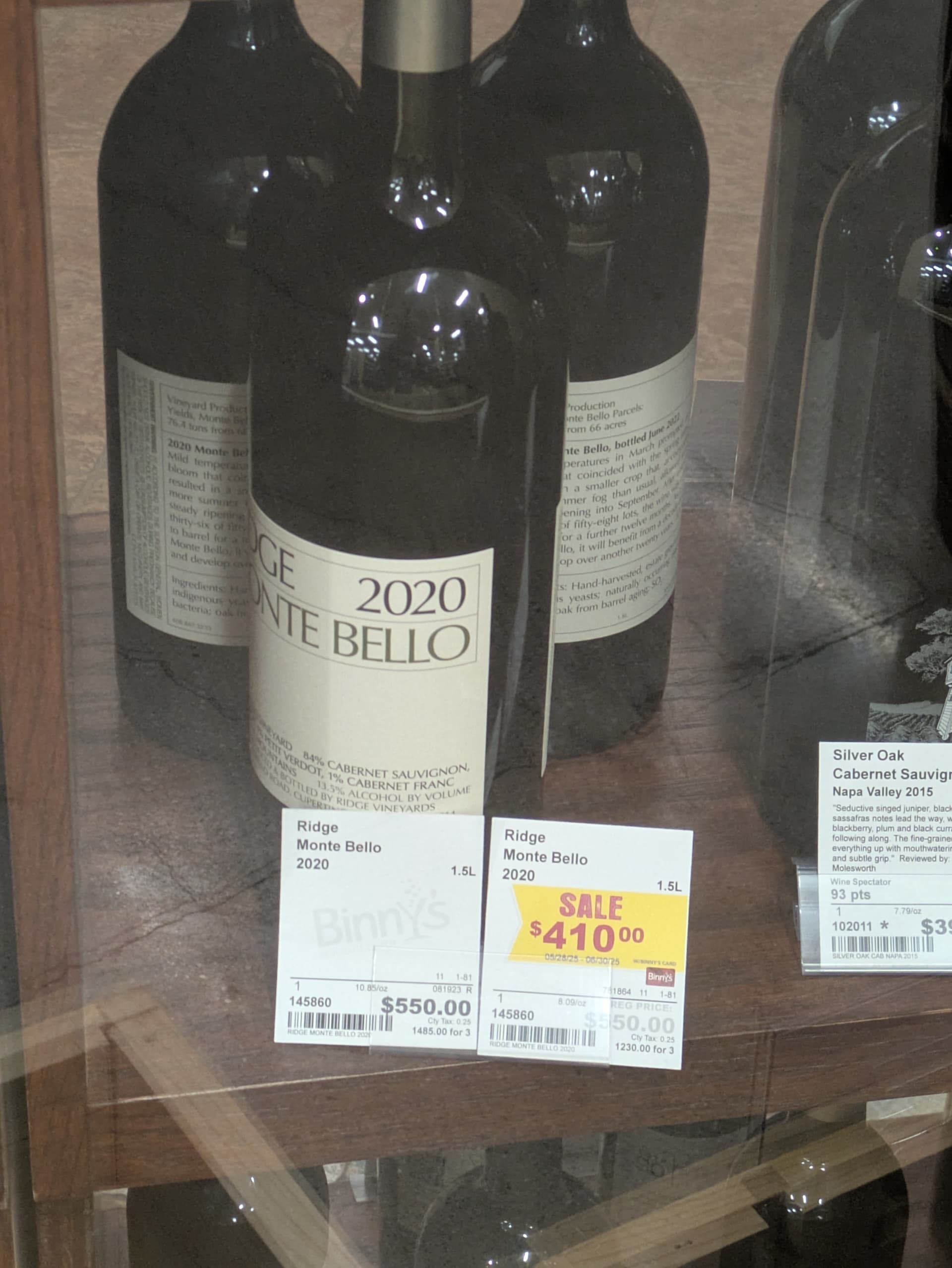
I’m surprised it’s not End of Bin pricing like the 750s were
The mags were $327, all in with tax & delivery, as futures.
Ridge served the '20 Estate Cab at their Final Assemblage tasting last weekend.
My first tasting of this was at their Spring Release event two years ago. Typical high quality and body, but a hint if smoke plus some ash tray and grit on the finish. No one else seemed to notice.
About a minth later at the Grand Cruz tasting it showed notable smoke and a harsher ash tray finish. Body and character were orherwise normal. I took the person I was with aside to take about it and she sort of understood what i was saying. We retasted later. Didn’t notice anyone else react poorly or not like it. But, to me, undrinkable.
What I had Sunday, and retasted later from another bottle, was proper, good body, drinking well. There’s smoke in there with the intense fruit, cedar, etc. Didn’t get anything bad in the finish. I told a friend who has 6 of these to drink them now. They’re at a good point, quite enjoyable. But, I suspect age fading the fruit will expose the smoke. Who knows what else. Drink 'em if you got 'em.
For context, I’ll remind that when I first tasted the '20 Monte Bello at that same Spring Release event 2 years ago it was proper and impressive, with just a touch of ash tray on the finish, which others didn’t notice. In subsequent tastings the body and dark fruit, any recognizable terroir and other aspects were just not there. From what Eric said, that’s a wine with much less smoke taint than the Estate Cab and Estate Merlot. They must have treated it differently. Did something drop out over time because of treatments? Did it go into some sort of shock that it will (at least partially) recover from? Is there something distractive hitting our sensory receptors?
3 Likes
The 2020 Monte Bello should have been comprised of the best parcels that would have shown no smokiness, and would only have shown excellent fruit, mb character, and fine tannins. 2020 Estate should not have included smoke tainted lots, but I’m sure it did since the majority of the vineyard was affected. One thing I did last minute, since we didn’t order enough cooperage for the unexpectedly large crop, was to purchase non-toasted head american oak barrels. That’s where a lot of the estate cabernet lots were sent to barrel. It seemed like the non-toasted oak had a way of sequestering some of the smoke components rather than accentuating them in the wines.
Unfortunately, the smoke molecules once in a wine, are difficult to remove. Any treatment to remove would have involved activated carbon which would strip more than just smoke from a wine. It would remove flavor and tannin, making a wine become fairly shallow and hollow. Even with that treatment, not all the smoke molecules would be removed. The bound ones would eventually be hydrolyzed and released to the wine and appear in aroma and taste. The other treatment would be reverse osmosis, which is similar to activated carbon, strips out smoke taint and may temporarily make a wine smoke-free. Eventually, more of the hidden bound smoke molecules would return to the wine. Basically, any wine that has smoke taint will always show it, even when aged out in bottle. You can’t bottle age it away.
6 Likes
Yes, it’s a given that all three (incl. the Estate Merlot) are smoke tainted. Yes, smoke taint won’t go away, and typically shows more prominently with time, both because the bound up molecules become unbound and fruit that masks or counters the taint fades. It’s a surprise the Estate Cab is showing so well right now, which is why I recommend drinking them now (not searching out to buy). A friend has 6.
The mystery is the Monte Bello, since it did show properly when released to MB Collectors, other than a touch of taint. From what you’ve said, I guessing the vast majority of the components didn’t need to be treated and weren’t. If they boosted the volume with, say, 20% treated wine and it was showing properly, other than that that low level of taint few noticed, why did all the black fruit, the oak character, all varietal character and terroir aspects disappear? That seems like shock to me. That bottle I had a year later didn’t show any tell-tale smoke taint. It gained a little weight and character day 2, drastically transforming it from a non-descript $15 Italian wine to a non-descript $17 Italian wine. If you give credibility to all of the array of TNs that are out there, up to very recent, some bottles show properly and some are just a little off. How far does self-delusion and label bias go? Especially when people try it knowing about the smoke taint issue? I’m not placing any bets, but I wouldn’t be surprised if the wine improves to some degree out of its freakish showing. I also wouldn’t be surprised if it got worse.
2020 Domaine Eden Cab now on Last Bottle for $18!
Hmm. Maybe the harvest should have been more leisurely still, like into 2021.
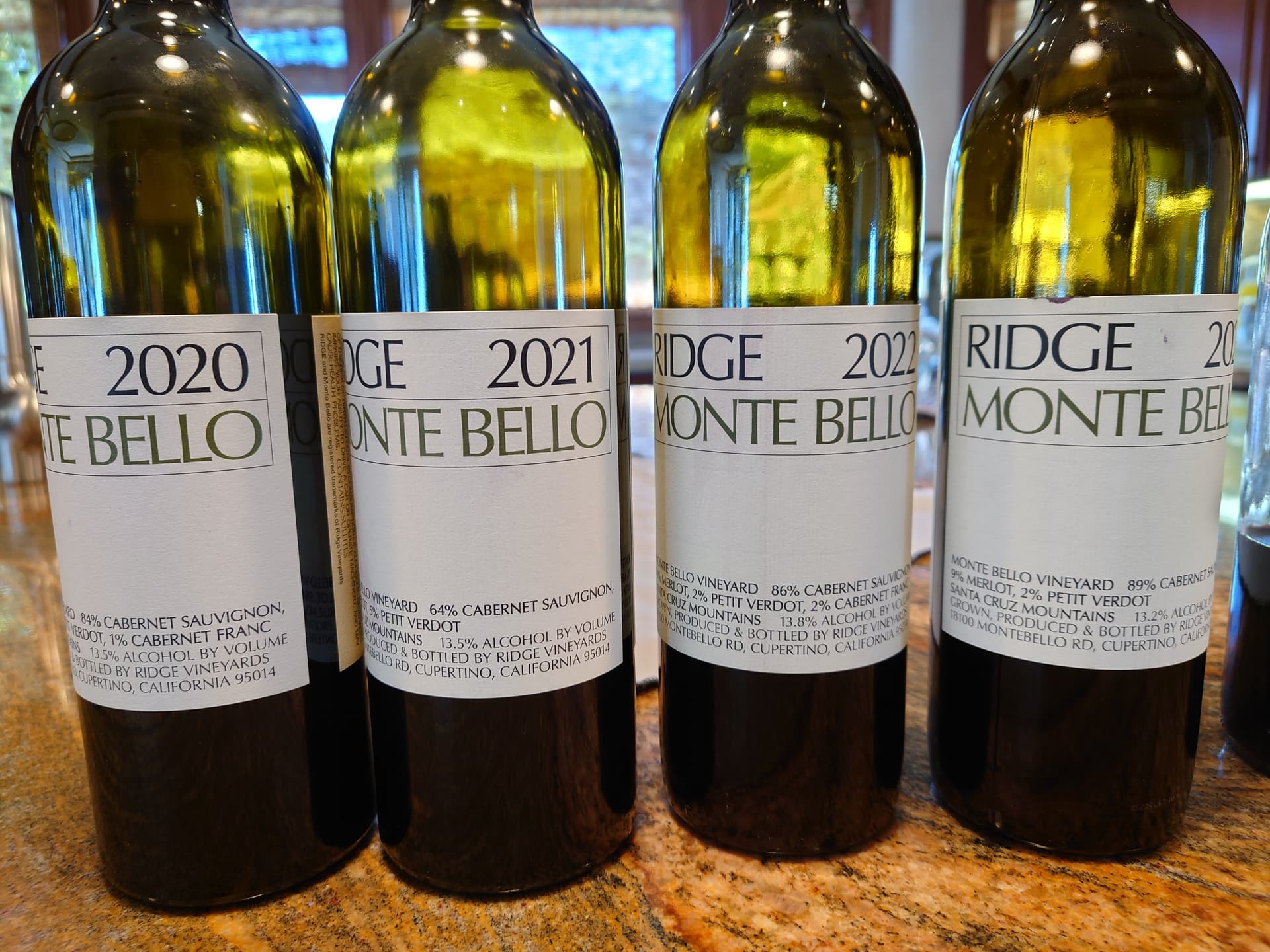
Lovely young vertical ofMontebellos to try today.
To me, the 2020 absolutely has noticable smoke taint. Noticable but not overt. I think the vertical really made it stand out.
Mostly noticable in the finish with an ashy slight peat smoke character, alongside some astringency. I also detect a bit of a bitter rubbery flavor that doesn’t taste like rubber you might get from reduction.
Overall not a bad wine. I think in a BLIND setting 85-95% would say it’s smoke free.
9 Likes
Opened a 2020 Chardonnay not too long ago - it was like licking an ashtray. The Merlot was not as bad, but substandard compared to all other vintages. Opened the Cab tonight and it’s the best of the 3, but far from standard Ridge has set. I still have one of each and two MonteBellos, one of which I’m planning to open with a few fellow winemakers when we gather in May…stay tuned.
Chards were picked before the fires so any ashtray notes came from the “terroir” local to you. 
Thanks, but the CZU Lighning Complex Fires in the SCM were from August 16 – September 22
Chard was picked August 22 – September 14
Nornally one of my favorite domestic Chardonnays, but both people who tasted this bottle found it undrinkable - even tried it again on Day 2, and it was obviously flawed.