Mosel: JJ Prüm, Fritz Haag, Willi Schaefer, Clemens Busch, Markus Molitor, Egon Müller, Heymann-Löwenstein
Rheingau: Robert Weil
Rheinhessen: Wittmann, Keller
Nahe: Dönnhoff, Emrich-Schönleber, Schäfer-Fröhlich
Highlights below, rest on Cellar Tracker:
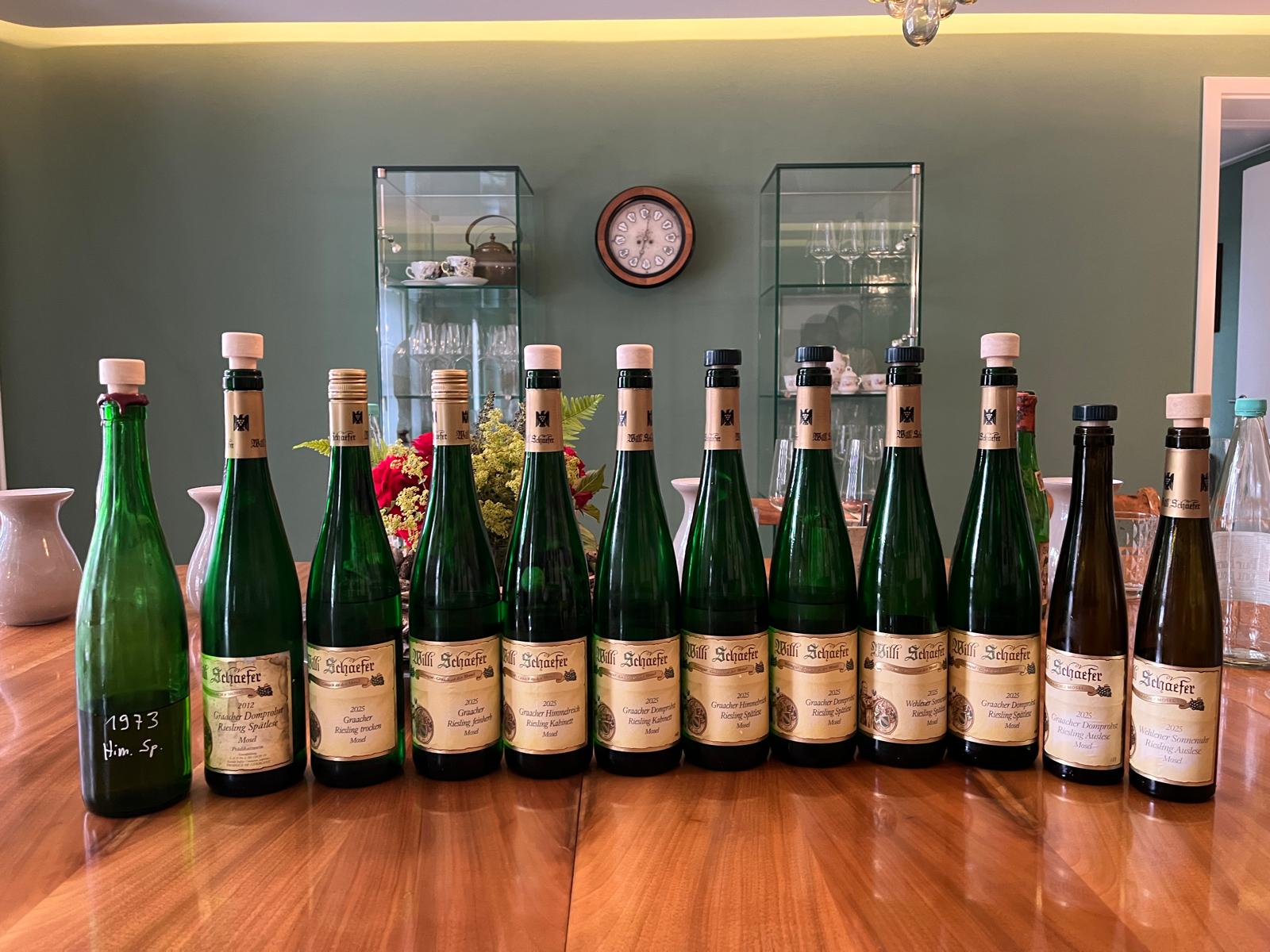
MOSEL-SAAR-RUWER 2026: TASTING AT WILLI SCHAEFER - Graach, Mittelmosel (30/06/2026)
Hosted by the great hospitable and insightful duo, Andrea and Christoph
Domprobst is just behind the winery and 70 degrees steep; harvest done entirely by hand; not organically certified given rain washes out the copper, requiring a new round of drone sprays; 4w long harvest, grapes picked opportunistically; Graach has a forest behind it and so there is good water base, makes dry years good for Graach but wet years can cause rot; therefore Graach can beat Wehlen in dry years but the opposite in wet years; Wehlen faces more south and so is hotter and drier vs Graach; Domprobst is tougher, powerful, more masculine given the red clay that stresses the vines, Himmelreich is ethereal and delicate, but both are in blue-grey slate;
With climate change extreme heat shuts the leaves stomata so halts maturity/concentration of the fruit, meaning more Kabinett/Spatlese: there were no Auslese in 2021, 2022 but for auctions; in such dryness and heat, vines switch to survival mode and so less sugar in grapes as well as more grape phenols, making some unusable; wet summers create fungal issues and makes the leaves less useful for maturation; 2023 was ideal as 34 degree heat in summer, just hot enough for ripeness but insufficient to stop maturity in higher and lower plots (typically 2 degrees lower temperature vs higher plots up to 200m higher); with climate change, each year is unpredictable and different; 2025 was wet so there was some rot, but harvested 2w earlier and so a lot of crop was saved;
18 15y-old barrels of about 1 litre each, every two years two new barrels added, using sulphur to water them down, making them more neutral; wood comes Ruwer, Maximin Grunhaus made by a Nahe cooperage; whole cluster pressing (Riesling has delicate stems), spontaneously fermented entirely in oak with steel as backup (used otherwise for filtration); suphur used to stop fermentation; lees aged, then filtration; 20-35,000 bottles, can be as low as 17,000; 70pc exported to 30 countries; 1 trocken made, rest feinherb+;
Wines are light, cool and not nearly as heavy or ripe/explosive as Prum; similarly classically sweet however fruit generally feels paler (particularly recent Himmelreich), less ripe or tropical; the result is a markedly more delicate style; I find Domprobst and Himmelreich very difficult to tell apart in youth and beyond Kabinett; would say "average" mineral expression vs pradikat peers for recent Kabinett-Spatlese; am however convinced that age is greatly rewarded above many given the phenolic and primary explosions of 12' and 73';
- 2012 Willi Schaefer Graacher Domprobst Riesling Spätlese - Germany, Mosel Saar Ruwer
Nose is exceptionally fruitty: peaches, apricot; molasses; guessed 2015, turns out 2012 was as ripe for the estate; ripe acids but low-side; light, cordial-like, herbaceous; (95 points) - 1973 Willi Schaefer Graacher Himmelreich Riesling Spätlese - Germany, Mosel Saar Ruwer
Special treat from Andrea/Christoph straight from the archive
Dried apricot is the distinct note, with good aged vanilla, caramel and mint on nose; herbal wrapping on the finish; concentrated dried apricot again on palette; undetectable acid, has a preserved, un-fresh quality; made by Christoph's father, was one of the better 70s vintages; guessed late 90s Auslese, not knowing the pradikat; syrupy but somehow light in texture; (97 points)
- 2025 Willi Schaefer Graacher Riesling trocken - Germany, Mosel Saar Ruwer
Ortsweine from Graach; the only trocken; QBA; grapefruit effervescence, refreshing, tart peach-like body gave it away; some astringency and an unripe sweet finish; (88 points) - 2025 Willi Schaefer Graacher Riesling feinherb - Germany, Mosel Saar Ruwer
Guessed Kabinett, was 20g sugar; herbal, mint fruit element on nose, some grapefruit elements; can taste grey slate; QBA, Ortsweine; chapitalised; low acids and weak finish; riper and more defined vs the trocken Ortsweine; (89 points)
- 2025 Willi Schaefer Graacher Domprobst Riesling Kabinett #3 - Germany, Mosel Saar Ruwer
harsher, white pepper on nose, spicy; clay of Domprobst vs Himmelreich is very clear here; also somewhat richer and heavier vs Himmelreich; some grapefruit effervescence; primary notes are similar, but more candied given higher perceived sugar; (92 points) - 2025 Willi Schaefer Graacher Himmelreich Riesling Kabinett #2 - Germany, Mosel Saar Ruwer
Funghal, yeasty; sweeter end of Kabinett, lemon honey, but not ripe and quite cold; phenolically vs Prum generally; (90 points)
- 2025 Willi Schaefer Graacher Himmelreich Riesling Spätlese #8 - Germany, Mosel Saar Ruwer
Funghal element as Kabinett 25' but more faint, feels even more ethereal, cloudy on nose, some calcium; body is sugary, find this distracting; fruit lacks ripeness/maturity, notes of honey and lemon; improvement vs Kabinett; (91 points) - 2025 Willi Schaefer Graacher Domprobst Riesling Spätlese #10 - Germany, Mosel Saar Ruwer
#10 is on the lower side of residual sugar and must weight; yeasty, very sugared traded for just a little more ripeness vs the Kabinett; prefer the Kabinett version; (91 points) - 2025 Willi Schaefer Wehlener Sonnenuhr Riesling Spätlese - Germany, Mosel Saar Ruwer
ripest and most mature in fruit so far; the fruit is yellow but again feels more saccharine and colder vs Prum; some mint; less mineral as well (91 points)
- 2025 Willi Schaefer Graacher Domprobst Riesling Spätlese #5 - Germany, Mosel Saar Ruwer
lower number higher must weight, and more sugar, more complex; a #10 is made if a #5 isn't available; this is the most feminine Domprobst, lacks the clay spiciness, harshness, and just a little sweeter; still prefer #10 (90 points) - 2025 Willi Schaefer Graacher Domprobst Riesling Auslese - Germany, Mosel Saar Ruwer
Only 500 litres; botrytis and very visible on nose; vanilla laced with the fruit; notes of honey and lemon; 110g of sugar (91 points) - 2025 Willi Schaefer Wehlener Sonnenuhr Riesling Auslese Auction #21 - Germany, Mosel Saar Ruwer
number was not mentioned, and may have been a gold capsule; 140g of residual sugar; very dense and sweet yet "melts", nose of grapefruit but quite dead minerality-wise; yellow raisin body; sweetest of the lineup; (92 points)
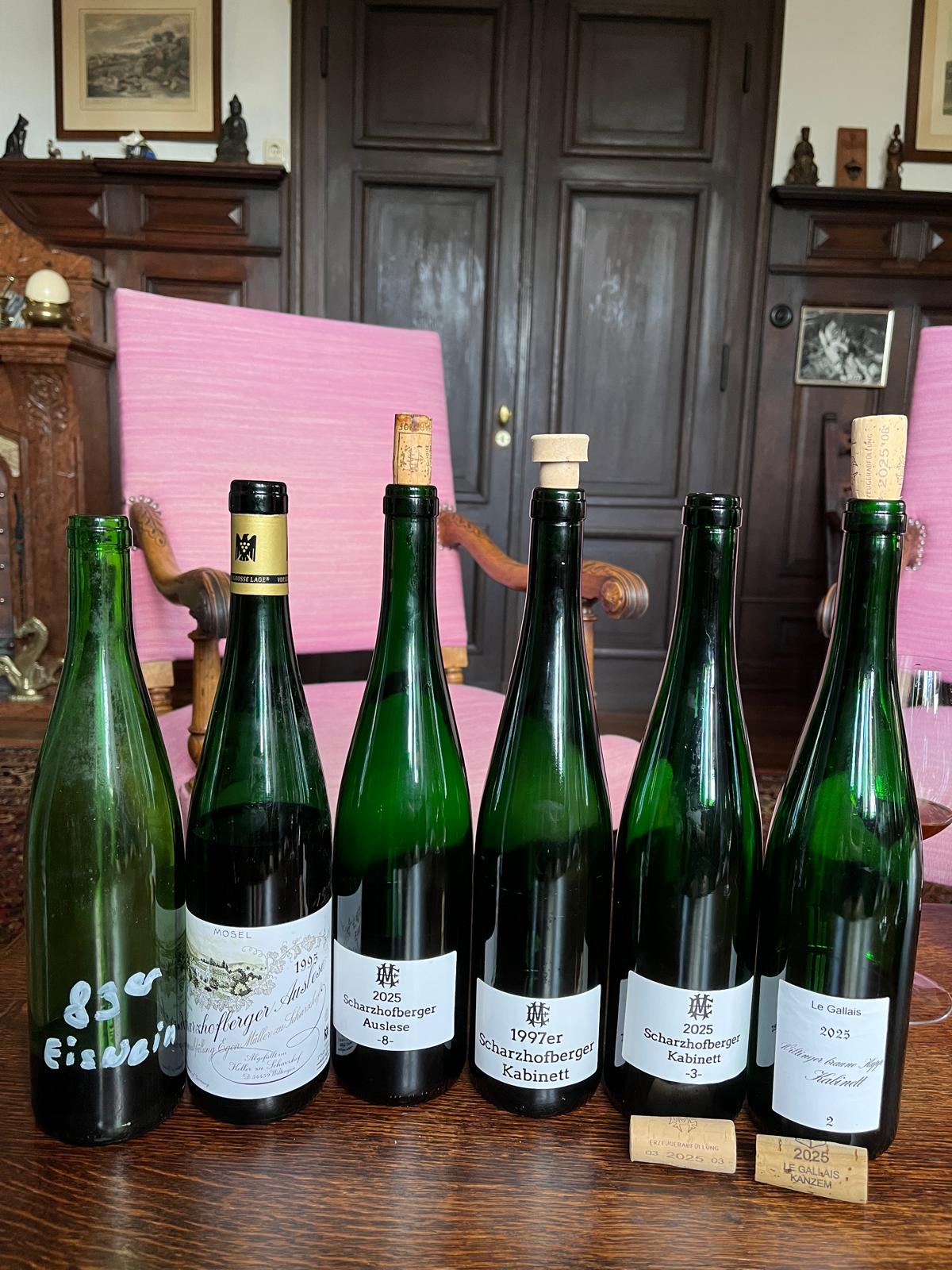
MOSEL-SAAR-RUWER 2026: TASTING AT EGON MULLER - Wiltingen, Saar (01/07/2026)
Hosted by the wonderful Veronika, the CM; kindly invited by Isabelle; met "little Egon"; traditional manor;
200y old house, some of the cellar is even older; Scharzhofberg is 28 hectares, been in use since the Romans, 1.5 hectares owned by Egon Muller; mostly spontaneous fermentation by taste using sulphur via 1000l fuder; steel used if out of space, otherwise only for QBA; every 5-6y new, not heavily toasted, oak is added and watered down to stop the from influencing new vintages; there is no river regulating the Scharzhofberg unlike the Mittelmosel, Saar is also a smaller river; this causes a more extreme diurnal shift; soil however is similarly devonian slate, grey with some clay; Braune Kupp is harsher with red slate and clay, "monopole" in production, 1/2 owned 1/2 leased;
Goldkapsel merely denotes better plots/batches, not botrytis as with other domaines, could be say a BA declassified into an Auslese; for Auslese and above 100pc botrytis is used; spatlese has a small amount;
Fermentation is done by December, not heavy in yeast ageing therefore, this is key as many dry-style winemakers rely on yeast to balance out the acidity; February racking, bottling March;
2025 was warm but not super hot, it rained very heavily in September but acidity did not drop, remained stable; 17th September onwards started harvest, 5 days of dry days for picking Kabinett; rain then started again and botrytis berries were under threat, weather then was stable and after 10 days of dry rest the botrytis berries were picked; TBA berries were even reached; good conditions overall;
Obviously this was an exceptionally unique opportunity and indeed confirms my suspicion that the wines did not show well back in February's tasting; these today were certainly the best old sweet wines I've ever had to date; there is a dimensional difference in the young vs old releases, young EM notably underperforms, personally wouldn't bother unless there is 20y+ age or thereabouts; would say the style is opulent, sugary and meticulously primary, to the point of encasing freshness, acidity in mature vintages; indeed minerality is in the background and really only detectable in youth or Kabinett;
- 2025 Egon Müller/Le Gallais Wiltinger Braune Kupp Riesling Kabinett - Germany, Mosel Saar Ruwer
Braune Kupp is next to the river an despite the ruddiness and clay its quite earthy and fresh, wet, some oriental spice, saffron perhaps; feels significantly sweeter, sugar water but the acids are slightly more tingly; less phenolically mature; crystalline balance; finish; very much prefer the Scharzhof given the spice and primary development; (90 points) - 2025 Egon Müller Scharzhofberger Riesling Kabinett - Germany, Mosel Saar Ruwer
Mix of Scharzhofberg plots; opened the morning, 35-40g;
this is pure power and hint of pungent grapefruit; embryonic though; some spice at the end, feels reductive and dense at this stage; crystalline feel; neither overripe or cold; coughed for a bit given the aggressive nose, burn percolates down throat; (92 points)
- 1997 Egon Müller Scharzhofberger Riesling Kabinett - Germany, Mosel Saar Ruwer
Nose was minty, dates, apricot and very low on vanilla; maple syrup on oats sensation; nose is finesse and multi-layered; I guessed mid <10y Auslese; acids still on, fresh herbal core, not overly sweet or caramel; fruit is a little unripe but yellow, still concentrated; perfect aperitif; tiny effervescent minerality on throat;
Since 88' with climate change there hasn't really been an unripe bad vintage; 97' was amazing; (96 points) - 2025 Egon Müller Scharzhofberger Riesling Auslese - Germany, Mosel Saar Ruwer
100pc botrytis as always;
Initially grapefruitty sugar, minus the spiciness now and with some flowers; not the most powerful nose; sweetness high but not blocky, getting some mineral water spice just at the end; youthful herbal element, after some air in the glass fruit improves into a distinct ripe red apple caramel; (93 points)
- 1983 Egon Müller Scharzhofberger Riesling Eiswein - Germany, Mosel Saar Ruwer
From what I can research AFTER tasting this we are clearly in unicorn territory, particularly as this is the "better" batch that's never left the cellar below of a total production of <=300 bottles; 83' was an epicly good year may have been best of 80s;
The last Eiswein was 16', as the distance between start and end of harvest season with climate change is so long, frost never came therefore grapes would be lost; one needs -7 degrees in the press, and this is measured by authorities; must-weight of a BA but predominantly healthy berries as the must weight comes from the frost not botrytis;
As this was being brought in by Veronika, we couldn't help but notice the incredibly viscous and petrol-like sloshing in the bottle; immense nose of a herbal leathery dried apricot spitzer-bullet with amazingly some hints of earth and pencil shaving; palette of maple syrup, brown sugar, expansive cordial; this isn't heavy or viscous on the mouthfeel "evaporates" like a ratafia or a cognac; throughout the sitting this was ever-evolving and very well could have lasted another hour in glass; (100 points) - 1995 Egon Müller Scharzhofberger Riesling Auslese Goldkapsel - Germany, Mosel Saar Ruwer
Assuming this was not the auction wine;
Dark gold colour; nose of yellow raisins, apricot and hint of vanilla, peach, herbal but in a ripe way, no green; hint of spice and constant evolution on the body; this is max density but light and unflabby given the phenolic expansiveness; finesse and multi-faceted; open since 15th June! (98 points)
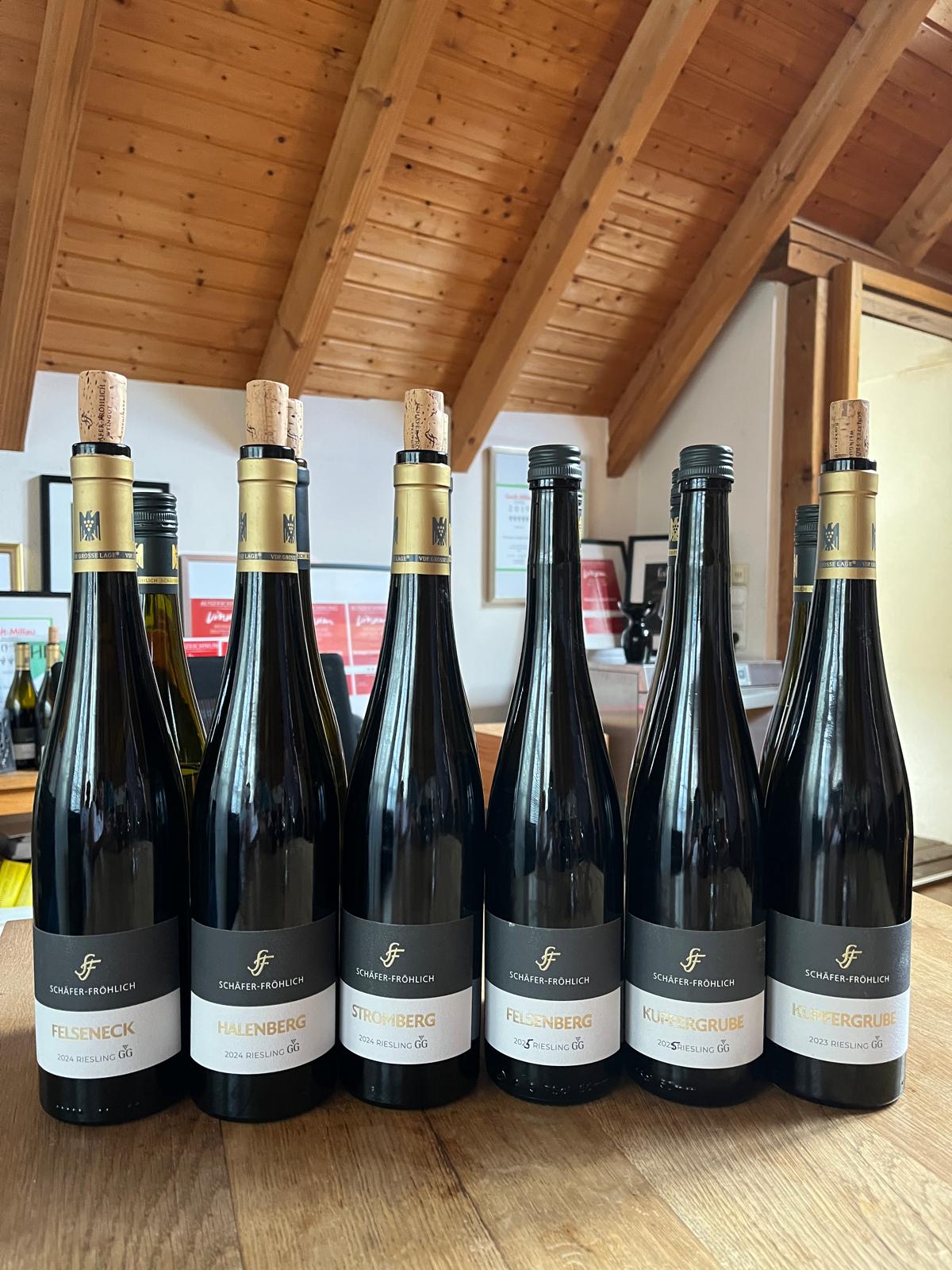
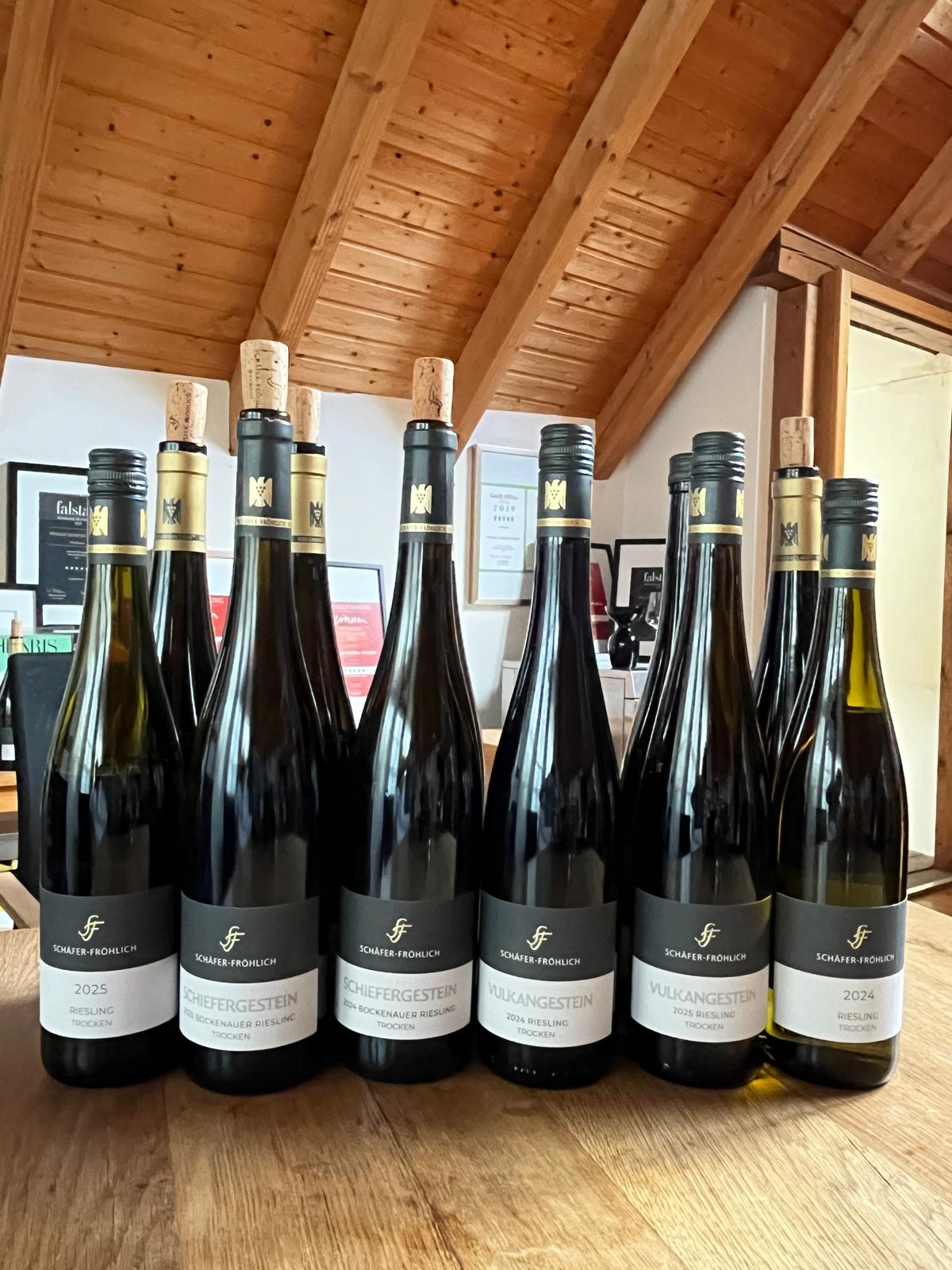
NAHE 2026: TASTING AT SCHÄFER-FRÖHLICH - Bockenau, Nahe (02/07/2026)
Greeted by Nicole and hosted by the patient and smooth Mats;
Terroir context is key; the Nahe is a small river and the climate is decisively cold vs the Mosel; ever-more-so, Felseneck, Frühlingsplätzchen, Stromberg and Halenberg are in-land from the river and in little valleys, they are thus the coldest, Felseneck the highest and the coldest of the three; Kupfelgrube and Felsenberg (also adjacent) are on the river and thus warmer, the former being hottest; there is also the tough rock-solid, hardly porrous volcanic porphyry of Stromberg, Kupfelgrube, Felsenberg vs the crumbly bluegrey slate with iron veins of Halenberg and Felseneck; the former is tough for the vine, perhaps imparting exotic fruit notes, the latter is more generous, both are far chunkier and thicker than Mosel slate, which is thinner and so are contextually less generous; Halenberg veers towards blue, Felseneck grey so former is harsher;
The above is the reason why this estate drew my attention so singularly; this is pure razor-sharp minerality without compromise; it helps that vine age is incredibly high and that all grapes are from GL vineyards; <15y age is Gutswein, <15-35y age for Vulkangestein/Schiefergestein, 35y+ for the GGs; this thus gives the vines a sufficiently ripe, cold climate fruit and strong acidity so as to stop the wines from becoming too powdery and saline; the cold climate fruit in my opinion is exemplified here;
Fermentation stops Christmas to end-January, stays with yeast until April then bottled around July; there is thus not a significantly yeasty element here;
The best of these wines, namely the young 24 GGs below are immensely intense in minerality and cold fruit; very reductive but done correctly; the wines are probably immensely high in acids but with all the minerality and primary phenols erupting this doesn't matter; terroir is really all that matters and the wines are very "easily" understood; this is my favourite GG grower going into and out of this trip;
- 2024 Schäfer-Fröhlich Riesling Vulkangestein trocken - Germany, Nahe
Contains Felsenberg, Stromberg and Kupfergrube; therefore not an Ortswein given different villages; nose is fruittier less of the sharp minerality more ground rock fragrance, wonderful integratoin, prefer the Gutswein nose though given the sharper minerality; sweeter and more generous on palette, unacidic, not at full development at this stage; screw cap; (89 points) - 2024 Schäfer-Fröhlich Riesling trocken - Germany, Nahe
Sharp but delicate perfume, grainy minerality; sweet and some ripeness but detectably dry (88 points) - 2024 Schäfer-Fröhlich Bockenauer Riesling Schiefergestein trocken - Germany, Nahe
Ortswein given same village, Felseneck, Halenberg and Fruhlingsplatzen; natural cork; some more creaminess vs the Vulkangestein, far more integrated and welcoming, well-laced; spiced and somewhat more fruity but again undeveloped; vines feel less edgy vs Vulkangestein; terroir is clear as glass; (90 points)
- 2024 Schäfer-Fröhlich Monzinger Halenberg Riesling Großes Gewächs - Germany, Nahe
Bluer slate Vs Felseneck's grey, so more austere; truffly, earthy, black pepper, some yeast but still beautiful; vs the 11' the earthiness is new and there is less clarity on minerality; far less powerful and primary (11' was very ripe); lacks the sharpness as well; body has notes of lime similarly; immense long pepper at the finish; this isn't ready yet but good potential; (93 points) - 2024 Schäfer-Fröhlich Stromberg Riesling Großes Gewächs - Germany, Nahe
Felseneck and Stromberg are monopole; Stromberg is 5 hectares, 3 hectares Riesling and in it 1 hectare GG production, 1/2 of that is 55y the other is 85y ungrafted; volcano porphyry;
Strong nose of durian (funnily was described the same by an Australian importer), liquorice, flowers; core is too reductive here, steel-rod like; again we need time; good burn on throat but not a pepper; would seem the volcanic soil is reponsible for that notorious South-East Asian fruit; (94 points) - 2024 Schäfer-Fröhlich Bockenauer Felseneck Riesling Großes Gewächs - Germany, Nahe
Greyer slate Vs Halenberg and thus more indulgent, yet this is countered by its highest altitude and lowest temperature; Creamy caramel, honey on roast embers, with some earthiness; C02-like, sparkling water sensation down the throat from acids and the fine grain minerality; body is the best here: a punch of ripe peach, lime, a good cold citrus; this is showing amazingly here, can't wait for the ascent! (96 points) - 2023 Schäfer-Fröhlich Schloßböckelheimer Kupfergrube Riesling Großes Gewächs - Germany, Nahe
Much more tropical and star-fruity (volcanic soil), papaya, there is still a background of minerality however; feels out of place in the line-up; great aromatics though; this is the warmest vineyard of the estate; fruit is ripest and lean; standalone still solid; (92 points)
- 2025 Schäfer-Fröhlich Riesling trocken - Germany, Nahe
bottled 2m ago; wide and perfumy, good fruit, mint and Turkish delight; brilliant showing before shutdown phase; good fruit but short; (90 points) - 2025 Schäfer-Fröhlich Riesling Vulkangestein trocken - Germany, Nahe
More powdery mineral and icing; somewhat less heavy acids but fruity; better vs the 24' version (90 points) - 2025 Schäfer-Fröhlich Bockenauer Riesling Schiefergestein trocken - Germany, Nahe
More minerality and slate, less creamy and fruity; trade-off, and lacks the thicker texture of 2024; (89 points)
- 2025 Schäfer-Fröhlich Schloßböckelheimer Kupfergrube Riesling Großes Gewächs - Germany, Nahe
Heavy durian pungency but in a fine grainy way; this is caused by the volcano soil; dominates the nose thus making this too unidimensional and unbalanced; bit more tart reduction on body and an undefined fruit sweetness; (90 points) - 2025 Schäfer-Fröhlich Schloßböckelheimer Felsenberg Riesling Großes Gewächs - Germany, Nahe
Pineapple instead of durian this time with the volcanic soil; adjacent to Kupfergrube; less pungent; mineral but not exceptionally; tropical sweeter finish and less reductive burn; (91 points)
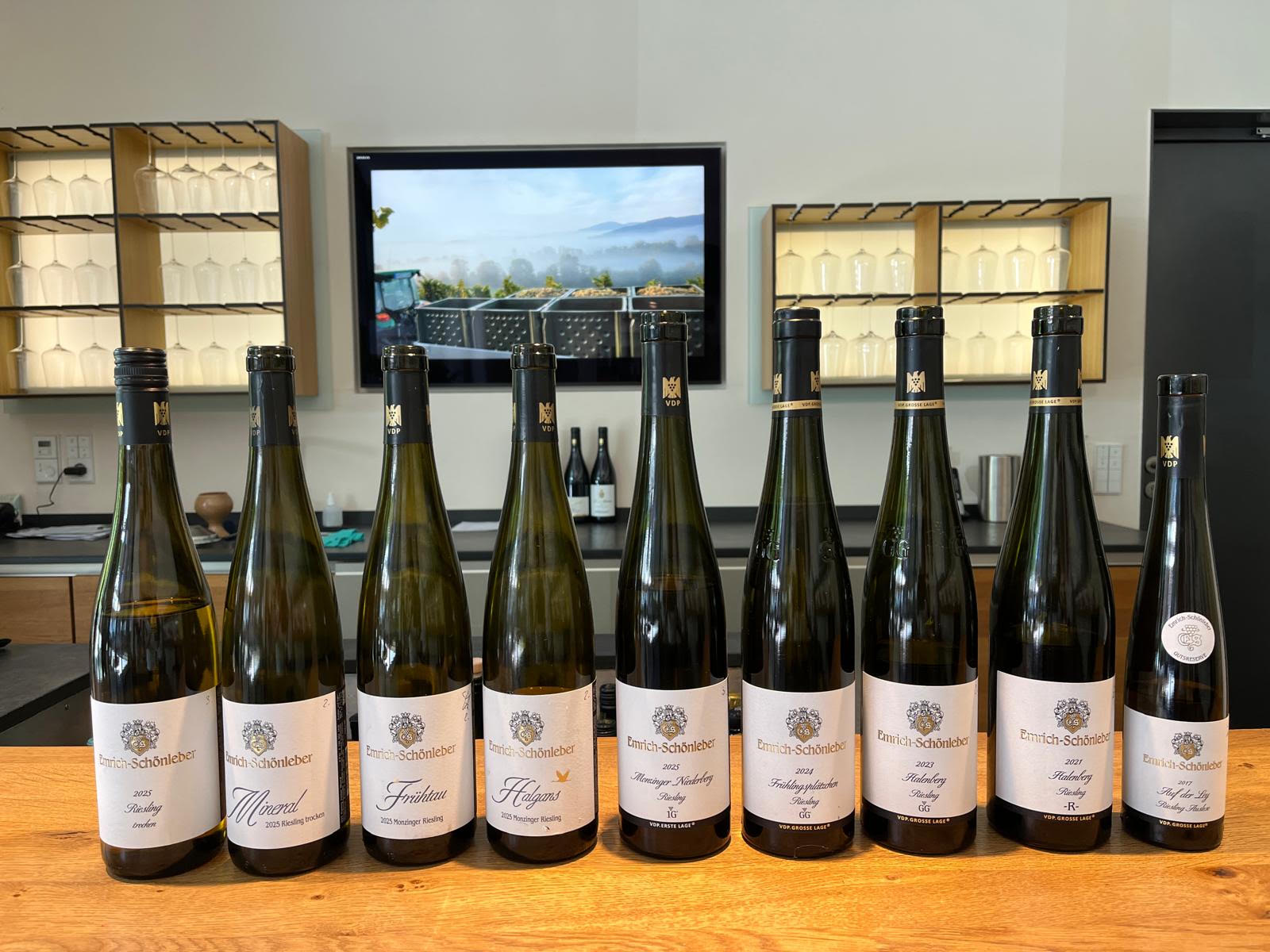
NAHE 2026: TASTING AT EMRICH-SCHÖNLEBER - Monzingen (03/07/2026)
Hosted by Frank himself who was concise and precise; Donnhoff, Schafer-Frohlich, Wittmann and others were discussing the upcoming VDP Bad Kreuznach Versteigerung wines this morning at Schönleber's;
All vines are from Monzingen, flanked by Frühlingsplätzchen on the left and Halenberg to the right; well in-land from the Nahe, cold and high; bottled in April so lees time is short (same as Schäfer-Fröhlich); no racking, fermentation +/- 1w into December;
Vineyard notes below;
Often described mid-way between Donnhoff and Schäfer-Fröhlich, I would say it's 3/4 away from former and 1/4 away from latter; the wines are very much clean and precise on minerality but balanced by a restrained primary and tertiary generosity; whilst cold-climate fruit is present, the wines on the higher tiers, and riper years can be come just a slightly yellow (say, Halgans/Halenberg), candied even; the tertiary components aren't just the crushed minerality but metamorphosise into grain and herbs; acidity is phenolically citric and high but given the focus on fruit this isn't very perceivable; one of the trip dry greats;
- 2025 Emrich-Schönleber Riesling trocken - Germany, Nahe
ortswein really as all from Monzingen; incense-length nose from some distance of grainy mineral, amazing nose; powerful body but very acidic and sinking, astringent but not dense; this isn't tart though; this makes an impression; (89 points) - 2025 Emrich-Schönleber Riesling Mineral trocken - Germany, Nahe
"more exciting" sites of stone and quartzite, comes from Niederberg EL; uses 3-4ha of that vineyard rest goes to mineral; nose is a bit more primary, some apricot jam; palette is more developed but tarter and embryonic; (88 points)
- 2025 Emrich-Schönleber Monzinger Halgans Riesling trocken - Germany, Nahe
nose is by far best in this beautiful lime skin; declassified Halenberg; this is an elegant nose of oats, crushed salty sweet caramel minerality, fruit is most developed here and quite more in the ripe pear department; bluer grey slate with quartzite and gravel Vs Fruhlingsplatzen; great value for this "EG" tier, strictly an Ortswein (92 points) - 2025 Emrich-Schönleber Frühtau Riesling Trocken - Germany, Nahe
a declassified Fruhlingsplatzen with young wines and not as perfect plots; grey slate with more iron, gravel, same as Halenberg; nice fragrant, saline nose with good hotter than cold climate fruit; lime as well; but irony acidic grip; 5-15y age of vines; (90 points)
- 2025 Emrich-Schönleber Monzinger Niederberg Riesling Erstes Gewächs - Germany, Nahe
tree gum candy icing, beautiful Turkish delight with the grainy white pepper, absolutely beautiful; body is somewhat complete and encapsule; the finish is unacidic and velvety; again great value (93 points) - 2024 Emrich-Schönleber Monzinger Frühlingsplätzchen Riesling Großes Gewächs - Germany, Nahe
little spring time place; all GG vineyards have vine age of 25-30y; grape quality higher; the nose is long range from the glass, like air refresher sticks: a misty sweet, Turkish delight, dies down but is a thick mist with ground white pepper; fruit a bit undeveloped here but it's sweet and unacidic, has a good phenolic backbone; (93 points) - 2023 Emrich-Schönleber Halenberg Riesling Großes Gewächs - Germany, Nahe
not an extraordinarily ripe year, but a good balanced year; the aromatics are the most primary here, we are getting more yellow in fruit, with some low pungence tropical fruit, some of the caramel on oats, on the background grainy minerality; sweet mint on palette, very delicate with very yellow fruit skin acids that feel sweet; would say the fruit here expresses the ripe vintage more than the "austere" vineyard, and was tasted alongside the above wetter year; (95 points)
- 2021 Emrich-Schönleber Monzinger Halenberg Riesling -R- - Germany, Nahe
Halenberg 21 R: opulence and cream, 1 more year on fine lees in cask, 2 more year in bottle afterwards; nose becomes creamier with some masala, fresh mint, given the extra barrel time, bit of cigar vanilla; sugar wise 10.5g, halbtrocken; quite visibly sweet and I then realised this was NOT a trocken, body is the most complex in primaries; there isn't despite the lees treatment too much vanilla soy milk yeastiness, as for instance in the Busch 21' Fahrlay reserve, the minerality is still apparent; (94 points) - 2017 Emrich-Schönleber Auf der Ley Riesling Auslese - Germany, Nahe
Auf Der Lay 25' is a GG and is in the VDP auction, there is only ever 1 barrel of it, 2017 climate meant an Auslese was made; 0.7 hectares; the vineyard matches Halemberg soil type and was re-discovered only last 10y; dominant aroma is a profound ginseng candy; liquorice; sweet dense and quite syrupy and not in a good way, but nonetheless the nose is a stunner; this probably has botrytis; (94 points)
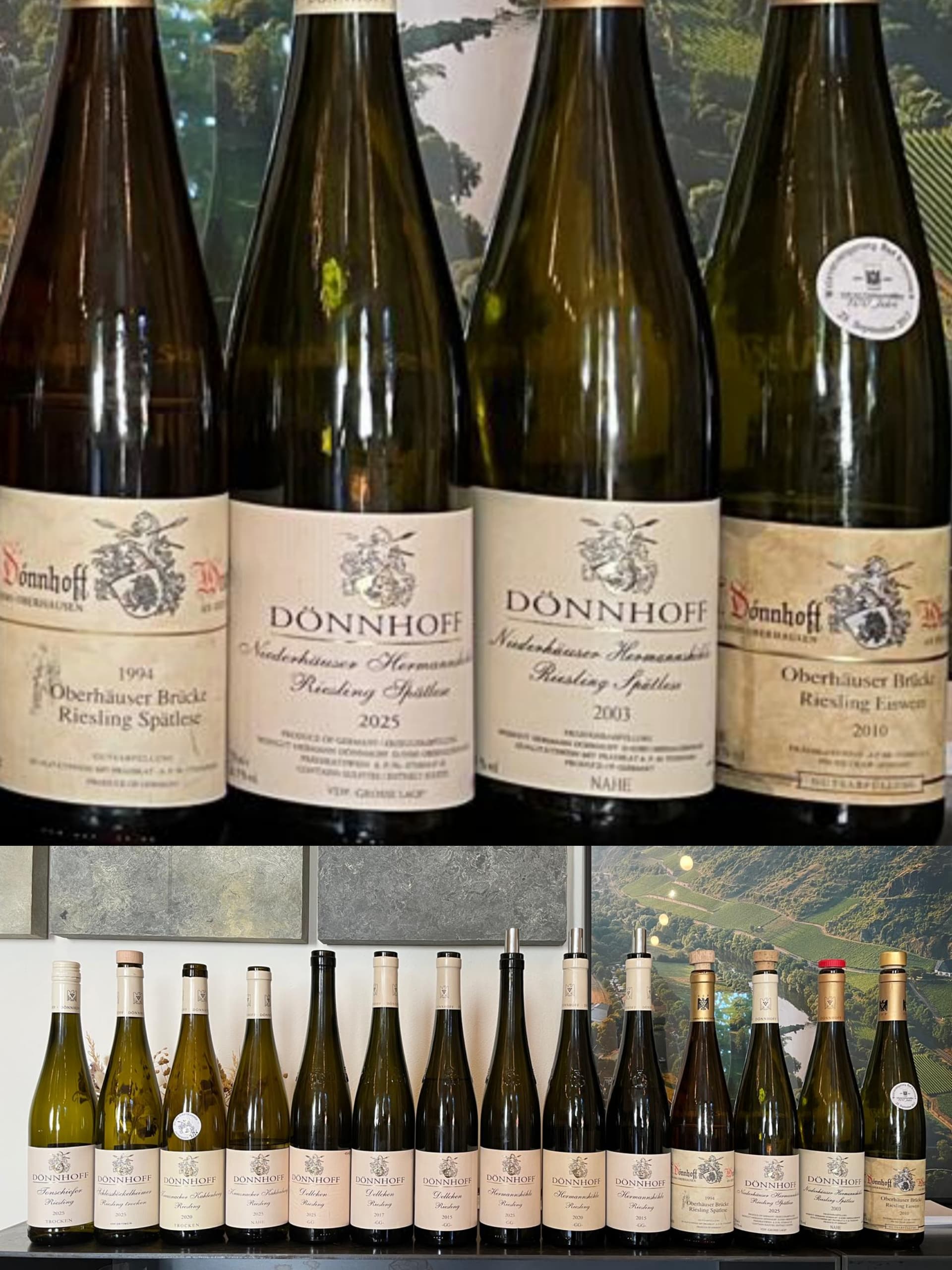
NAHE 2026: TASTING AT DÖNHOFF - Oberhausen, Nahe (03/07/2026)
Hosted by the sweet Anna Dönhoff who was so kind to offer us some rare back-vintages; winemaker with husband, mainly CEO;
Reduction is "not part of the tradition"; Not entirely spontaneous fermentation; Fine lees for 8m+ for GGs post fermentation (more than double the time vs the previous two), less for others; middle part of the Nahe is the focus, with most vineyards on or very close to the river, certainly the best; style is classically rich; noble sweet wines are the historical "DNA" and specialism before the GG craze;
Particularly with Dellchen and Hermannshöhle GGs I am getting a very Roulot, Meursault nose, perhaps speaks to how hot and rich these wines are; I sometimes wonder if these are in the same region as the other two I've tasted at; these wines are unintellectual and at maturity or near to, opulent and succulent; the execution of this style is superb, I am able to appreciate it but I do very much prefer the more linear philosophy of Fröhlich and Schönleber;
- 2021 Dönnhoff Weissburgunder Blanc de Blancs - Germany, Nahe
Handgeruttelt, Deutscher sekt, Brut, disgorged 03/26; 100pc Weissburgunder;
Mineral freak's sparkling; maybe too astringent on nose and dark in minerality; no fruit on body like drinking pebbles; (87 points) - 2025 Dönnhoff Riesling Tonschiefer trocken - Germany, Nahe
Slate but sweet and generous, grapefruit soda on nose; "Ton" means loam-clay, a little too sweet; single vineyard of Oberhauser Leistenberg, meaning slate hill, a Grosse Lage site; (87 points) - 2025 Dönnhoff Riesling Schlossböckelheimer trocken - Germany, Nahe
Vineyard opposite bank of Oberhauser (North) on slope, and on the river, almost Mosel-like; volcanic porphyry;
Nose quite dead to me, some citrus; indeed more tropical and a bit flinty; warmer fruit on palette; (88 points)
- 2020 Dönnhoff Kreuznacher Kahlenberg Riesling Erste Lage - Germany, Nahe
Exotic tropical mineral, pineapple and quite indulgent; thick and heavy great fruity body; acids less intense but indulgent (90 points) - 2025 Dönnhoff Kreuznacher Kahlenberg Riesling Erste Lage - Germany, Nahe
Erste Lage to the very North-East, near but not on Nahe; gravel and loam, next to Krotenphful; these and Hollenpfad are the most Northern vineyards at Donnhoff;
Grainy white minerality; more astringent and tough, hint of immaturity; (88 points)
- 2025 Dönnhoff Dellchen Riesling Großes Gewächs - Germany, Nahe
Volcanic grey slate soil, melaphyre significantly more porrous vs porphyry; 50m high very steep terraces, hollows; directly on the river, perfectly south-facing, a "classic vineyard", in the richness sense; impossible to work at 40 degrees;
Pungent heavy tropical fruit on nose, we are getting very Mosel; sunny vintage; unidimensional; (90 points) - 2017 Dönnhoff Dellchen Riesling Großes Gewächs - Germany, Nahe
Creamy Meursault caramel, mineral nose, very pleasant; After Eight mint, herbal with ripe tropical acidity and fruit on body; this is so indulgent; (94 points) - 2015 Dönnhoff Dellchen Riesling Großes Gewächs - Germany, Nahe
Freshly opened for us; Brioche, caramel, minty and most acidic by far, particularly vs 17', complementing the fruit; some citric fruit skin; not as open, some flinty pepper as well on nose; I needed more time but I think this exceeds 17' (94 points)
- 2025 Dönnhoff Hermannshöhle Riesling Großes Gewächs - Germany, Nahe
On the river as well, historically "best" vineyard in the Nahe; name comes from a small mine middle of hillside, Hermann refers to Hermes; blackish grey slate with limestone, porphyry, igneous rock; due South-facing; the Donnhoff pinnacle
Faint dead nose, some exoticness; rubbery dark mineral; saline and embryonic on body; (89 points) - 2020 Dönnhoff Hermannshöhle Riesling Großes Gewächs - Germany, Nahe
The same mineral/fruit exoticism, potent vanilla on nose, good tropical fruit and Dr Oetker oats with dark syrup; again vanilla finish as well; (91 points) - 2015 Dönnhoff Hermannshöhle Riesling Großes Gewächs - Germany, Nahe
Far more tropical and pineapple-like, more herbal and syrupy even, nose is a little shier and airy initially but the flinty grainy minerality explodes soon; honey, yellow raisin on core palette; acids are strong and give a clean finish in contrast to body; this is the more complete and much less yeasty, vanilla vs 20'; (93 points)
- 2025 Dönnhoff Niederhäuser Hermannshöhle Riesling Spätlese - Germany, Nahe
syrupy, heavy and fruity at least; unidimensional; zero minerality; sugary grapefruit; too early to assess at all; (88 points) - 2003 Dönnhoff Niederhäuser Hermannshöhle Riesling Spätlese Goldkapsel #16 - Germany, Nahe
This is the 5th 2003 sweet wine I've been served and probably the worst; heat clearly shut the vines down; phenolically stunted on nose, could say unripe/green; good honey and quite pale in fruit on body, not the best showing and an underperformer of a bad year; (88 points)
- 1994 Dönnhoff Oberhäuser Brücke Riesling Spätlese Goldkapsel - Germany, Nahe
Monopole; directly on the river adjacent Oberhausen and next to Schloßböckelheim; due to river, early flowering and long growing season; grey slate covered by loess loam soil ensures very good water supply in dry years; it is also within a small valley allowing sheltering for frost to create ice wine; 1.1ha; name means "rich";
No botrytis; well-defined heavy honey, herbal sweetness with a yellow rain and light apricot body; feels a dry year; 45g residual sugar only; refreshing and light-weight; 9.5pc, slightly more fermentation; would say this is a small underperformance given the 95 and 97s sampled this trip; (92 points) - 2010 Dönnhoff Oberhäuser Brücke Riesling Eiswein Auction - Germany, Nahe
VDP Versteigerung wine;
Nose is a merciless frosty shaved ice onslaught up the nose; palette sugar is the densest "recent old" vintage I've ever had for this varietal, acids sting my teeth nerves; the upmost concentrated honey, dark lemon candy; cordial of a cordial; a landmark, and clear winner of the lineup; too bad we didn't have long with this, Friday late afternoon; (98 points)
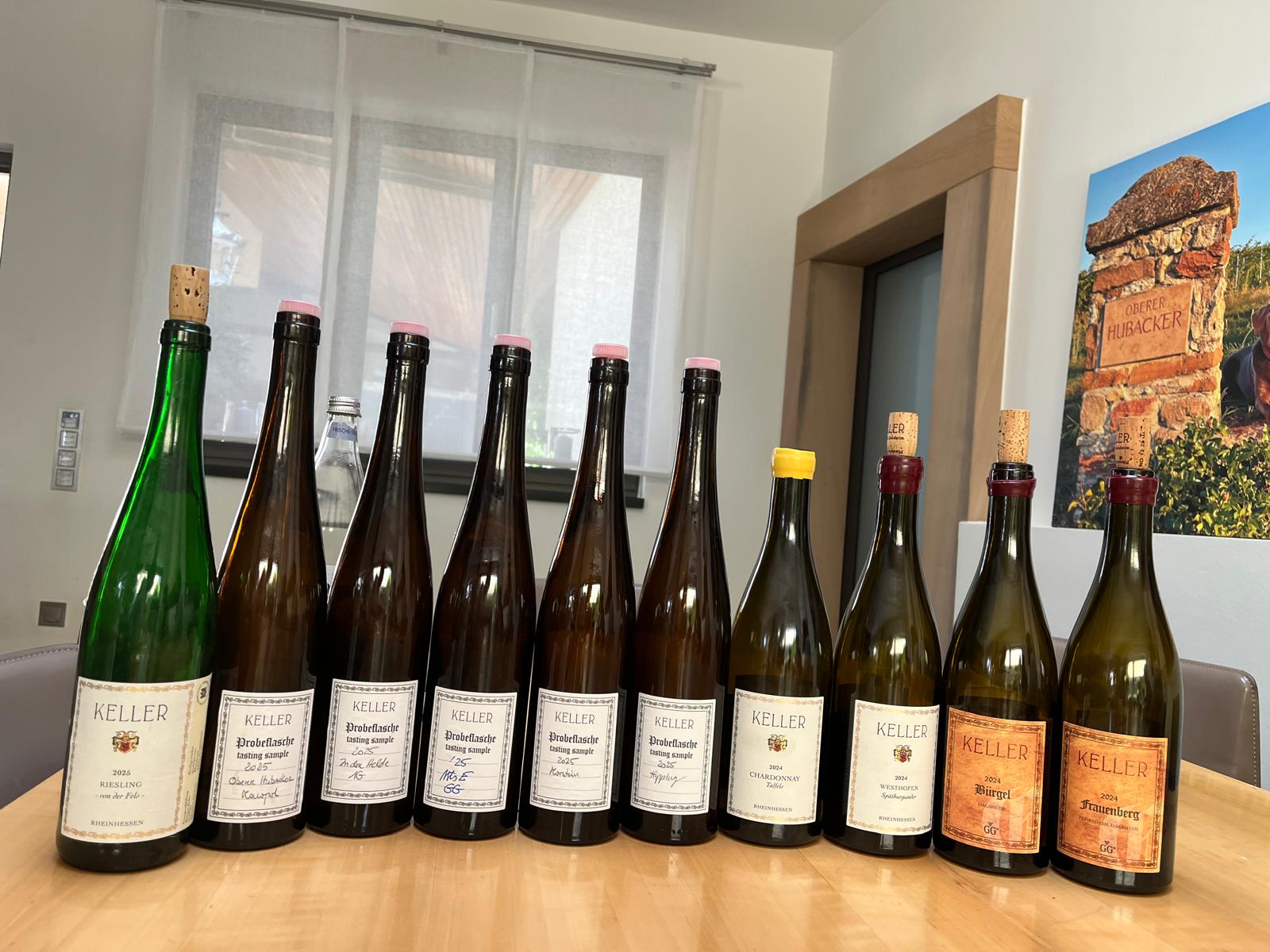
RHEINHESSEN 2026: TASTING AT KELLER - Flörsheim-Dalsheim, Rheinhessen (10/07/2026)
Hosted and driven by the bubbly, savvy, ex-Londoner Bella. Vineyards below were toured;
Keller's Oberer Hubacker is the core of Dalsheimer Hubacker, surrounds the tower on the hill; 40pc steepness on slope vs the plateau; more limestone/rocks here; been with family since 1789; reclaimed as a monopole subplot in 2021; bottled 1921 as Oberer, in 70s Dalsheimer under wine law; 4 hectares; Mosel clones brought by KP's mother, who was from there, planted with others as well;
Frauenberg, lower part Pinot, upper Riesling; massale selection from Rousseau Clos Saint Jacques; high density here, 1.5x young vines in Hubacker; soil is rocky and heavy in limestone; Vinto and Libero American rootstock used here developed by Geisenheim, good resilience to drought and rain; named as such as "was the furthest women could go to bring food and water to the men";
Zellerweg am Schwarzen Herrgott is so named given a nearby crucifix slowly turned black overtime; Pinot planted here to 18k vines per hectare and in another subplot 36k! single stake trellis used, one vine north another south of pole which took nearly 3y; vineyard minutes from Pfalz, and thus quite south and hot, highest percentage of active limestone here with red soils; two mountains to the North-West which cut down storms and hail; this was historically cool but climate change has warmed it up;
Felix, the 10th generation worked in France/Germany, Bereche for instance; family originally Swiss and moved in 1789 farming Hubacker; "90pc focus" on vineyard work; the hottest and thus earliest ripening are Nierstein, then Westhofen then Dalsheim; 15-20y old vines for GGs, rest lower; Aulerde is not regarded as good enough as a standalone GL as it's becoming too warm, Riesling here is increasingly being replaced by Pinot;
Given climate change focus is now to more than double plot density for old vines throughout all Riesling and Burgundy varietals; average Riesling 10-12k vines per hectare given its vigor, EU regulations suggest 4k; rootstocks have been changed to become more tolerant of climate change-induced drought, extreme climate and temperature fluctuations etc; higher density means more competition meaning roots go deeper and penetrate more minerals, reaching more water; there is also less grapes per vine and so less stress, better for vine health and thus new vines can last 1-2 generations here; 1 person per hectare managing vines given this focus; different rootstock and clones for different vineyards; these changes have been gradually implemented since 2018;
Estate is becoming more Burgundy; have been acquiring still and sparkling wine vineyards; greater focus now on Pinot and Chard given more workers in cellar and field, able to balance this with Riesling vineyard work; indeed wax caps are being used 2024 vintage onwards and limestone signs being erect labelling vineyards;
There hasn't been an estate on this trip so engrossed in vineyard management, which shouldn't be a surprise given the wines. The trend here is clearly towards Burgundification in terms of both varietals and viticulture as a reaction towards climate change and perhaps given the expanded resources/portfolio, resulting directly from commercial success in Riesling. Not much to comment on the Rieslings as they were all far too embryonic at this "EP" stage, but I do find myself revising my bias against red soils given Hipping and Abts Erdes' successful opening skirmish below. Similar to Muller previously these barrel samples are a dimension away from back vintages but the foundations are solid.
Will Keller's Riesling success be replicated in Burgundian varietals? As KP himself says "nature is our boss". I don't think it's possible to escape the "Spatburgunder trap" without a riper, to be more precise, acidic and tannic fruit so perhaps the estate needs higher temperatures, longer hang-time, more dryness, but the topology and the soils are very much similar. There is also a lack of that Burg earth, tertiary-ness and so I am always thinking of Sonoma on aromatics. I'd say these Pinots are marginally better vs Wittmann's but not by a significant amount. I look forward to monitoring both in the coming years.
- 2025 Weingut Keller Riesling von der Fels - Germany, Rheinhessen
QBA; good year, strong hail wrecked some grapes and so the rest got more rain, thus became highly concentrated;
Reductive, grapfruity and too tight; good salinity and length but not much depth; Kirchspiel and Frauenberg (GL) young wines this year but vintage dependent; (89 points) - 2025 Weingut Keller Riesling In der Helde -Heldentürmchen Erste Lage - Germany, Rheinhessen
In der Helde acquired by Keller 2y ago in Zellertal; has a "Latour" tower; rebuilding a clos here; could be a GG but given new plots with new vines it is an EG here; work in progress;
Quite open, some fruity pungency, papaya; good acidity and tropical fruit but again embryonic; fruit better vs von der fels; comes from a relatively cooler place vs other GLs; (90 points) - 2025 Weingut Keller Oberer Hubacker Riesling Monopol - Germany, Rheinhessen
Reductive, saline and a bit more fruity; less of a burn however; still so embryonic; incomparable to the 19' last Saturday; (89 points)
- 2025 Weingut Keller Abts E® Riesling Großes Gewächs - Germany, Rheinhessen
Good mineral pungency, and some faint chalkiness; am not detecting the iron here initially on nose; a little austere but some good tannic acidity and irony heat on back palette, a throat burner; finish is the trademark powdery citrus acidity; indeed the more austere, serious and mineral plot at this "age"; (93 points) - 2025 Weingut Keller Morstein Riesling Großes Gewächs - Germany, Rheinhessen
Vineyard of heavy chalk and some blue clay;
On nose, spicy chalk, unripe immature red apple on body as well; good heat on finish with a ruddy apple skin; hints of guava and a young citrus sears through nose like horseradish; (93 points) - 2025 Weingut Keller Hipping Riesling Großes Gewächs - Germany, Rheinhessen
heavily flowery chalk nose, peanut oil, wonderful, fruit of kiwi, starfruit; fruit is potent and tropical but unpungent; 6-7g and to a degree more detectable, was a very ripe harvest; mild long spice on throat; some pear as well on second pour, but shut down; best fruit here by far of these barrel GGs; (94 points)
- 2024 Weingut Keller Chardonnay trocken “Talfels” - Germany, Rheinhessen
Bottle; Quite "flat" but creamy, this is clearly trying to be Puligny, more of a 21' Puligny achieved; that briny chalky minerality on the low side; indeed cool vintage from high density vineyards; Von der Fels equivalent; good acids but coldness and lack of fruit clear; uses new barrels from French coopers; barrel fermented, 15m elevage; does not use second-hand for reliability, 3y for the Chard then used for sparkling; overall, getting close but much work needed; (90 points) - 2024 Weingut Keller Morstein Spätburgunder Westhofen - Germany, Rheinhessen
Label states "Westhofen", but this was made from 60y Morstein pinot, a pinot-specific parcel; single barrel only;
Good caramel, some vanilla; lacks in acids again like Wittmann Pinots, very weightless; cool year, and evident given this corniness and vegetal characteristic; whole cluster fermentation used but varies per year; 15-18m elevage, racked at end via gravity; hint of minerality at end; blanc de noir was made this year in fact given the climate! (91 points)
- 2024 Weingut Keller Frauenberg Spätburgunder Großes Gewächs - Germany, Rheinhessen
Rousseau Clos Saint Jacques clones; cuttings made and planted straight into rootstock; like an eye into the stalk;
very good tannins here, vanilla on nose but good freshness; brightest acidity and a very red fruit; hint of that ruddy rock on throat; cool fruit again; menthol finish on cheeks; "Musigny" in style; indeed, this is Chambolle, would say more border Bonnes Mares myself, stylistically and is the closest thing to red Burg here; none of these are overly oaky or vanilla in anyway; (92 points) - 2024 Weingut Keller Bürgel Spätburgunder - Germany, Rheinhessen
Burgel, GL from Dalsheim; GG; even more cooler than the previous but more mineral, chalk streamy; better tannins and acid; fruit is red here on nose no doubt but thin; (91 points)