I linked the article in the first sentence. The author may have won numerous awards (not sure how these are judged) but the entire article had the editor in me wanting to scream.
Maybe as simple as tastes like wine as opposed to the opposite (cf Prisoner or Caymus)
Also the “generously proportioned medium-bodied flavors”
It’s amazing – the tasting note appeals to everyone because this wine is all things to all people. Whatever type of burg you want is contained within a single mouthful.
Markedly floral
Decidedly reticent
Concentrated
Generously proportioned
Medium bodied
Subtle oak
Spiced plum and chocolate
Firm tannins
Slightly grippy
1 Like
By the same token there is something there for everyone to hate.
I tasted at the domain and this marker was evident to me but when i mentioned this, I seemed to be the only one to notice it  .
.
Ah! This site is very odd in the way it conceals links. You have to mouse over something to see if there’s a link.
When it came to lengthy sentences to describe complex intricacies, David Schildknecht (RIP) was the Faulkner of wine critics.
That would be Andrew Jefford, and let me plead the case for the defence here. Jefford by his own words is not a critic; he says he is a wine writer. If I got a critic’s note with that kind of prose in it I would not react well: it doesn’t really tell me a lot about that wine in particular. It’s excessively literary for a critique. But Jefford here is trying to paint a picture of what constitutes tension and energy in a more generic sense (admittedly with a specific example). There is a time-honoured tradition of this in both literature and art (or both: cf. Blake’s “minute particulars”).
I happen to enjoy Jefford’s writing I would not necessarily buy based on his descriptions
I’m all for free-associative and metaphor-laden wine writing …
But a trout jumping in my mouth and shedding scales as I take a sip of Chablis just doesn’t work for me. YMMV. 
3 Likes
I hear you.
Plus, don’t look up “fish in mouth” in Urban Dictionary if you’re at work.
That’s all well and good, but I think the leaping fish was poorly chosen, and frankly the rest of the article comes across as a lot of fluff.
Exactly. It was not exactly an attractive image. Fish slime and scales.
1 Like
What bugged me was the arbitrary new acronym (TEPF) as I don’t think of each letter as representing the same thing.
1 Like
I don’t think he can claim the writer’s defense when employing such a terrible metaphor.
3 Likes
Seems fishy.
I forwarded this tweet to Greg Tatar, which prompted him to draft Galloni’s tasting note for this wine.
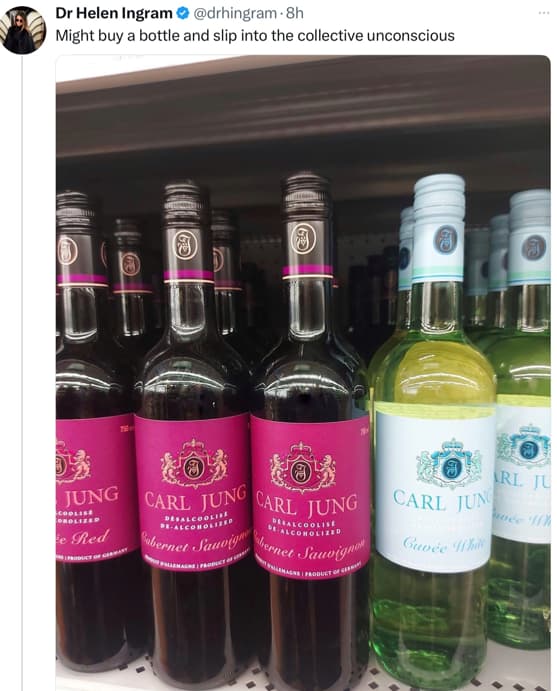
“This archtypical Cabernet, while bursting with introverted, yet reticent, expression on the nose, retreats to an extroverted, yet exhuberant, finish, bringing wholeness and balance to the collectively unconscious depth of nuance and vertical explosiveness.”
4 Likes
He should then also try Alter Ego
3 Likes
It doesn’t seem like there was any problem discerning the elements here (emphasis added).
98 points Vinous
The 2021 Tignanello is every bit as impressive from bottle as it was from barrel and then just after bottling. Silky and polished, with exceptional finesse, the 2021 has all the pedigree to become a modern benchmark for Tignanello and Italian wine more broadly. Bright dark red fruit, blood orange, spice, cedar and sweet pipe tobacco all soar out of the glass, framed by a discreet touch of French oak that adds raciness. In some vintages, the elements are discernible. In 2021, it is the total harmony of the wine that makes the strongest and deepest impression. The 2021 spent 17 months in wood, three months in neutral oak during the malolactic fermentation and then 14 months (50% new) for the rest of its aging. Superb.
1 Like
That would be Carbon, Hydrogen, Oxygen etc? Never thought of having a mass spectrometer in a tasting room.
1 Like
I am just a rando wine rube, but doesn’t oak typically….blunt the raciness of acid? Is this just a way of saying the wine is young and the oak-imparted tannins are not integrated?