Not sure I understand your intent behind “meaning-bearing”. Are you suggesting a connection to utility or an abstraction of something else?
It’s funny because I find your first paragraph to be an excellent argument for wine as art.
The 2nd concept that just because we have never sytematically done so, it can’t be art is an anathema to me. Like saying that the Fosbury flop wasn’t high jumping until everyone did it. Or that shooting free throws overhand wasn’t baskeball.
Most evolutionary improvements, in art or anywhere else are things that weren’t systematically agreed upon prior to their occurrence. After they just become how things are done.
Are you implying that Sauternes are sweet because of the ground? The place offers fruit that functions best when the vigneron moves with the place.
Also, the idea that the farmer doesn’t influence the place and taste of the grapes is incorrect. I field questions all the time about what we’ll do when the Willamette Valley is to hot for Pinot Noir and Chardonnay, and I point out that we’re currently making the lowest natural alcohol wines I have ever produced. Our choices in how we are directly shaping the vines is responsible for a massive impact in style and what we see as raw materials in the vineyard. If you need more open any bottle of Archery Summit and any bottle of Goodfellow Whistling Ridge. Regardless of your preference, there is an unquestionable impact on the wine at the vineyard level, in what we’re doing and most other producers.
The general minimization of cultural impact in the outcome of wines is unfortunate.
How does Jackson Pollack fit into this concept? His art doesn’t really depict much of anything.
When you say that a wine would depict a place by smoke or other visual expression, I think that’s trying to force art to mean a visual art.
The fruit of Oregon represents the disposition of the place that is the Willamette Valley including the people, in far more detail than I have the words to express. I wouldn’t want to force the idea that the wines are art on anyone who doesn’t want to feel that way, but you can also see that there are a lot of mis-conceptions about what winemaking actually is up thread.
I certainly understand your revulsion to that second paragraph. As I mentioned, I bias heavily toward the first. I do believe that winemaking is more than merely shepherding grapes toward their final destination and that a great deal of decision making and risk taking is necessary to coax the epic out from the conventional.
Sadly, it seems to be winemaker’s curse to always be overshadowed by the vintage. As you so aptly pointed out in several of your posts, there’s knowledge and there’s wisdom… knowledge you can easily obtain from multiple domains of expertise (chemistry, geology, horticulture, physics, etc.). Wisdom can only be obtained by putting in the time, year after year after year. Enduring and overcoming the hardships that consume both sweat and blood. The former produces wine, the latter produces art.
However, as much as I’d like it to not be so, my opinion is equivalent to a grain of salt and won’t change the vox populi. Maybe it’s more of a US thing… I’ve noticed a different attitude in European countries where wine is an essential part of who they are.
1 Like
That would be the equivalent of me saying your wine does not express its terroir, as you have intended it to be expressed. Pollack’s art is very expressive and does depict something and maybe many things, you just are not interpreting it that way. And fwiw it is worth, I do think the making of wine can indeed be described as an artistic process that yields art.
Sorry Robert. I do interpret Pollack that way. I was just pointing out to Jon that Pollack doesn’t depict images we can relate to a picture, like a fire or a portrait would of a person. I felt he was limiting how wine could represent art and was trying , poorly, to use work of Pollack to suggest that wine shouldn’t be limited either.
I agree with you on Pollack, and think that wine absolutely has the same visceral representation as do artists like Pollack.
I think many of the objections that Marcus follows up with go to Ted’s question of what I mean by “meaning-bearing.” I use that term instead of “has a meaning” because i do not want to be confused as saying that art is merely anything that has a meaning, but rather that one feature of art is that it means something. And I mean by meaning what dictionaries mean, that things that mean communicate ideas, concepts, information about one’s emotions (as opposed to conveying an emotion: it is the difference between saying one is angry and growling), etc. It is the purpose of language to mean (and other means can be used toward the same end) and it occurs when people use language to express their ideas to another person (again, they can communicate with means other than language–pictures, sign language, etc. but those other methods still enact communicating my idea to someone else). All of Marcus’ objections about terroir will be answered by asking whether the facts he adduces make a wine “mean” its terroir.
Jackson Pollock is, like much modern art, a special case. I will not offer an interpretation of a specific painting (only specific items communicate specific ideas, and thus mean something) because I could be wrong in that interpretation. Being wrong is not a definitional or theoretical problem. It just means you made a mistake. But, unless you think that the purpose of a Pollack painting is merely to show you pretty shapes and colors, and it can’t be distinguished from wallpaper, you will have to posit that he meant to show you something in particular and not merely look pleasing.
Finally, I want to turn the question around on you. Assuming that you do not take labeling something as a work of art to be value-enhancing, but merely definitional, why do you care? A wine does not need to be a work of art to be great. Nor does a human being need to be creating a work of art to create something valuable. A hammer is not a work of art, but making one that serves its purpose well does entail creating something of value, whose value can be communicated by words like great. Sporting events are not artworks but athletes can be great at what they do. Wine and cooking are similar in that they take edible and potable things and transform them into things that please us in different and complex ways. It isn’t saying anything reductive about them to say that they are not works of art. So why does anyone care about this question except as a definitional one?
Says the man behind the infamous Rieslingstudy and Spatburgunderstudy events!
2 Likes
Sorry, I misunderstood, sounds like we are aligned. I have a very broad interpretation of what art can be. That’s kind of the way I see the universe.
1 Like
The irony is not lost on me! That is one reason why I try to make them more of a big party than just a wine dinner with several wines per person. I had a recent string of 4 dinners in a row that just wiped me out.
1 Like
Need to figure how to get the CIA to buy large quantities of our wine.
FIFY
Have enjoyed reading through the discussion. Robert, I take a little different view than you on wine dinners. The monster ones where there are something like 6 flights to blaze through, no. But if you’re looking at 6-8 wines through a dinner with 4-10 people, that’s optimum enjoyment for me, because part of the pleasure and the appreciation is sharing thoughts and impressions with other “audience members”
Some of the discussion in here, particularly about the role of the winemaker, touches some edges on this thread I put up a while back.
Thinking About, Part 2 – IPA – In Pursuit of…Authenticity - WINE TALK - WineBerserkers
Great post. And pretty much a great thread. Very fun and interesting to delve into this morning and a great cross section of different opinions to make things interesting.
I would suggest that even something as impactful as vintage can still be turned to the artists way, but perhaps more as a matador must direct the bull in that particular art form.
Me too
Thank you, @Marcus_Goodfellow for mentioning the Jackson Pollock example; I was going to do the same when I had time, for the same reasons. Although, given that Pollock is a world-renown artist, I was going to substitute “Jackson Pollock” with “some random person who haphazardly throws some paint on a canvas.”
@Jonathan_Loesberg , your response to Marcus’s post about Pollock feels a bit tortured to me, but I nonetheless buckled-down and followed you.
You responded to my “salad/house drawing query” by saying, “The house on the piece of paper is a representation of a house (whether haphazard or not; remember, the question is not whether it is any good). A representation, by representing, means something, although in this case, not much.”
And then in response to Marcus’s Pollock post you said, “Jackson Pollock is, like much modern art, a special case. I will not offer an interpretation of a specific painting (only specific items communicate specific ideas, and thus mean something) because I could be wrong in that interpretation. Being wrong is not a definitional or theoretical problem. It just means you made a mistake. But, unless you think that the purpose of a Pollock painting is merely to show you pretty shapes and colors, and it can’t be distinguished from wallpaper, you will have to posit that he meant to show you something in particular and not merely look pleasing” (emphasis mine)
.
.
I suggested that “Art is in the senses of the beholder.”
It sounds like you are saying “Art is in the intent of its creator.” It seems to me that necessarily flows from your statements. Agree or Disagree? (I am paying particular attention to the part of your response that I put in bold, above.)
Not sure this applies directly to the post, but based on its recent email, Seven Stones certainly believes wine and art have an intimate relationship:
Seven Stones Estate has long been a sanctuary where wine, art, and culture have been celebrated. Since 2005, the wines grown, produced, and bottled at the Estate on the eastern hillside of the Napa Valley above Saint Helena have been a true representation of our land’s unique character.
This year, we are thrilled to share an exciting new chapter in the history of Seven Stones Estate. We are proud to announce our new Artist-in-Residence Program, welcoming both renowned and emerging artists who will contribute their creations to the Estate’s collection, enriching our cultural tapestry.
From a winemaking perspective, we are equally excited to unveil our newest wine project: The Collection by Seven Stones. Our journey to discover lands and terroirs that best represent the Napa Valley has led us to source fruit from unique vineyards on the western hills of the valley.
The Collection by Seven Stones is a celebration of creativity, wine, and art. Our commitment extends beyond wine to foster enriching collaborations with artists. The release of the 2022 The Collection by Seven Stones marks the beginning of this journey. The label of our inaugural release features Olga de Amaral’s iconic “Cesta Lunar 64” from our collection. This inspiration is reflected in the winemaking artistry of Aaron Pott, who has woven fruits from diverse higher altitude vineyard blocks, creating a full-bodied wine exhibiting amazing density and depth of flavor, with astounding length.
Brian, use this instead of that Pollock thing…
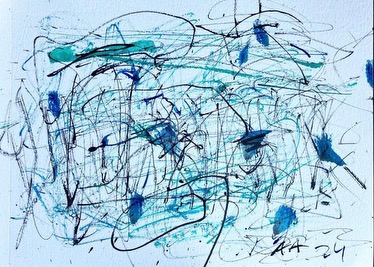
I made this distinction before by fleshing out my definition of art (the wording of which I take from Arthur Danto, the concept of which we both take from many others): art is about something (in my terms, it is meaning bearing) and it embodies what it is about. So, since meaning is something intended, accurately determining that a thing is an artwork and that it means one thing rather than another does depend on accurately determining an author’s intent. Now, since many artworks look exactly like something else (Duchamp’s Fountain or a string of words produced by a computer program that could be taken for a poem) determining whether an object is an artwork or not is indeed in the eye of the beholder, as long as one adds that that determination can be incorrect. As I said, people make errors all the time. That’s not a theoretical problem.
1 Like
Of course it’s art.
Art is an idea. Some ideas are shit, some are brilliant. The skilled winemaker listens, feels and creates “their” idea. Long live our talented artists.
Fabio Alessandria is one of my favorite artists, fwiw.
1 Like