I also tried the 05 recently, which I was less impressed by - and that was the first MDT in many years. I used to buy it a lot but sort of lost touch for no particular reason. The 00, 01 and 02 were all good and probably still are, but my fondest memory is of the 90, one of the best of all Margaux in that year.
My impression, but I need to try some more recent vintages (I have the 16 and 17) is that MDT is classically styled but made with modern techniques, so like most Margaux today and definitely not in the overripe camp.
1 Like
duplicate post
I tasted a few wines here and there and ended up buying mostly 2014s, 2016s, and 2017s. I bought a pair of magnums of 2009 St. Pierre for family events where my preferences are less important, and a mags of 2010 Beychevelle, Grand Puy Lacoste, Brainaire-Ducru and Cantemerle for when my preferences are more important. In general I only bought wines on sale so pricing was generally good and in some cases for 14s and 17s really quite excellent.
I also reminded myself that I bought far too little Leoville Barton, and focused on Chateau that I always seem to like, the aforementioned mags, Barton, as well as Brane Cantenac, d’Issan, Haut Bailly and Domaine de Chevalier.
I’m really happy with how this section of the cellar looks now, titled a little more recent vintages perhaps, but with a variety of maturities and focused on vintages and Chateau that I empirically like.
4 Likes
Sounds fantastic.
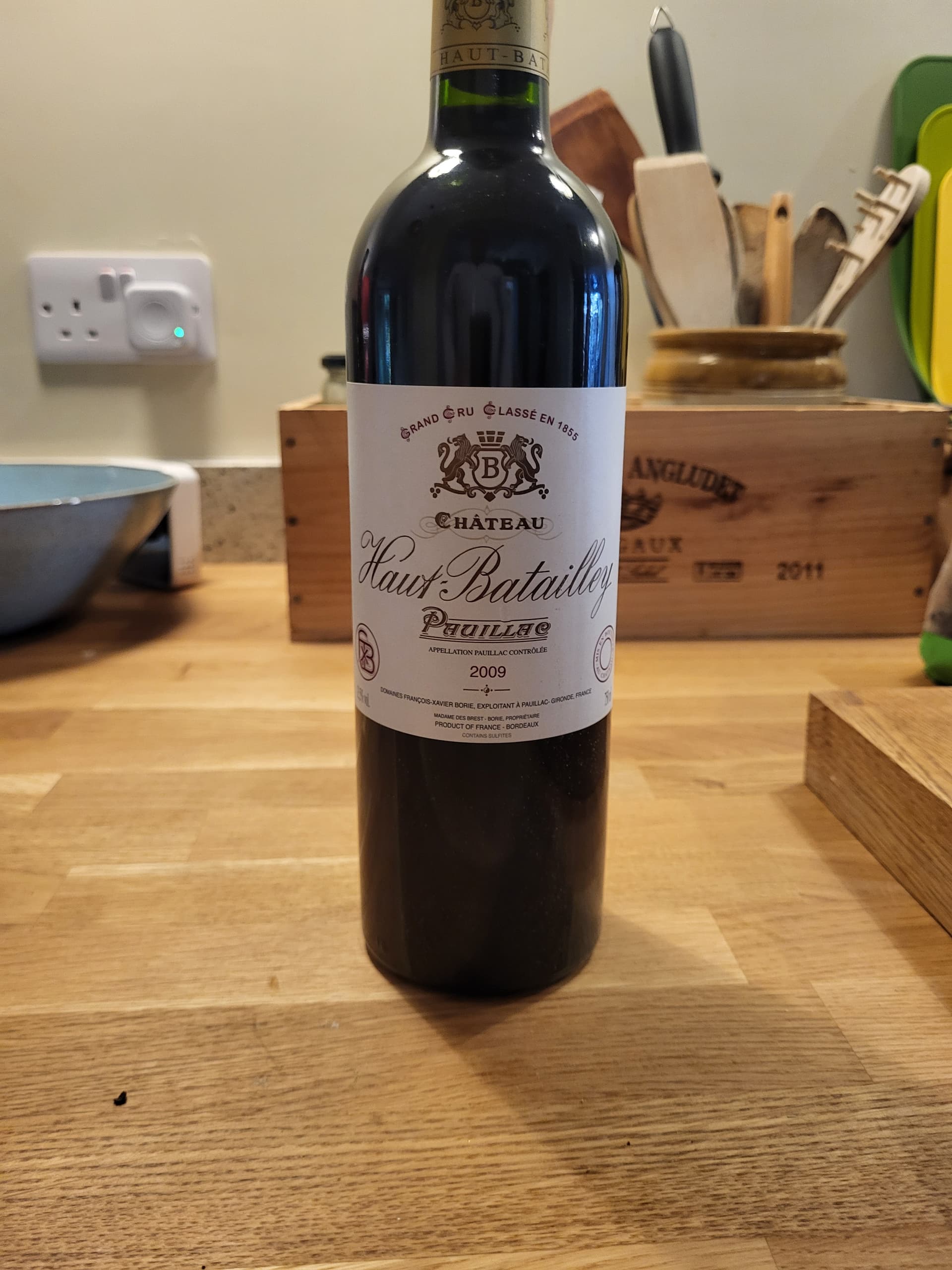
The first bottle this year, still a ripe red Bordeaux, tannins are unobtrusive, there is enough acidity, dark fruit of the cherry/mulberry part of the spectrum, and some lovely floral and cedar notes. These hang around as a sweet aftertaste for a fair while.
Drunk with duck and prune sauce, a good opulent pairing. 93ish or ****.
2 Likes

18 months since the previous bottle.
Double decanted, the depth of colour and blackcurrant scent clear while doing so.
Deep garnet colour, rich product of a warm vintage.
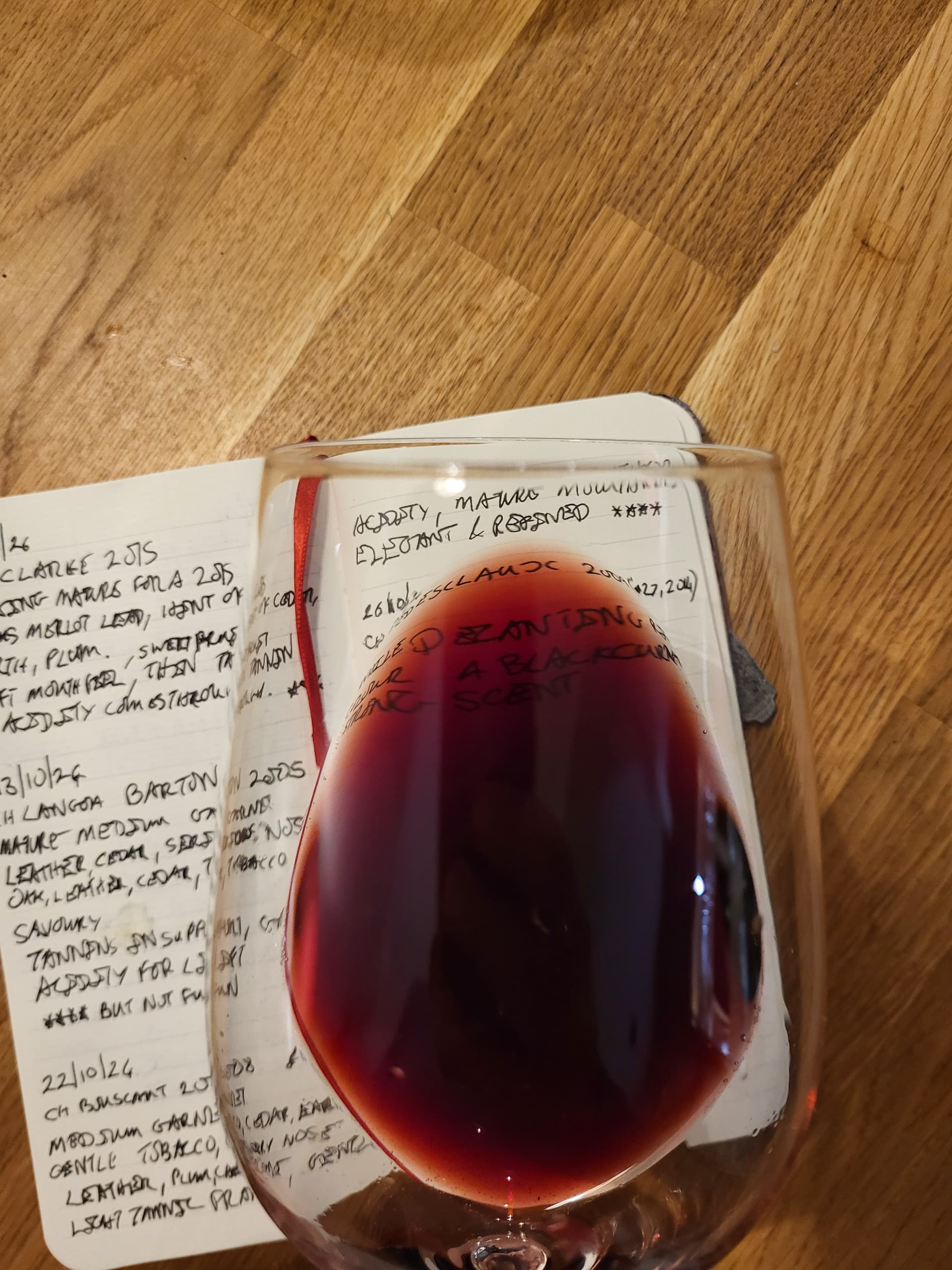
Nose of cedar, blackcurrant and tobacco.
Ripe mouth feel, soft tannin, enough acidity, blackcurrant and plums.
Far less funky than the last bottle, very enjoyable, ****+.
3 Likes
Duhart-Milon - Pauillac 2009
The nose gives the game away immediately - classic Pauillac aromas of blackcurrant and cigar box, but much richer and more powerful than normal, with blackberry cream and vanilla also very prominent. So I was a little concerned, but needlessly - it’s certainly rich, with all the aromas transposed to the palate, but without the cloying sweetness of other 09s. Although the acidity tasted low to me, I can’t see it ever becoming a syrupy mess, and unlike the 05 at the same age, at least it’s drinkable now. But only just - like so many other 09s, its Tiggerish enthusiasm and vigour become tiresome after a glass and a half. So for now, not too bad but not great either.
For now, if you have both, I would recommend committing sacrilege by blending some 09 with some 08, which really needs a dollop of dense fruit - that would produce a great Christmas wine.
Once again, the Duhart 09 is a child of its time, a victim of the mindset prevalent back then (how anyone can refer to the style as “modern” today beats me).
I’m hopeful the 09 will turn into something good with at least another five years in the cellar but I wonder whether it will ever be as good as the fresher 2016. So hopefully 93 pts
6 Likes
Love your description!
1 Like
In terms of wine, I would describe “modern” as the period of winemaking between 1982-2015? in which prominent winemakers in many regions drastically updated their growing and winemaking techniques to emphasize fruit purity and increased body. This period coincides with, and many believe was largely caused by, the influence of Robert Parker, a leading wine critic of that era.
I put a question mark after the end date because I don’t know exactly when winemakers began to move against that style en masse. I’ll gladly adjust it.
1 Like
Thanks!
Yes, that’s certainly the idea - as to the period, perhaps it depends on one’s views but also taste: I’d put the real starting period later, since I wouldn’t say that RMP had any impact on 1982, he just liked them and his praise together with the 100 pt scale set the ball rolling (or Rollanding, tee hee!). I’d say that on the Right Bank things started with 1995 (I remember describing a Monbousquet 95 as being to wine what a mullet is to hairstyles), a bit later with the Left Bank. There are still wines made in that style today, as I discovered recently with a Labégorce 2016. I’m sure there are plenty more on the Right Bank for those that like the style.
Although I really don’t like that type of wine myself, I find it hard to actually blame RMP for it. I think people just tried to make wines in they style they thought he would like, which he usually did (the most cynical example being Lascombes, when it was owned by Colony Capital). Of course, if they did so it was because of the incredibly dominant position he had, and the influence of his scores on prices. But knowing that he also was one of the first critics, if not the first, to taste and approve of Clos Du Jaugueyron does disprove the idea that his taste was only for monolithic fruit bombs.
Anyway, I would certainly say that 2009 was the high water mark for that style of wine.
The term “modern” has always bothered me because whenever we agree the style stopped being dominant, it was several years ago, and is therefore no longer contemporary or current. I expect a learned critic will eventually come up with something better!
2 Likes
Architecture came up with “post modernism” in the 1990s, surely wine making can only be 30 years behind.
Funny, I was just wondering how the 09s are developing.
If you were going to describe the “modern” approach in general, across regions, I’d say:
- Picking later for riper fruit, typically at the cost of acid and (in my view) often precision, varietal character and terroir identity.
- Various techniques to soften tannins (micro-oxygenation, rotofermenters, shorter macerations).
- More new oak, and barriques (some new) in areas where they weren’t used before (e.g., the Langhe, Etna) or by few producers (e.g., the Northern Rhone), and American oak in areas where it wasn’t used historically (e.g., Bordeaux). Moreover, by picking later, alcohol levels rose and the higher alcohols tended to draw out more oak flavor from the barrels.
With a bit more thought, I could probably add a few more bullets.
This was underway by the early 90s, and Parker was a big part of it, because people started making wines to win points from him.
5 Likes
As I understand it, in furniture, etc., modern is a style of a particular point in time while contemporary is more the current style. I think it is fitting to call the “Parkerized” fruit forward, very ripe wines from whatever time-period they come from modern. Certainly, there are still a lot of wines made in this style all over the world, and a lot of lovers of this style of wine (Leve, Hack, for example) even today.
1 Like
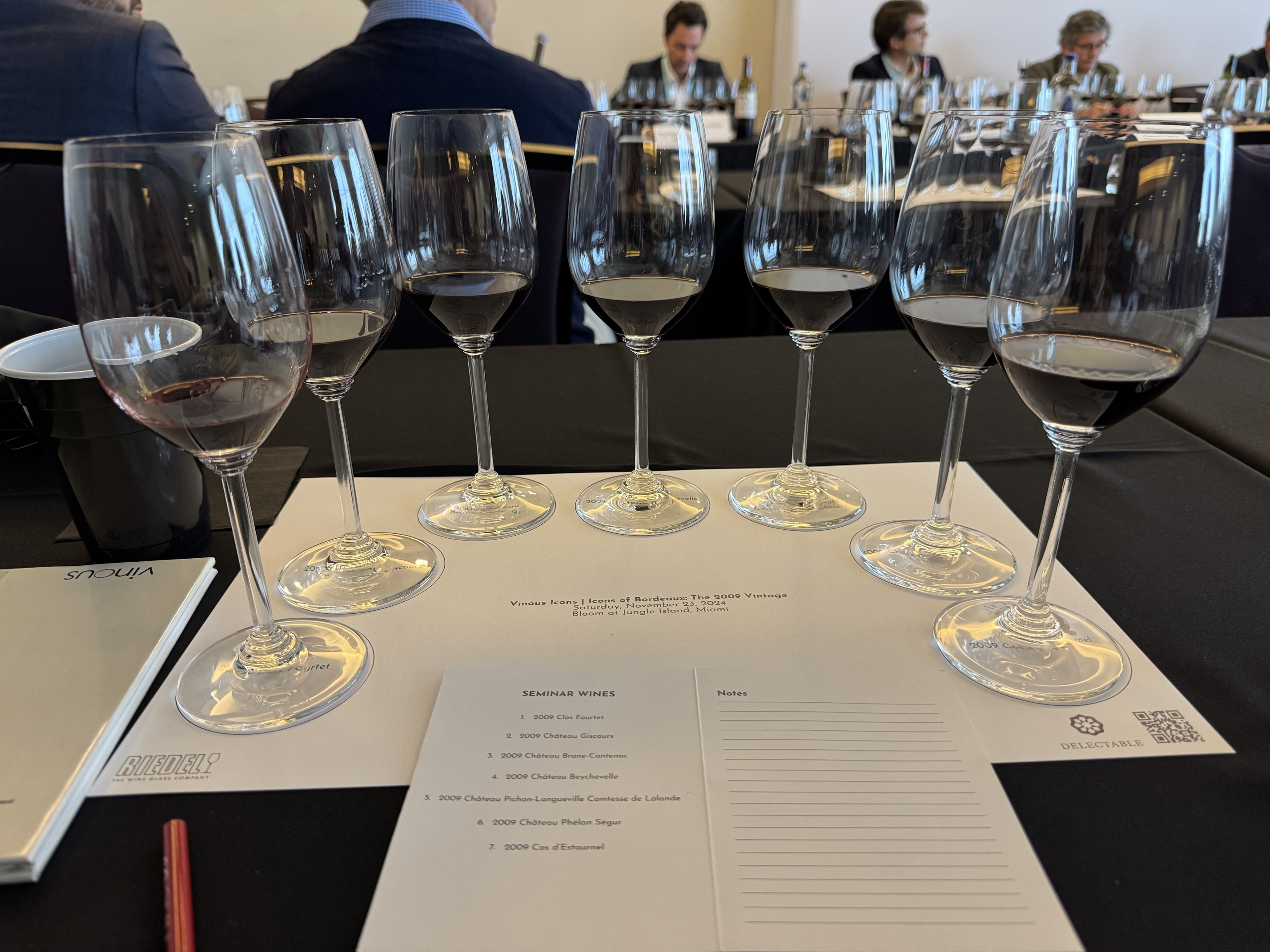
This past weekend I attended the 2009 Bordeaux Vinous tasting led by Neal Martin in Miami. We tasted a flight of 7 different wines from 2009. The tasting was very well done and Neal kept me laughing with his wittiness.
This was the last tasting of the day so I don’t have any notes, just some thoughts on the wines. The only wine that impressed was the Beychevelle, the rest were very tough to drink, two of them were undrinkable to me.
Clos Fourtet - meh
Giscours- enjoyed this wine very much, finished the glass
Brane Cantenac- ehhh tasted like Napa
Beychevelle - Great stuff. Will purchase this wine.
Pichon Lalande - straight black licorice and anise
Phelan Segur - undrinkable
Cos d’estournel - great aromatics but undrinkable
3 Likes
Can you explain undrinkabke to you please?
3 Likes
Thanks for posting this Jesse, it sounds like a fun time, apart from the wines! I’ve never met Neal, but he has always come across as very amusing in his writing, so I’m glad that he is!
In the line-up, I’ve only tried the Giscours and the Phélan - I liked the former and hated the latter.
I’m curious - what did the other participants think of the wines? What did Neal say about them? He and I had a “frank exchange of views” about Phélan 09 earlier this year so it would be fascinating to have his take now.
Did Neal agree with your assessment of the wines?
That’s what I want to know!
I largely ignored the 2009 vintage and glad I did. I recently had another 2009 Palmer and was again disappointed with it. A milkshake. A recent 2009 Cantemerle was better but still not my fave, 2014 and 16 much better.
I was going to say something about the Cos, as I have had several run ins with Jeff Leve over this wine. Nasty to begin with, and not improved with age. A hodgepodge of alcohol, bubblegum and regret, and resembling no Cos that I have ever tasted before. One of the great terroirs of Bordeaux utterly obliterated in the glass.
Friends knowing my utter disdain for the wine used to enjoy serving it blind to me, but always in a half bottle.I knew any time I saw a wrapped half bottle, to gird my loins, try it again and have something nearby to take away the taste.
The definition of madness is repeating the same event and expecting a different outcome. Strangely the same team made a pretty good wine in 2010.
5 Likes