Great to have some hard numbers! Thanks a bunch! Do share the Bordeaux figures if you can track them down.
This is vague memory, but I had '59 Haut Brion aabout half a dozen times from the late 60s into the early 70s (with one last memorable bottle about 20 years ago). I discussed it with Robert Parker, who told me the wine was 15% alcohol and considered a total freak that would never make ‘old bones’ by the Bordeaux ‘experts’ of the day.
I would love to know what the actual alcohol was on that wine. I think 15% sounds about right. Maybe the Chateau has records?
Dan Kravitz
Parker used to say the same about 47? Cheval Blanc iirc
A little sleuthing behind the scenes turned up some hard numbers from an impeccable source. (Dan Kravitz can attest to their reliability.) The ’59 Haut Brion was a bit under 12.5%.
Just one data point and one opinion, but I had a 1992 Williams Selyem zinfandel in 2013 that was one of my favorite wines I can remember, and it was 15.6% alcohol on the label.
I’m not trying to argue there aren’t general issues with high alcohol wines and aging, but just that there are definitely instances of high alcohol wines aging very well.
I have some new data to resurrect this thread, from labs run yesterday:
2003 Château Haut Brion: 12.22%, 0.51 TA, pH 3.62
2005 Château Lafite-Rothschild: 12.10%, 0.51 TA, pH 3.72
2000 Château Margaux: 12.20%, 0.57 TA, pH 3.63
1976 Pétrus: 12.05%, 0.45 TA, pH 3.60
1961 Château Palmer: 11.03%, 0.53 TA, pH 3.71
1982 Château Mouton-Rothschild: 11.49%, 0.51 TA, pH 3.66
1990 Château La Mission Haut Brion: 12.04%, 0.49 TA, pH 3.70
I am pretty sure that these numbers are representative of pre-2005 Bordeaux. And note that some of these wines were likely even chaptalized to reach these modest degrees. It is clear that contemporary Bordeaux, with Châteaux such as Léoville-Las Cases and Haut Brion coming in at >14%, without chaptalization, is quite simply an entirely different animal. Whether it’s better or worse might be debated, but that fact that there has been a seismic change in wine styles is indisputable.
3 Likes
William, thanks for sharing
Wow! I’m amazed at those figures in warm vintages like 82, 90, 2000 and 2003.
Were they watering back? ![[snort.gif]](/uploads/db3686/original/2X/b/bdc3944606213c4dca6c1169cf0a166c8bc4f8c9.gif "snort.gif")
Fascinating data. Thank you for this. It certainly puts things in perspective
Now if only someone can come up with data for the 1947 Cheval Blanc, that old RP chestnut
Me to, and yet, some are actually, at least for my palate, perfectly ripe wines. The 82 Mouton and 90 Haut Brion are spectacular wines. I’m actually very surprised at the 2003 Haut Brion.
The number that is cited is 14.4%, but it would be interesting to see a full analysis, including TA, pH, VA and RS. If I can persuade someone to open a bottle and sacrifice 20 ml in the name of science, I’ll report back. It would be interesting to see the numbers on some of the other headier post-War Pomerols and Saint-Emilions from vintages such as '45, '47 and '50, too, to see where the 1947 Cheval Blanc fits in. I have some inter-War and post-War Gazin, Nouvelle Eglise (which became La Violette), Guillot, Rouget and VCC in my cellar in France and will try to run some numbers, but I am not in a hurry to open all my bottles to tell the truth. But I am guessing that, if 14.4% is indeed accurate for the '47 Cheval, it’s an outlier, even in that context.
Again, to reiterate, my point is not to say that higher-alcohol wines cannot age, but rather to show that many of the supposedly higher-alcohol wines that have aged very well and which are frequently cited as such are in fact, comparatively low alcohol.
But with wines such as 1982 Mouton and 1961 Palmer, it is very interesting to see that rich, ripe and sumptuous textures and flavors can or could be attained at less than 12% alcohol in the Médoc. And the lower abv may well account for how easy it is to drink copious quantities of such wines without any deleterious consequences the following morning!
It is also worth noting, looking at the analyses above, that on paper, 2000 Margaux and 2003 Haut-Brion are very similar, yet they are obviously very different wines (I am wondering if the Haut-Brion saw an acid addition, as many wines did in 2003?). So it also bears reiterating that there is a lot more to wine than the numbers.
William, Great data! Thanks very much for sharing it.
Shocked how low the ABV for the 2003 Haut Brion was. At first glance, it suggests that despite a monster heatwave, ABVs can be “tempered”.
RT
William,
Do you know how long they have been using concentrators and reverse osmosis in Bordeaux? Wondering about post 2000 data…
Cheers.
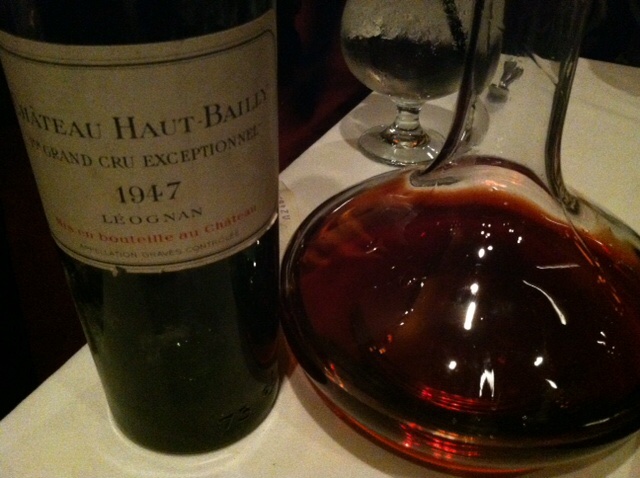
While 1947 was reputedly an abnormally hot and long dry summer in Bordeaux - read that on Leve’s site - I will say this tasted nothing like an uber-ripe wine:
The HB was a red-fruited lovely wine, quite alive as well.
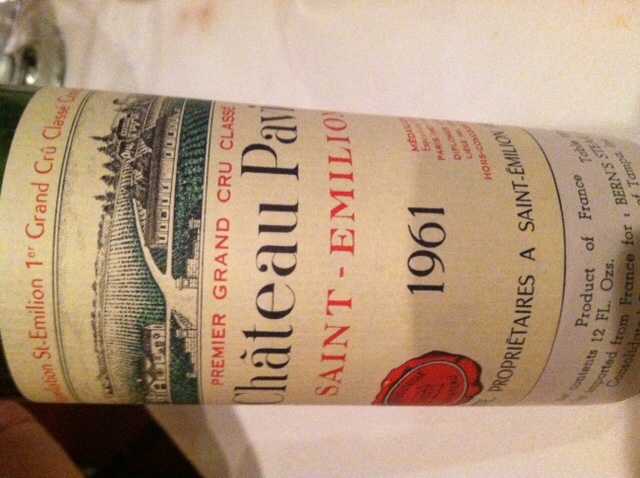
The 61 Pavie drank like an 82, nothing like Pavie from 2000 forward.
Drought conditions can cause vines to shut down and stop photosynthesizing. In such circumstances, sugar accumulation is by dehydration, not true ripening. For example, lots of 1976s, a year of serious drought, were very low in abv and chaptalized.
Thank you William for those fascinating figures - I cannot remember seeing anything like that before and it’s extremely good of you to post them here - I do feel rather sorry for the poor owners of those bottles!
I think the “preservative” notion is a conventional wisdom carry over from our experience using propyl alcohol as a sterilizing agent. Ethanol also serves as a preservative, but you need much higher concentration than found in even the most alcoholic of wines to achieve that, at least biologically.
As for the chemistry: I’m no great organic chemist, but this is pretty simple stuff. Reviewing my Ochem textbook, there isn’t a common reaction between esters and alcohol. In fact, it’s the reverse, as you get ester formation from the reaction of acids and alcohols. However, this takes much higher temperatures and conditions than would be found under typical storage conditions.
The most likely mechanism for alcohol reduction (meaning lowering the concentration) in bottle is a poor cork, allowing oxygen ingress, and the oxidation of alcohol to acetaldehyde and potentially ethyl acetate. But in that case, you have a bad, non-representative bottle. So I think it’s possible to have a bottle where the alcohol has gone down, but you probably wouldn’t want to drink it.
Back to the OP, my own opinion is consistent with some of the views already posted: high alcohol wines don’t generally age well (though some manage to hold up and still be quite drinkable, in my experience), not specifically because they are high alcohol, but because high alcohol is a marker for very/ultra-ripe fruit. So the balance of flavor compounds, acidity, types of tannins, etc., is different going into the bottle, regardless of the alcohol. Would be an fascinating experiment to take a 16% wine, de-alc half of it, and bottle two versions at 16% and, say, 13%, then taste them side by side over a decade or two.
Leoville las Cases began using reverse osmosis in 1987, according to Jeff Leve’s website. As I recall, they were a very early adopter.
When I visited the region with Claude Kolm for several days in June 2001, tasting 98s, 99s and 2000s, many chateaux were quite open about using it. My notes for the 2000 La Louviere, for instance, read “a bit of bleeding, a bit of reverse osmosis.” Ch. Olivier and Malarctic-Lagraviere both said some RO. And that was for 2000!
Fieuzal, Haut Brion, Beausejour Becot and Canon said no RO; Pavie said none in 2000.
1 Like
Agreed, Jancis echoed your dehydration assessment: October 2010. She’s short on the stats you provide but does opine about the sugar and alcohol.
“It is probably not surprising that a growing season never seen before or since would engender strong feelings. In Bordeaux, as elsewhere in France, the grapes were picked earlier than ever before, since 1893 anyway. The levels of sugar, and therefore resulting alcohol, reached record levels, but the grapes did not go through the normal ripening process. Many of them literally shrivelled on the vine rather than building up nuanced flavours, so that what was picked was more like a raisin than a grape. Such dessication tended to produce dried fruit flavours and the resulting wines too often lacked freshness and juiciness. The tannin levels were relatively high, so that in the exceptional cases where there really is some interesting fruit to preserve, 2003 may prove exceptionally good, but to judge from a major assessment of 2003 red bordeaux at the beginning of this month, few wines seem to have a glorious future.”
RT
I generally don’t mind high alcohol in wine, but the last one of these I had w/age was a hot mess