I appreciated the fact that you left it to me to finish off the bottle.
John,
I added some Everclear to your portion. Much better that way.
First off, just like wine or whiskey in barrel, the external humidity would dictate the potential relative water-ethanol loss.
Second, permeability of a cork itself is, well, a secondary issue. Before a cork breaks down, or unless you have an extremely unusually defective cork, and ingress or egress will be between the cork and the glass. Seams to make more sense, doesn’t it…
No unadulterated leftovers for me next time?!
![[wow.gif]](/uploads/db3686/original/2X/7/7d450e9830889c8943b674446a21b7254cad657e.gif "wow")
![[cray.gif]](/uploads/db3686/original/2X/8/853b6e76c6e8406be77a6727c2a27ad1672678b3.gif "cry")
![[shock.gif]](/uploads/db3686/original/2X/0/0b1dcf699ec319f43254f92e3f145786dcd93904.gif "shock")
My understanding, based on Jamie Goode’s books, is that a prime cork allows essentially nothing (wine or air) in or out, through the cork or at the surface with the glass. If that’s true, external humidity won’t matter (though a dry cellar might over time cause corks to dry out and deteriorate).
In any event, to go back to Jay’s query, I’ve never seen anything to suggest that alcohol diminishes more than fractionally, even after decades, unless there’s a bad closure. Have you?
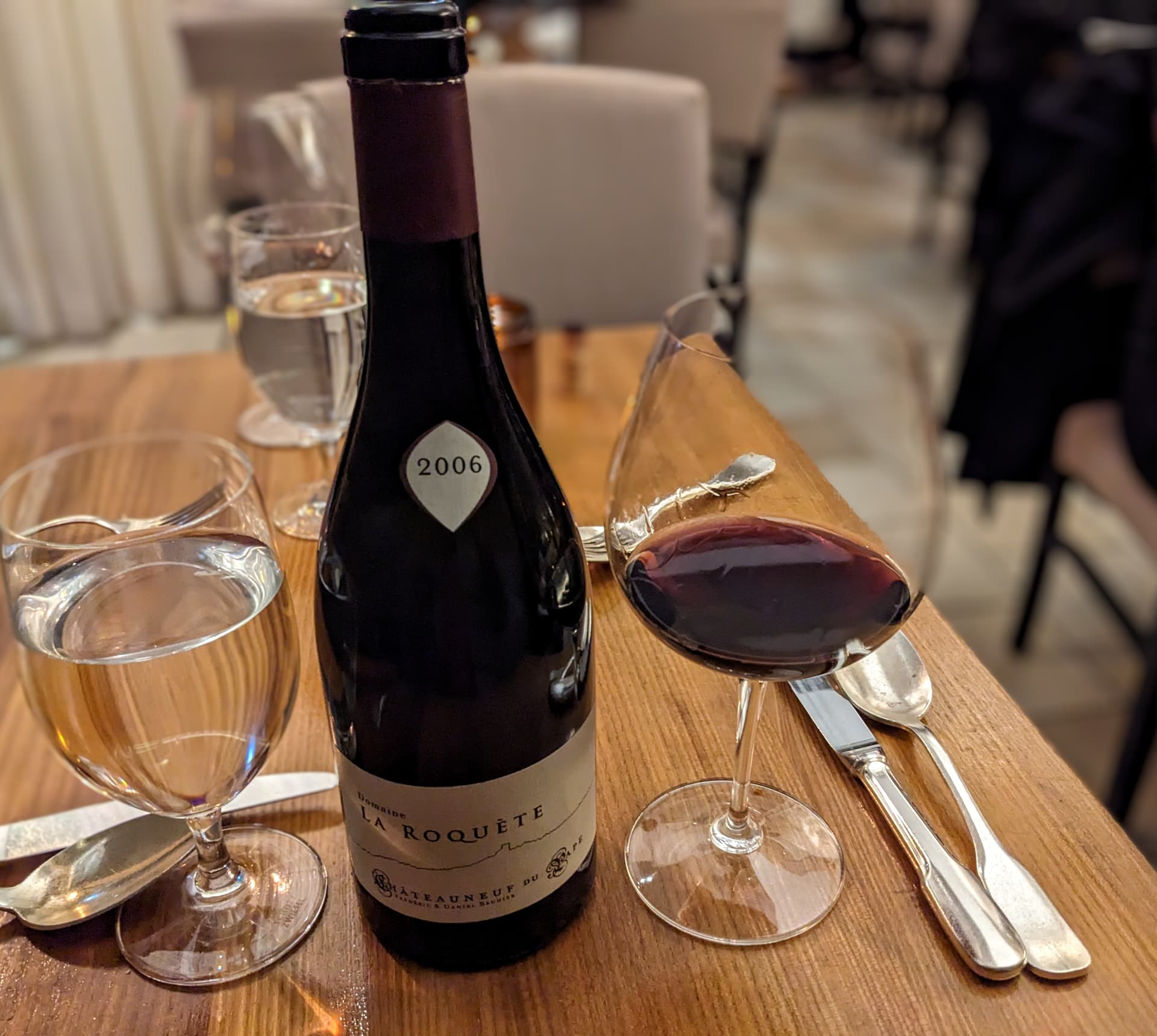
Normally, I love this property but the 2006 La Roquette [CNDP] felt like the ripeness and high alcohol had diminished it. At age 17 it felt tired and faded, despite a great fill and cork. Maybe this would have been better drunk up by age ten tops. It’s too bad since I found their 1998 and 2001 all aged very well. In my ledger, a B-. Drink up!
I am wondering how you can make any kind of comparison between a fortified wine and a wine.
But I have had plenty of aged Chateauneufs which have developed complexity, but not one example of a high alcohol wine that was worth drinking. I still have nightmares remembering the mess that was Henri Bonneau’s 1990 Cuvee Speciale, that cost more than La Tache at the time and was deemed too risky to use for a Beef Bourgignon. The most expensive non corked wine ever to go down my sink.
1 Like
Mark,
nice that you eventually replied to my posting from 2020.

The problem with the Bonneau was the res.sugar … the alc. was app. the same as in the Celestins …
As I wrote: it’s often lack of structure (destemmed grapes) that makes wines with high alc. “hot” …like Clos St. Jean …
Pegau Da Capo has the same high alc. content but is great wine …
2 Likes
I’ve had some conversations about this kind of thing with other winemakers recently and in the past. I just published a podcast with Dustin Mowe and we chatted about this as well (I can give you a link if you message me, don’t want to post something here as I’m not sure if it’s appropriate to post a link that could be seen as self promotional etc)… Alcohol is a wonderful preservative, the trick is to understand that different wines can posses a sense of balance at an incredible wide range of alcohols. I’ve made wines over 17% that were absolutely stunning and aged well. If a wine is showing an imbalance however it won’t likely get better with time. The idea that a wine needs to be below a certain alcohol range to be age worthy is heavily flawed, I’ve seen this to be true time and time again.
1 Like
This issue of alcohol and aging is becoming ever more important because of what @William_Kelley above referred to as the “seismic” change in wine styles in Bordeaux, with wines today two or even three degrees higher in alcohol than wines of a few decades ago. Will these 15% La Mission or even 14.5% Montrose (in 2019) age like decades past?
As a consumer I wish I had a better sense of what specific changes in winemaking had led to this shift. As I said above, given previous alcohol percentages in hot vintages it’s not just about global warming.
2 Likes
I had a couple of bottles of this in 2010 and 2012. (Interestingly, they came from CostPlus World market, back when I guess they sometimes brought in interesting wines.) I liked, but didn’t love it, and my notes indicate it was showing heat even at that stage and came across as a ‘big’ wine, albeit complex.
I hope you’ll get that soon, for Bordeaux at least, in the lengthy free-to-read essay I’m about to publish on TWA about everything that has changed in Bordeaux.
I think what we have is, in the context of a warming climate, rootstocks and clones chosen for more rapid ripening combined with aesthetic objectives that dictate picking later. That’s a knot that takes some time to untie, but how well the wine ages will also have to do with the approach taken to élevage. Choices that tend to favor precise, more reductive results will be more successful at integrating higher alcohols. Anyway, it’s a big subject.
2 Likes
Sounds like a big subject! The mass migration of critics to what by historical standards are incredibly high scores for classed growth Bordeaux (which i realize is hard for any one critic to push against) tends to give consumers the message that Bordeaux is simply getting better and better and erases any sense of trade offs in style. Of course the whole idea of a single one dimensional score makes that difficult too.
One thing that’s been confusing for me is that for a decade now I’ve been hearing that Bordeaux is moving toward much less extraction, precise “teabag” extraction, etc. but with a few vintage exceptions alcohols have tended to increase. In a non-expert way I get that alcohol and extraction are not the same thing but I’ve always thought of them as connected.
Gerhardt, I could agree with you, but then we would both be wrong. 
Seriously my tolerance for alcohol ends at 14.5% and even then I seldom find much balance. A recent Montrose 2019 managed to stay in pool balance, and one or two VCCs are also capable of dealing with 14 plus. But in both cases, the fruit was very fresh with no hint of plumminess or port flavors towards the finish.
I most other cases, particularly at higher levels, I can’t get beyond the first sip or two.
My palate and body disagree with you David. I’m not interested in drinking table wine with up to 50% more alcohol. I also subscribe to the view that alcohol doesn’t often integrate and become less obtrusive; it frequently becomes more apparent and disjointed over time. Or has in my experience and to my palate, which are the most important considerations when I choose to buy or drink a wine.
Only one of many reasons why I’m drinking mostly Champagne these days.
1 Like
Well we can agree on the champagne at least 
1 Like
What did you think of the 2015 VCC Mark? I know you love VCC and that was close to 15% I think.
I sold a bunch through Commerce Corner. Kept a few back just in case.
1 Like
Beyond the fact that alcohol is in itself a solvent, the two really are entirely unconnected. The wines of the 1920s, for example, were (generally) low in alcohol and extraordinarily extracted.
What’s more, ripe, concentrated grapes liberate tannins and anthocyanins very easily, so working such fruit with very gentle extraction techniques can still deliver wines that are analytically very high in “extract”.
Hopefully my forthcoming essay will clarify some of these things and set them in context.
5 Likes
Mark,
… no offence intended, but that´s simply your personal problem.
Others estimate such wines often very highly …
I do not know any Bonneau Celestins below 14.5%, no matter what´s indicated on the label.
My opinion is that when the structure (tannins or/acidity) is sound the wines can be balanced indeed despite an alc. of app. 16% or beyond.
Da Capo 1998 indicates 16% (on the label) … and it is a great example of a traditional powerful Chateauneuf-du-Pape …
Other wines - often in a more modern style, destemmed and lacking in structure, can be flabby and show the alc. too much … (like Deus ex Machina for instance).