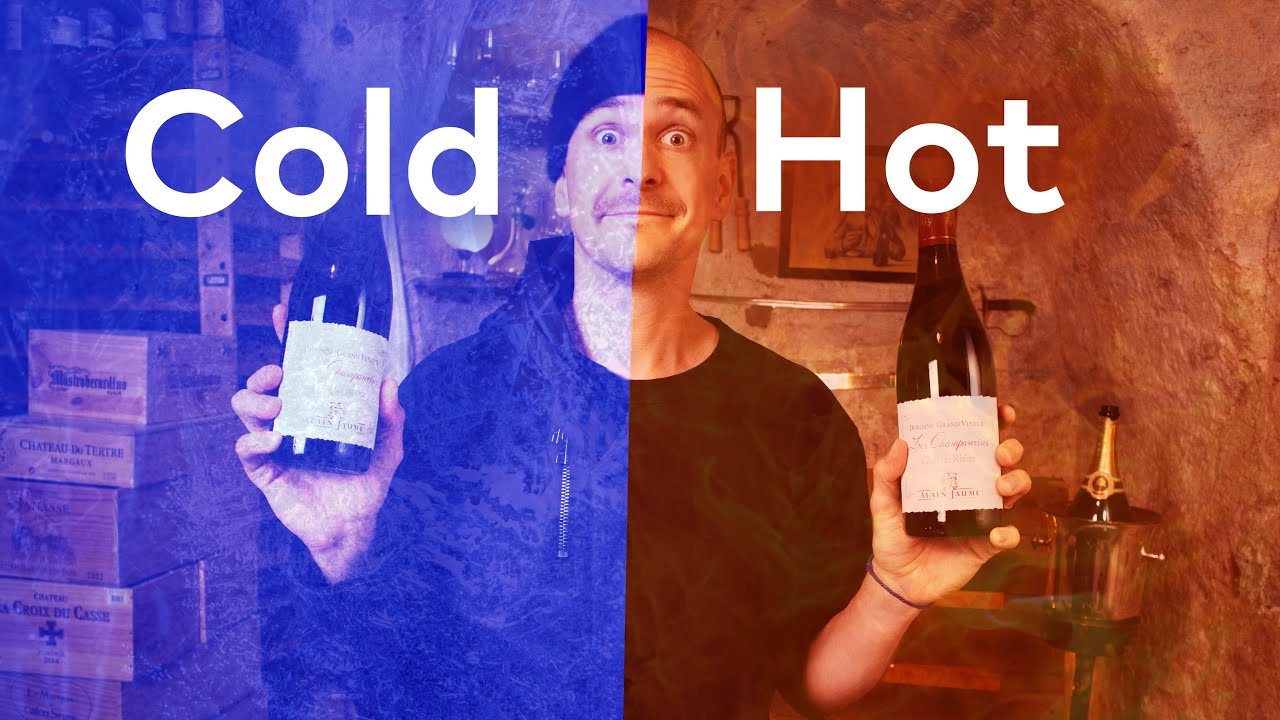
Hi everyone- seeing as its the height of summer here in the Northern hemisphere, I am sure many of use are worried about wine getting heat-damaged during shipping. I know I am! I ran across a very interesting video on YouTube that I found somewhat reassuring. An MW took three identical bottles of wine and for 1.5 weeks left one in his cellar, one in his freezer, and one out on his 90-100 degree porch in the direct sun. Spoiler alert: Blind tasting revealed all bottles were pretty decent.
It’s not a prefect experiment. The wine he chose was a young Cotes du Rhone, so who knows about old fragile wines, or whites, and the period seems more pertinent to shipping than long term storage, but nonetheless its reassuring. I first ran across his stuff a few months ago and I like this guy’s videos quite a bit.
I posted my tasting notes on presumably heat damaged 17 Rousseau CSJ (with a bit of cork protrusion) which tasted spectacular. Not sure if it would’ve affected long term aging but it was consistent with other bottles I’ve had.
I always wonder about this, as people usually say it’s the temp swings that kill wine.
I have a basement that stays generally 60-65 in the winter and 70-75 in the summer, which is obviously higher than usual ‘cellars’, but intraday swings are minimal. Haven’t had any cooked wines yet
From the UK perspective there does seem to be a cultural difference, lots from the US seem more concerned about temperature control than we are. It may just be the fact that the weather is so lousy here that it never gets hot enough to cook wine.
I always think about the guy in my tasting group who kept wines in his basement for 40+ years. It got into the high 60s/low 70s in June-August, and the 1966 and 1970 Bordeaux were still amazing in 2010 (and later).
It would be interesting if he did a second group of 3 wines and after the rough exposure, put them in the cellar for ~1 year to see if the heat/cold did lasting damage vs a control bottle. IOW: trying to mimic the effects of “dangerous” shipping conditions for a few days then storing them well thereafter for an extended period of time.
The bottles I have presumed were heat damaged, presented the damage after years of aging. mostly stewed, muddled flavors and very advanced when compared to other examples of the same wine.
I personally don’t worry about cold/freeze unless the seal was compromised
thats pretty reassuring for me, where I have a crawl/basement space in a new house that I’m suspecting will be in a similar temp range and debating whether it needs temp control or not. would save me a lot of money if i dont need to insulate and build something!
I do think the degree of concern some have is unwarranted but I don’t find the experiment terribly convincing. David’s anecdote is somewhat more useful. If you buy wines to cellar, as most of us do, and intend on drinking wines 10-30+ years after vintage date, the performance of a young off-the-shelf CdR under these circumstances is neither surprising nor informative.
I know I have discussed this several times in the past, but a good while back I did a two year aging experiment. I took 3 bottles each of 3 different wines (a good Bourgogne, a Muscadet, and Riesling Kabinett), and put a bottle of each in three different storage locations. One set was in my 53-55 degree wine cellar, one set was in the 54-71 degree (depending on the season) basement, and one set was in the 60-80 (again seasonal) family room closet.
After two years I did a blind tasting for my group. I had my wife number the flights, so I didn’t know exactly which bottle of the three I was trying. The group universally found the bottles from the family room closet to be more evolved, but still tasting sound/undamaged. We were unable to identify the uncontrolled basement bottles from the controlled wine cellar bottles.
It’s the increased probability of our wines getting damaged by too much heat that we are concerned about. Heat damage might not always occur but we do our best to avoid it if possible.
I inherited bottles from my father that were kept in a basement that ranged from the low 60s to mid 70s. None were noticeably advanced or heat damaged. I had an opportunity to compare bottles of 1983 Prieure Lichine (we bought 3 cases together and split them) that were stored in his basement for about 6 years before I inherited them to bottles stored in my 55-degree cellar. I did this over years, including several blind tastings. The basement stored wines peaked a few years earlier and started to decline a few years earlier but it wasn’t a major difference and in some cases they were indistinguishable.
But 90-100 degrees? Nope. Not even for a day. Corks will start to push and the seal may be compromised. The wine will likely show heat damage, if not right away then years down the road.
My personal comfort zone for wine temperature for a few days is somewhere in the mid to high 70s.
There’s been a couple of papers published on how temperature affects wine over time. IIRC, they track alongside David’s blind tasting, in that continued exposure to elevated temperatures seems to cause wines to develop faster, with whites seeming to be more sensitive to higher temperature than reds.
This all makes good sense to me. Too high, for too long, and bad reactions will play a more noticeable role. Modest temps, even for lengthy time periods, will accelerate things, but not so differentially that the wine veers from its “desired” aging curve that much, except to push the peak to an earlier point.