I have read it many times. It is not perfect but what is? My second favourite wine book after the Official Guide to Wine Snobbery.
2 Likes
Read and loved it. Sits on a shelf with a few other wine books I consider classics. Highly recommend to anyone interested in wine.
Yes! It’s not a buying guide, even though you would have done well buying those wines.
1 Like
It’s a fun read, and Kermit is a great writer, but the book definitely captures a different era in the wine world, particularly where over use of SO2 in imported wine was an issue…today the pendulum seems to have swung too far in the opposite direction.
Yes, I think there was a similar issue with ripeness at the time (the Parkerization phenomenon mentioned earlier). One of his other repeated issues back then was temperature control of the wine shipments, although I don’t recall this was mentioned as much in the book as in his monthly newsletters.
-Al
1 Like
Something that hasn’t aged well in the book is his disdain for mobile bottling lines. Nothing can be gained in bottling a wine, only lost. I’ve found using a professional line - yes on a truck that comes to you - is highly valuable.
2 Likes
my favorite wine book. But, I originally read this a very long time ago.
1 Like
I haven’t read the book in a while, but I think much of this was because they always wanted to filter the wine, which Kermit never liked. I also imagine French mobile bottlers of the '70s and '80s weren’t quite as sophisticated as what is used today?
2 Likes
All true or potentially true. I just thought I’d run into more of the dynamic that the bottler would push the maker around, but it’s never been that way, at least in the 20+ years I’ve seen it in the U.S. Whether it was true then or not, in France, I suspect it was more an embodiment of outside/commercial influence on growers/makers. Just not accurate now and I can’t imagine it’s like that with good producers in France. I’m imagine someone might argue otherwise.
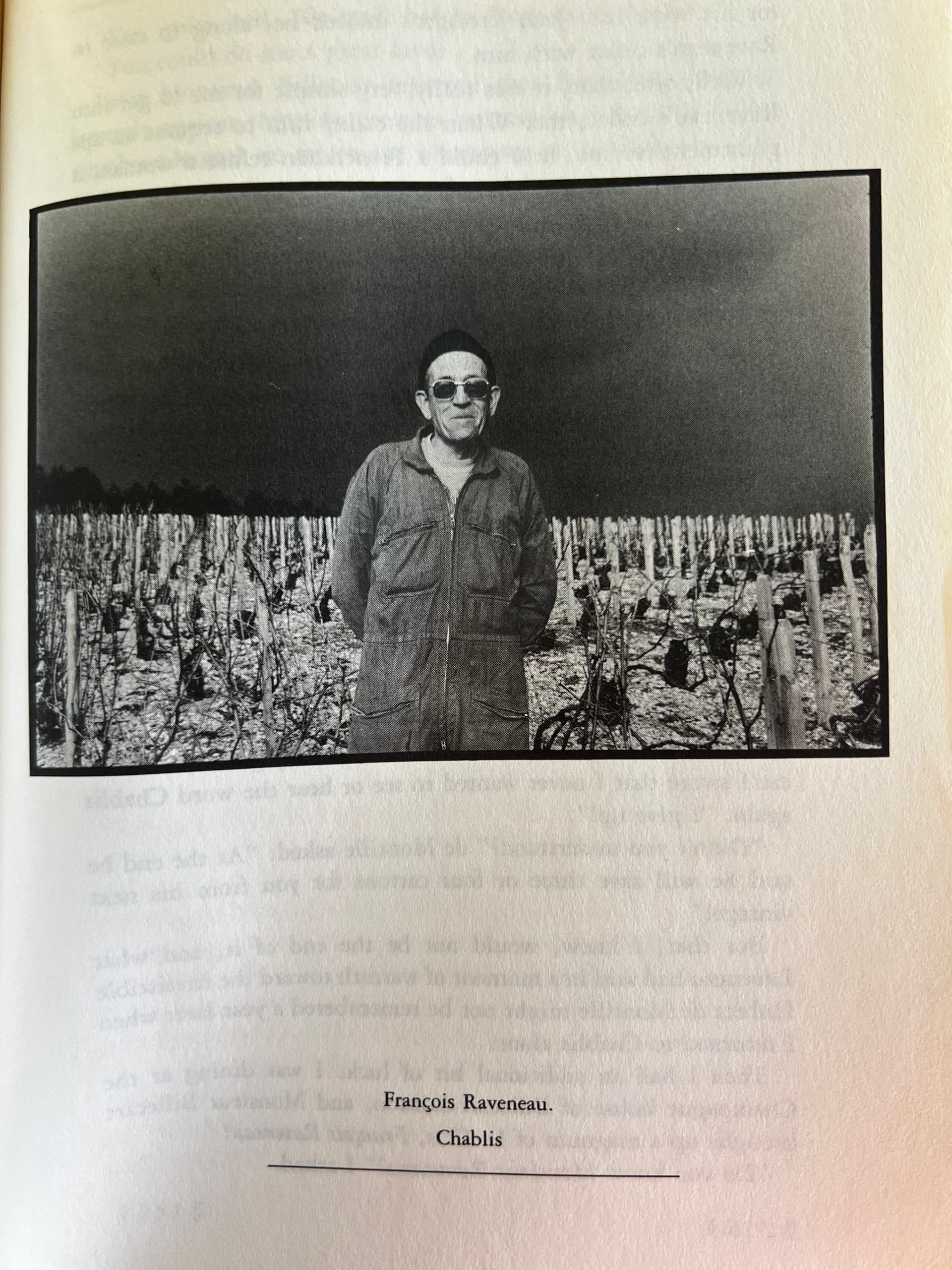
I really enjoyed this book. It felt like a mix of Paul Theroux and early Anthony Bourdain, but with wine. I think it was really just the chuckles that I got out of it - reminded me of their witty humor. I learned a lot from this book and can see myself reading again many times. My favorite part of the book is the pic of Francois Raveneau in the last chapter:
3 Likes
Gail Skoff was the photographer for the book (and newsletters).
-Al
3 Likes
That book came out when I was in my early 30s and had only been paying attention to wine for a few years. Loved it and ended up purchasing multiple copies over the years, because I tended to give them to friends who seem simpatico. There was one other book from that era that played a similar role (“you really need to read this”): John McPhee’s Basin and Range. Both were published by Farrar, Straus & Giroux (go figure).
3 Likes
Annals of the Former World is one of my absolute favorite books.
1 Like
Like many, I also really enjoyed reading this at the beginning of my own adventures in the wine world, and I think it offers an important perspective. The writing is also vivid and engaging, something one can’t say of many wine books, and why it remains a volume I regularly recommend.
But I think at times it falls into a rather simplistic, polarized view of good/romantic = old/primitive/small/dirty vs bad = modern/big/sterile that is superficially attractive but also somewhat unhelpful. While there are lot of reasons to be cautious about change in winemaking practices, there is a middle ground: between dirty and sterile there is clean, for example; just as between the primitive and the industrial there is the meticulously artisanal. The visible effects of herbicide in the Raveneau photo, which you’d also have found chez Trollat and Gentaz, among others, is a reminder that not everything about the “old ways” is admirable or desirable.
10 Likes
In the chapter on the Southern Rhône, Kermit Lynch explains how Domaine du Vieux Télégraphe—which is no small domaine with 70 ha in La Crau—smartly modernized its cellar and winemaking techniques, whereas he criticizes Domaine X (Château Rayas) for being unclean and inconsistent. (Robert Parker, on the other hand, was more critical of Vieux Télégraphe and preferred the wines, such as the legendary 1978 vintage, before those changes were made. Two exceptions were the 1995 and 1998 vintages.) If I were at home in Trier, I could look inside one of the two copies on my bookshelf (including the 25th Anniversary Edition) to double-check this, but I’m visiting family in Central Texas. My criticism of the book is that he failed to acknowledge top producers who were not in his portfolio. For instance, he could have mentioned Clos des Papes, which he later praised in one of his newsletters many years later. To his credit, he did say that he missed out on Dauvissat, because the wines seemed off to him on the day when he tasted them, but this led him to Raveneau instead. As for “not everything about the ‘old ways’ is admirable or desirable,” I couldn’t agree more. One forgets, for example, that high-density plantings were to insure a healthy yield. In the Mosel region, many of the best sites were planted less densely to improve quality in the late 19th century. It’s not as simple as higher density equals deeper roots and thus better wines.
4 Likes
Thank god for that! Or Dauvissat would be priced like Ravenau in the U.S.
1 Like
Would be curious to know your favorite Burgundy book (written in English), if you have one.
1 Like
It was a very important book when it first came out because it was more accessible to wine consumers in the U.S. than most of the other texts on the wines of France. It also turned attention to the food and culture of France in ways that few works at the time managed. And let’s not forget Gail Skoff’s amazing photographs that gave a rare insight into the people and producers of wine outside of the U.S.
2 Likes
One nice aspect of the book is that it’s a breezy read, maybe 1.5 to 2 hours. Maybe a gazetteer can be hyper detailed, but other books benefit from being concise.
1 Like
Kermit Lynch is a very good writer.
1 Like