I do think you’re right in that there’s probably not much kabinett out there fits a filigreed/delicate auslese mold. Kabinett that are made to push ripeness probably lack the delicacy of auslese of other producers.
I still don’t see the point of chasing the pradikat label though. There are probably enough spatlese that would fit the bill of what is being sought, even if specific cuvees of specific producers are fairly singular
My point was that it is not uncommon for producers (esp in ripe years) to release Spatlese where the grapes exceed the minimum must weight for Auslese. In some cases, this is because the producer believes that the wine is more “light and bright” than the wines it would label as Auslese. In others, it is because in today’s world there are vintages where many of the producer’s grapes get more ripe than they did in the old days and the producer wants to have some Spatlese to sell - so, they declassify some Auslese, potentially the ones that are “light and bright” compared to the producer’s other wines that year. As someone else said, don’t just look at the label. Try to find out from a good retailer or someone else what wines they have that meet the “light and bright” criteria.
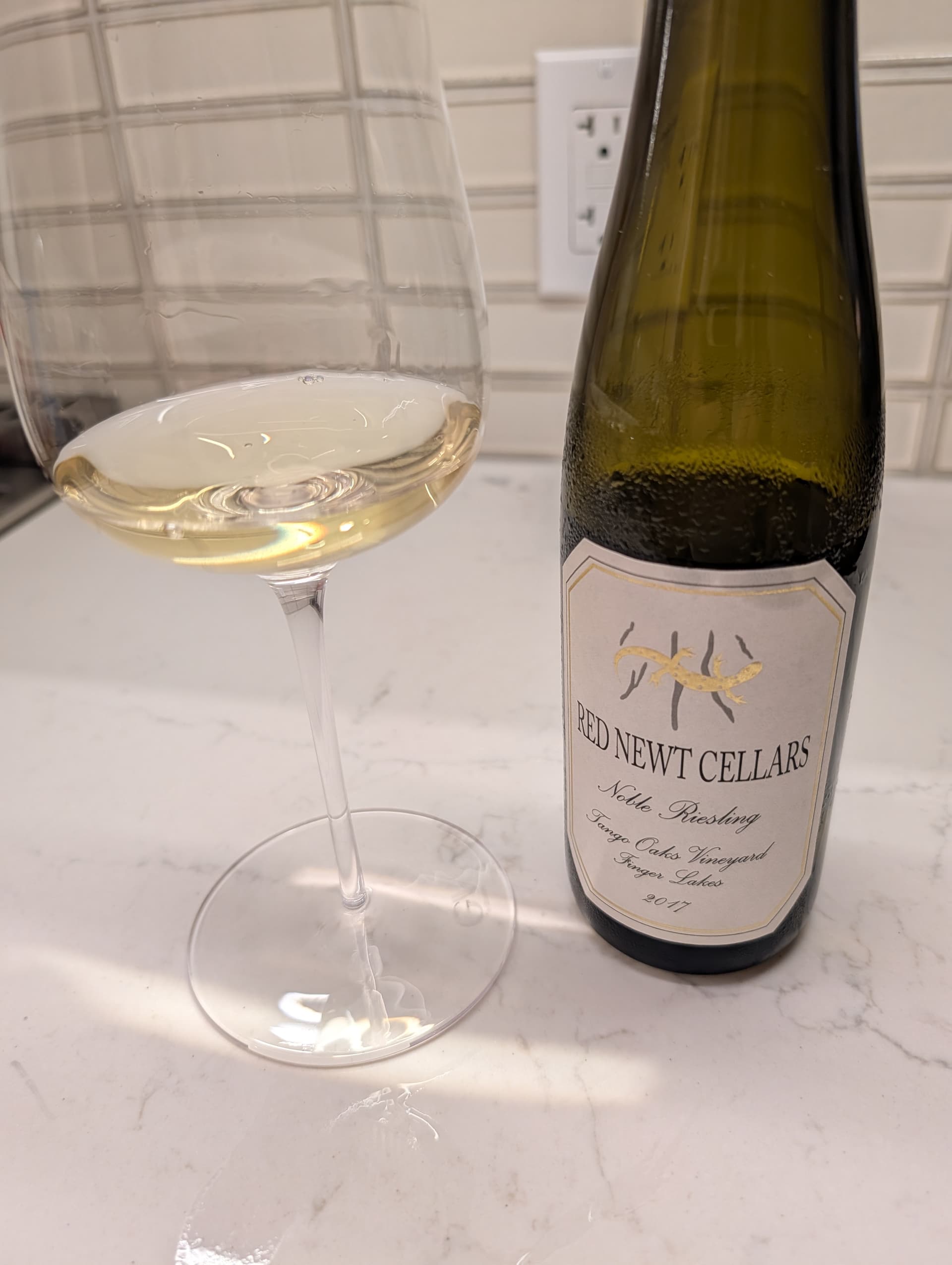
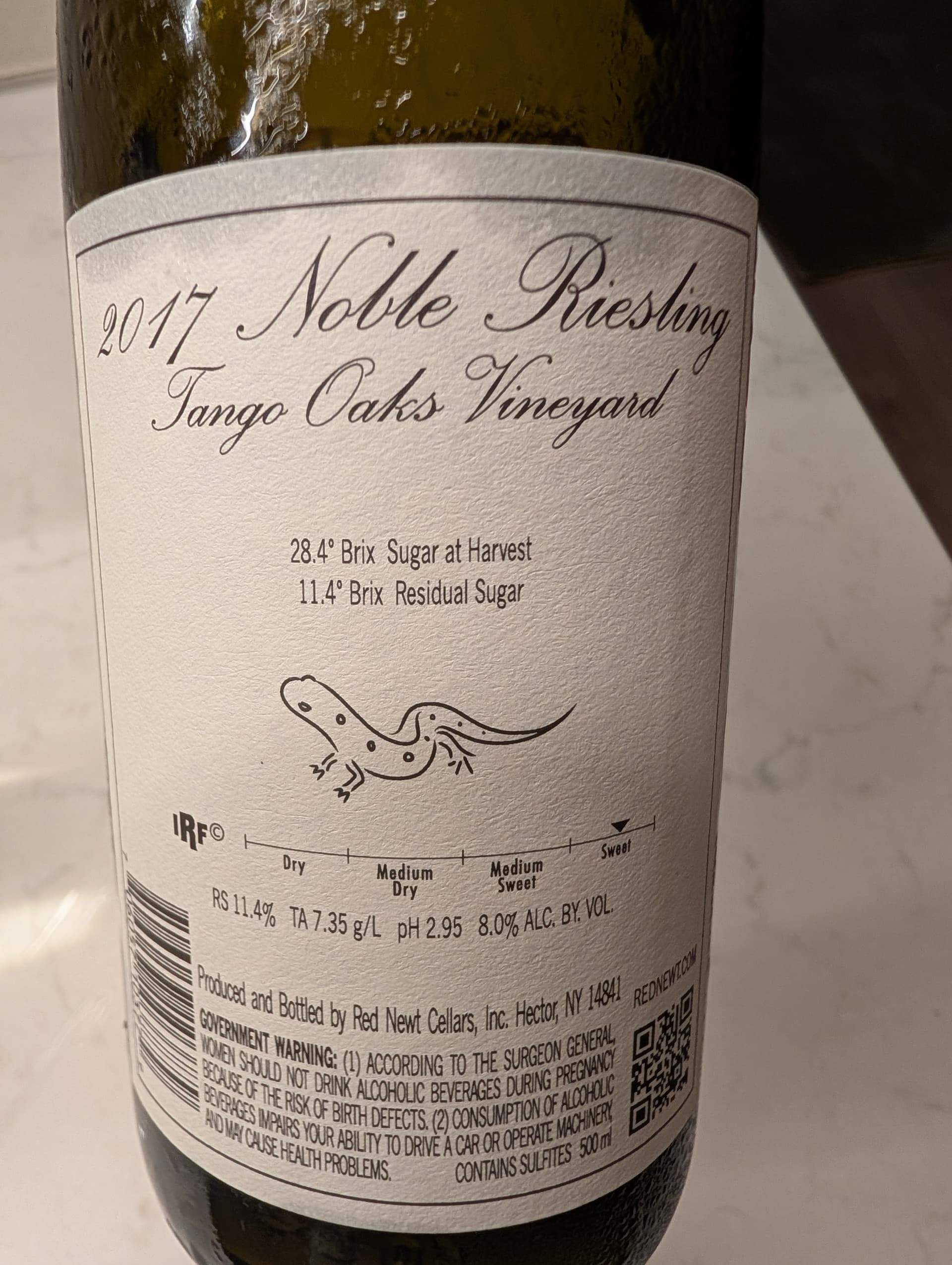
Not German, but this Berserkerday pickup definitely checks the box. Made in the auslese style according to the winemaker notes, although the brix at harvest would qualify it as a BA if I’m doing the math correctly.
The nose gives a whiff of botrytis at first, but gives way to fresh squeezed lemon, creamed peaches, and apricots. The palate retains enough acidity to balance things, and there’s a bit of wet slate going on too. Definitely drinking quite fresh and on the lighter side now 9 years in bottle.
2017 Red Newt Cellars Noble Riesling Tango Oaks Vineyard
From the producers I typically drink, I don’t think I could really mistake a Kabinett for a Spatlese or Auslese blind. There are clear stylistic differences in the wines. That would also be the case for a lot of producers that I don’t drink a lot. But for some, like JJ Prüm, it gets a bit more complicated, because of the extensive use of gold capsules (short as well as long). I just tried about a dozen or so ‘24 Prüm and can imagine that I might mistake a regular Auslese for a Spatlese. That said, none of them were very good, and particular the Auslese were underwhelming. There was a big step up to the gold capsule bottlings though. You wouldn’t mistake them for Spatlese. As such there are producers whose Auslese are probably more or less within the same range as their Spatlese, but generally, like Prüm, they produce Auslese at different levels.
I would also add that I think a lot of producers have knocked the intensity of their Auslese up a notch in the last 5-10 years (in some cases more) and perhaps also increased the lighter floral notes, linearity and acidity of their Spätlese, so the difference might be bigger than it used to be.
On a side note, J.J. Prüm switched to the 350-mm bottle for their Auslesen several years ago, but I believe they reverted back to the standard 330-mm bottle. Most producers who have both bottles use the taller one for their high-end dry wines, such as GGs.
Thanks Lars. What a fabulous article (including the comments in the discussion after the article). This states in much more detail, and from much more knowledgeable people than me, how much more complicated this all is than “I always can tell the difference between a Spatlese and an Auslese”. I love the point that what was a Kabinett, Spatlese or Auslese in the 1970s or 1980s is much different from what they are today. To me, if you want to see somewhat what these distinctions were like in older times, try 2021s, which is to me a throwback vintage.
I find comparisons between 2019s and 2021s to be particularly fascinating. Both excellent vintages, with the 2019s much richer overall (but with excellent acidity - at least for the wines I have had) and the 2021s more elegant.
Always good to re-read that piece and the interesting comments. It’s one of the few times when David Schildknecht’s comments are shorter than the original piece!
FWIW, the Selbach-Oster block picked wines still have pradikat designations. It’s just on the back label, at least in the U.S. There was even a block picked wine that wasn’t designated as an Auslese, the 2007 Zeltinger Schlossberg Schmitt, which was labeled Spätlese, and has always been an amazing wine.