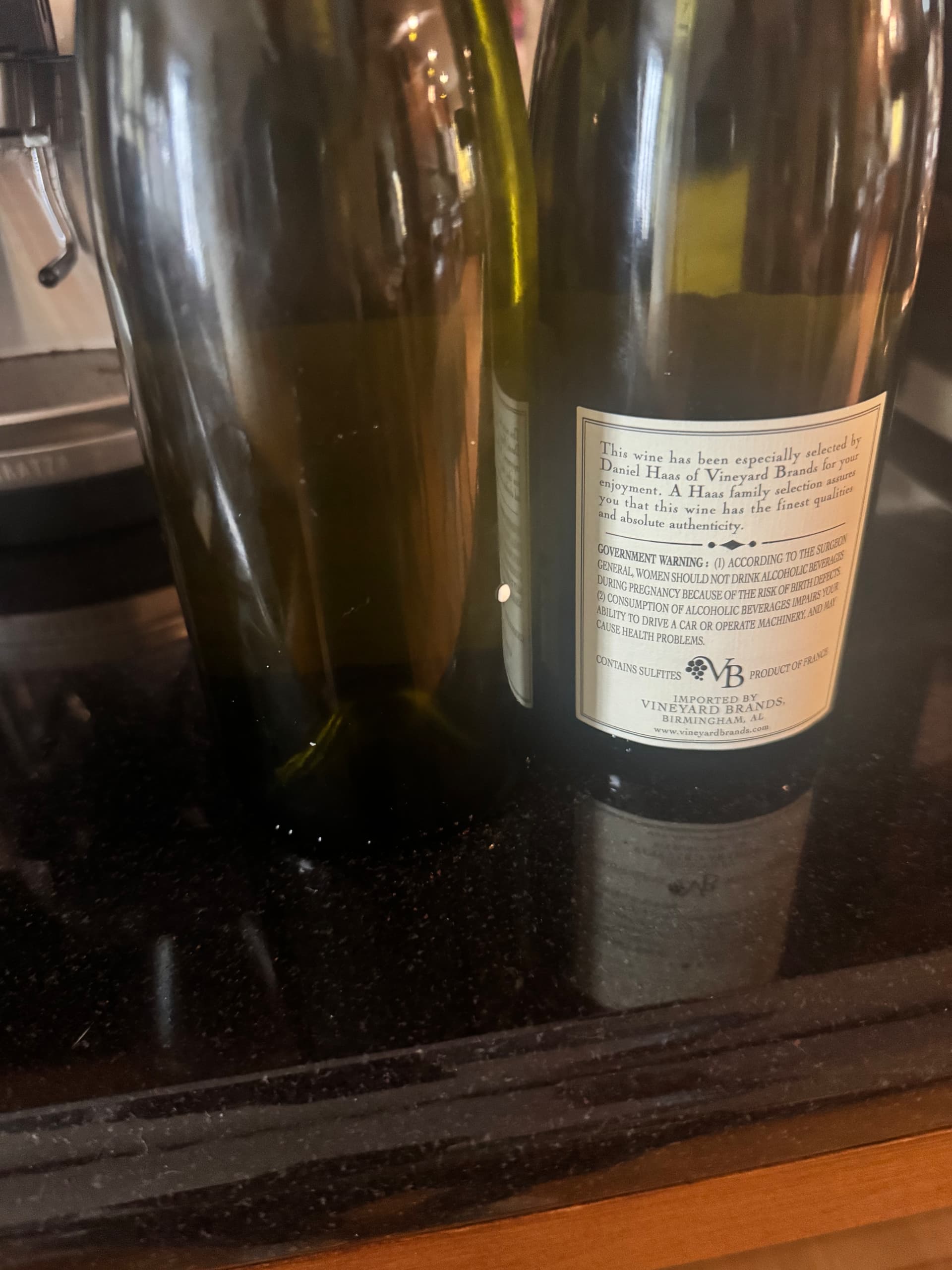
Is the following accurate? (It seems to be Coates’ line also.)
“In addition to the Vincent Dauvissat label, there is the Dauvissat-Camus label, which, many contend, is the same wine as the Vincent Dauvissat bottling. In fact, the Dauvissat-Camus wines state explicitly at the bottom of the label that the wines are grown, vinified and bottled by Vincent Dauvissat. So what’s different? The importer. That’s all”
NOTE: US consumers should be aware that, contrary to the statements of Vincent Dauvissat which have been repeated by various wine critics, including Burghound, the wines appearing under the R&V Dauvissat and Dauvissat-Camus labels are NOT identical. The US cuvee of the R&V Dauvissat wines (imported by Vineyard Brands) is apparently bottled at least 3 to 4 months before the european versions of the same wine and the Dauvissat-Camus labeled wines (imported by Grape Expectations and Classic Wine Imports.) The Vineyard Brands versions of the Dauvissat wines are typically bottled in November of the year following the vintage and are usually offered for sale in December of the year following the vintage. The European version of the same label and the Dauvissat-Camus wines spend an additional 3 to 4 months in oak and are usually bottled in February or March of the second calendar year following the vintage. Additionally, according to Steven Tanzer, in the past some of the Vineyard Brands’ cuvees have been filtered, whereas the later bottled cuvees are generally not filtered. Be aware that the finished wines that have been reviewed in Burghound, IWC and Wine Advocate which have been tasted at the estate have had an additional 3 to 4 months in barrel (and may be unfiltered cuvees) and thus are not identical to the Dauvissat labeled wines bearing the Vineyard Brands strip labels. Whether the Vineyard Brands cuvees are better or worse than the others from a premox perspective remains to be determined. It is certainly arguable that less time in wood may mean that the wines are less likely to suffer premox in the long run. (N.B. note that the wines from Leflaive and Roulot spend only 12 months in barrel and the rest of their elevage in stainless steel). But the important point is that Vineyard Brands is not “identical” to the others. [Don Cornwell]
Nice summary. There have been several long threads on this issue, and it’s nice to have it all summarized from the get-go. Personally, I don’t have any problem buying any of the bottlings, and at least in Seattle, the Dauvissat-Camus is considerably cheaper than the V Dauvissat.
Depends on one’s criteria for the “same”/“different” wine. But…it is mostly about bottling date, as John says. Vincent Dauvissat says that the only difference is the label (“Camus” is his mother’s maiden name…and it was created to bottle and sell some of the production…whether it is also for tax reasons, I’ve never asked.) Many places have different bottling dates for the “same” wine…for various reasons, including not having the capacity to bottle all at once in one assemblage; and, I don’t think that the assemblage (of barrels) is identical in all bottlings, ie, I doubt the wines are all in one tank and then bottled from the same mixture at the same time.)
There have been several threads discussing this…and…bottom line…the answer is: “it depends on what your criteria are”? I’ve almost never had a bad “Rene et Vincent” Dauvissat wine (or, in later versions, “Vincent Dauvissat” wine) (and, in fact had a marvelously complex unctuous Chablis-Sechets 2000 with lunch today!)…but have experienced very few “Dauvissat-Camus” over the years.
This question surfaces on the board every year or so.
In the 60s when Burt Miller and Fred Ek were getting Classic Wine Imports up and running Fred combed Europe for import opportunities (most famously Guigal which he introduced into the American market).
Classic established very strong relationships with a number of wineries but as time passed the wineries needed broader distribution in the US so they sought out “national” importers. The larger importers expected exclusive arrangements in order to market the wines. Some of the wineries, not wanting to hurt Fred or Classic, created or activated alternate labels to give Classic an exclusive or near exclusive brand.
For example when Fournier went with a national importer we began to sell Celestine Blondeau Sancerre and Pouilly Fume instead of Fournier. Same wine.
Andre Lurton made a different arrangement when he went with Deutsch. He gave Deutsch the rest of the country but Classic continued to buy direct (that has since changed).
Dauvissat-Camus was a similar situation to Fournier.
The Dauvissat-Camus wines are handled at the winery the way the winemaker feels is optimal.
Allen is essentially right that they are the same wines, but with the caveat that a few of the cuvees are bottled at different times. For many years, Vineyard Brands, Vincent Dauvisssat’s US importer has asked for earlier bottlings of the wines to arrive in time for the Christmas season in the US the year following the vintage, so Monsieur Dauvissat has done an early bottling run of (some of?) their allocation in time to get the wines shipped into the US market early. The remainder of his cellar is generally bottled the following spring, and this includes the Dauvissat-Camus labeled wines.
Our 2012 Dauvissat-Camus allocation just arrived in June (FYI they are all sold out). I was lucky to be able to grab a case of La Forest.
I ‘try’ to buy only dauvissat camus, given the price difference - need a compelling reason to buy r+v dauvissat. My. 12 clos and Preuses were under 85 bucks!
I can’t find the other thread where this has been discussed, so I’ll bump this one. I was curious about the wax capsule bottles/European versions versus the VB versions. I picked these up from Thatchers since I had a bottle of the VB that I picked up in the summer. The website had an image of the bottle with a wax capsule. These just arrived and there’s no wax capsule, but it does have the green image on the too that says “Recoltant” and no label on the back. Just curious if anyone knows what this is. Label on front slightly different too with the “don’t drink while pregnant” image.
As I’ve typed all this, I’ve just realized I could just call Thatchers. . .but figured id post anyways in case anyone has thoughts/cares about such minutiae
The bottle with the green seal on the capsule/pregnant-lady logo was originally intended for the European market. The seal declares the wine to be tax-paid for the EU and the logo is their preferred anti-pregnancy-drinking warning. The other was bottled for Vineyard Brands, the official Dauvissat importer to the US, so wasn’t tax-paid for EU sale and the warning is the standard US verbiage.
That said, not sure if VB still does different bottling times or not.
As a general point, when we’ve imported white wines that were bottled in several batches I have always preferred the later bottling. I’m referring to wines aged in stainless steel here.