Baumard "hits back" vs Jim Budd

This is a good example of how the real issue becomes diluted. Z, I respect totally your right and desire to pick apart and argue on multiple points as you see fit, and I will respond as best I can to some of them, but it does again dilute the issue at hand as I see it, which is - most importantly - the Baumard 2012 harvest from the Quarts de Chaume vineyard.

Some points you raise and my responses:

With regard to developing an understanding of cryo-extraction, I think you need to look for more impartial sources of information on the technique than Florent. I like and respect Florent and hold his father in some regard; he in particular has done much for the Quarts de Chaume appellation, and his book (although hard work - only available in French) contains everything you need to know on the history of the appellation. Nevertheless his account only describes how he sees it, with his choice of supporting evidence. hardly impartial; there are plenty of other sources out there for that. Some sources say very different things to the Baumard explanation.

With regard to my Castéja/Baumard comparison, you are having a hard time understanding the ‘distinction’ because I didn’t make one. I merely made the point, to highlight the fact I do not have an inherent hatred of cryo-extraction, that I had tasted many wines where cryo has been used and I would never have known. Castéja is just one of several Bordeaux examples I could have cited, but he is an easy one as he is so open about his use of the technique. I gave what little data I have to highlight the fact that Baumard uses it quite differently to how most people use cryo-extraction; it is not fine-tuning, but the defining step in making the wine (in at least one/some vintages). It’s up to you to decide how you feel about that. If you think 80% water removal from the harvested fruit is OK, that’s fine by me. Buy and drink the wines. It isn’t a wine I would buy, but if the cryo has been used legally then I see no problem with it.

Baumard’s wines are, by the way, often delicious. I have a few vintages in my cellar. Nevertheless, if you taste a line up from the same vintage you can see, as I did last year with the 2007 vintage, that the style is different, but the distinctions are subtle. But as other posters have indicated, there is more to wine than what is in the glass. I like to understand what I am drinking, as it can enhance my pleasure. I would like to understand, for example, before I put my lips to the glass, whether I am drinking a botrytised sweet wine, or an ice wine; the appellation should guide to that. Where the line of distinction between cryo-touched botrytis wine and cryo-defined icewine should be drawn is impossible to determine; but I know 10% is very different to 80%.

As for INAO regulations, these are clearly written, easily available online, and must be adhered to in order to have the appellation. You don’t need to be an INAO official to see that.

With regard to wine data, I find your response very unusual. Having asked many winemakers for data many times, when one suddenly regards such data as a secret it is, to me, remarkable. You can spin the “Baumard doesn’t report to me” line if you want, although at not point did I intimate that he did. You are quite right, he does not report to me. If he did, I would insist the information was given. But I have not; I asked face to face, and he couldn’t remember (in itself unusual if you grasp how important these figures are in winemaking) and he invites me to ask again. I did so one more time, and received a blanking email with no meaningful information. I find the position taken by Baumard unusual and noteworthy in itself (and you don’t - fair enough) nevertheless for me that is the end of the questions, so do not cast me in the light of a pitchfork carrying mob member. I have only asked Florent the same questions I asked Jo Pithon, Claude Papin, Matthieu Baudry, François Chidaine, Jacky Blot, Vincent Carême, Vincent Ogereau and Yves Guégniard among others, al of whom happiky threw out numbers for yields, ripeness and residuals off the top of their head without batting an eyelid. In addition, I have posted here giving factual data and personal opinion, an account of the questions asked and the answers given. I find your pitchfork analogy to be inappropriate at the very least.

As for the issue at hand, for me it remains the 2012 Quarts de Chaume harvest. I have seen the images of the fruit, I have learnt what quantities were made by Baumard, I have learnt when Baumard picked, I have first-hand accounts of weather on the Quarts de Chaume in 2012, and I have first-hand data from other winemakers on the analyses of the fruit. For me, it is plain - no matter how much obfuscation there is from the cryo debate (and please feel free to carry on with it - don’t take my belief that it clouds the issue as some sort of indication you should stop) - that Florent Baumard has made a miracle wine in 2012. That is the really amazing thing here. The questions should not be “is cryo wrong?” because that will never be agreed by all - we all have our own opinions - but the question I would like to know is “how have you done it Mr Baumard?” In a vintage where everybody else fell by the wayside, he has made - looking at the published figures - about 10,000 bottles. Aren’t you at all curious to know how he has managed that?
Nothing shouts failed debate response quite like an ad hominem attack.


From my read of the text available, Florent did communicate that he uses the freezing process to separate out the grapes by a method he terms ‘cryo-selection’. As the distinction seems easily misunderstood, Florent did expend a great deal of effort trying to make a distinction between his ‘cryo-selection’ process and that of the broader term ‘cryo-extraction’. A small distinction to be sure, but nevertheless an important one to make if Baumard’s pressing process is to be accurately described or clearly understood.

Florent’s statement that, “The frozen, immature, berries are unpressable”, seems a fairly clear and declarative statement. Therefore, it should follow that if the grapes are indeed unpressable (for him) that both ‘pressable’ and ‘unpressable’ wouldn’t likely combined during the pressing process. I’m not a winemaker, but it seems reasonable to conclude that having frozen and unpressable fruit interspersed with the unfrozen fruit you’re attempting to press would only act as an impediment to the pressing process. If it’s true that the only grapes that are being pressed are fully ripened (the raison d’être of cryo-selection - as described by Florent), then you have no valid argument for debating frozen vs. unfrozen and how that relates to the potential alcohol levels reaching the required levels.

More to the point: much like your fallacious contention regarding overcropping (inspite of the fact Baumard’s 2012 declared volumes were below allowable maximums) you continue to forward your speculation about Bamard’s potential alcohol levels based on nothing but heresay evidence and the unscientific observations of others. While it would require some effort on your part, next time try offering facts to back your spurious and slanderous opinions about a Domaine for which you have made it clear that you aren’t a buyer. Seems your only mission here is to dissuade others from either trying their wines or poisoning the interest of those who have already found pleasure in their offerings.

I’m not sure that I agree with your contention about diluting the issue here. The allegations that are being voiced (collectively) extend beyond that of just the 2012 harvest of the Baumard Q de C vineyard. While you have raised the issue about the harvest itself and the related issue of potential alcohol levels, you have also furthered a dialog about the separate issue of the use and understanding of the practice that Florent terms as ‘cryo-selection’. There is also an additional issue of what I can only view as reckless journalism [pointing to Jim here]; the sort of reporting that chooses to besmirch the good name of a Domaine that is otherwise well-respected, while rushing to render a judgment based on little more than heresay evidence and unscientific observations.

Some points you raise and my responses:

With regard to developing an understanding of cryo-extraction, I think you need to look for more impartial sources of information on the technique than Florent. I like and respect Florent and hold his father in some regard; he in particular has done much for the Quarts de Chaume appellation, and his book (although hard work - only available in French) contains everything you need to know on the history of the appellation. Nevertheless his account only describes how he sees it, with his choice of supporting evidence. hardly impartial; there are plenty of other sources out there for that. Some sources say very different things to the Baumard explanation.

Not for a lack of trying. Though time constraints have lessened my opportunities to indulge hobby research, I have found reasonably available comprehensive research on the subject to be relatively scarce; especially so, when you filter out much of what is more specifically about the ice wine making process. If you have links you can provide to better sources of information, I would be interested in and appreciative to review such material. Though this does beg the question: If you’re aware of sources that present a different take on ‘cryo-selection’ then why haven’t you offered that up already?

With regard to my Castéja/Baumard comparison, you are having a hard time understanding the ‘distinction’ because I didn’t make one. I merely made the point, to highlight the fact I do not have an inherent hatred of cryo-extraction, that I had tasted many wines where cryo has been used and I would never have known. Castéja is just one of several Bordeaux examples I could have cited, but he is an easy one as he is so open about his use of the technique. I gave what little data I have to highlight the fact that Baumard uses it quite differently to how most people use cryo-extraction; it is not fine-tuning, but the defining step in making the wine (in at least one/some vintages). It’s up to you to decide how you feel about that. If you think 80% water removal from the harvested fruit is OK, that’s fine by me. Buy and drink the wines. It isn’t a wine I would buy, but if the cryo has been used legally then I see no problem with it.

From my read, it seemed you were (at least) implying there was one. Why mention Castéja, “…takes hard-won botrytised fruit, true to what Sauternes is, and removes a little water.”, if you aren’t intending to make a distintion? By omission, you imply (to me) the Baumard’s fruit is somehow less hard-won, Baumard is not true to what Q de C is and Baumard removes more than a little water. Perhaps I read too much in to that statement, but that is how it read to me. I was also confused by the statement, “Having made some indication of my misgiving as per the technique Baumard is using, I would not say I am against cryo-extraction per se.” Read like a contridication to me. You have misgiving about the technique on one hand, but on the other your not against the practice. Why the misgivings about the technique if you claim not to be against the practice?

Baumard’s wines are, by the way, often delicious. I have a few vintages in my cellar. Nevertheless, if you taste a line up from the same vintage you can see, as I did last year with the 2007 vintage, that the style is different, but the distinctions are subtle. But as other posters have indicated, there is more to wine than what is in the glass. I like to understand what I am drinking, as it can enhance my pleasure. I would like to understand, for example, before I put my lips to the glass, whether I am drinking a botrytised sweet wine, or an ice wine; the appellation should guide to that. Where the line of distinction between cryo-touched botrytis wine and cryo-defined icewine should be drawn is impossible to determine; but I know 10% is very different to 80%.

We also seem to differ on the importance that we each place on things not related to “what is in the glass”. While I do like to understand what I am drinking, there is no getting around the fact that knowing specifics about what you are tasting can alter your perceptions by virtue of expectations related to that prior knowlege. Blind tasting are always an eye-opening excercise in understanding the differences between what is actually in the glass and those perceptions that are shaped by expectations.

As for INAO regulations, these are clearly written, easily available online, and must be adhered to in order to have the appellation. You don’t need to be an INAO official to see that.

No, but you do need to be an INAO official to act on enforcing those regulations. Absent the ability to compel disclosure or evidence to support compliance, you are back to speculating publicly about issues that you cannot prove the truth or falsity of. Were such specualtion done privately or even on a forum like this one, it would be a far different standard that you would be fairly held to. My gripe being that it’s unfair to engage in activities that have the potential to damage a producer’s reputation, before you have more than your conjecture to offer. If the INAO finds there was some impropriety, then the producer can be taken to task for their actions. In my view, the court of public opinion is not the proper place for a responsible journalist to do their fact checking.

With regard to wine data, I find your response very unusual. Having asked many winemakers for data many times, when one suddenly regards such data as a secret it is, to me, remarkable. You can spin the “Baumard doesn’t report to me” line if you want, although at not point did I intimate that he did. You are quite right, he does not report to me. If he did, I would insist the information was given. But I have not; I asked face to face, and he couldn’t remember (in itself unusual if you grasp how important these figures are in winemaking) and he invites me to ask again. I did so one more time, and received a blanking email with no meaningful information. I find the position taken by Baumard unusual and noteworthy in itself (and you don’t - fair enough) nevertheless for me that is the end of the questions, so do not cast me in the light of a pitchfork carrying mob member. I have only asked Florent the same questions I asked Jo Pithon, Claude Papin, Matthieu Baudry, François Chidaine, Jacky Blot, Vincent Carême, Vincent Ogereau and Yves Guégniard among others, al of whom happiky threw out numbers for yields, ripeness and residuals off the top of their head without batting an eyelid. In addition, I have posted here giving factual data and personal opinion, an account of the questions asked and the answers given. I find your pitchfork analogy to be inappropriate at the very least.

We will have to agree to disagre about the pitchfork analogy. While it may have read as overly dramatic to you, the point remains that you can’t ignore the changing circumstance here. In the small world of a Loire vigneron, this seemingly unimportant contention has gone completely virile. As they say, “It isn’t paranoia if they really are out to get you.” From a perspective of perception, it would be hard for Florent to ignore you posting on your blog about this thread, as some further sign of your solidarity with Jim Budd’s position. It didn’t escape my notice that the first (and only - so far) comment to your blog entry was an ‘atta boy’ from Jim. I can’t blame Florent for circling the wagons in repsonse to a full frontal assualt by Jim Budd; it is simply human nature. The fact you have received a warmer reception previously or other vignerons have been more forthcoming has little to do with what I view as an understandable response to adversarial actions that present a threat to the Domaine.

As for the issue at hand, for me it remains the 2012 Quarts de Chaume harvest. I have seen the images of the fruit, I have learnt what quantities were made by Baumard, I have learnt when Baumard picked, I have first-hand accounts of weather on the Quarts de Chaume in 2012, and I have first-hand data from other winemakers on the analyses of the fruit. For me, it is plain - no matter how much obfuscation there is from the cryo debate (and please feel free to carry on with it - don’t take my belief that it clouds the issue as some sort of indication you should stop) - that Florent Baumard has made a miracle wine in 2012. That is the really amazing thing here. The questions should not be “is cryo wrong?” because that will never be agreed by all - we all have our own opinions - but the question I would like to know is “how have you done it Mr Baumard?” In a vintage where everybody else fell by the wayside, he has made - looking at the published figures - about 10,000 bottles. Aren’t you at all curious to know how he has managed that?

Ah, here we go again with the “miracle” characterization… What you have is still mostly heresay evidence. Heresay can be described as “information gathered by one person from another person concerning some event, condition, or thing of which the first person had no direct experience.” Were such evidence being presented in an American courtroom, it would likely be excluded from being admitted in to evidence. You have yet to present any meaningful evidence. Do you have the analysis of the 2012 Baumard Q de C fruit to present? I thought not.

I do remain curious about how the 2012 Baumard Q de C will taste in my glass. As for all the other noise, I will wait until the story unfolds a bit further and any tangible evidence is presented (if it ever is) before passing judgment on some great vinious injustice that may or may not have occcured.

It’s already been pointed out by several people that Baumard is claiming to do seems impossible just from a basic understanding of high-school physics. It’s not enough to take his word that he’s somehow accomplishing this miraculous task, just like we cannot take the word of an inventor that he’s invented a perpetual-motion machine. HOW does he distinguish between a grape that’s 1% frozen and 0% frozen (because pressing a grape that’s even 1% frozen makes the process cryo-extraction)?

Yes, and while several people here have speculated about what is going on, no one has been able to offer up anything that (I personally believe) conclusively supports such conjecture. No doubt, others here feel differently.

HOW does he distinguish between a grape that’s 1% frozen and 0% frozen (because pressing a grape that’s even 1% frozen makes the process cryo-extraction)?

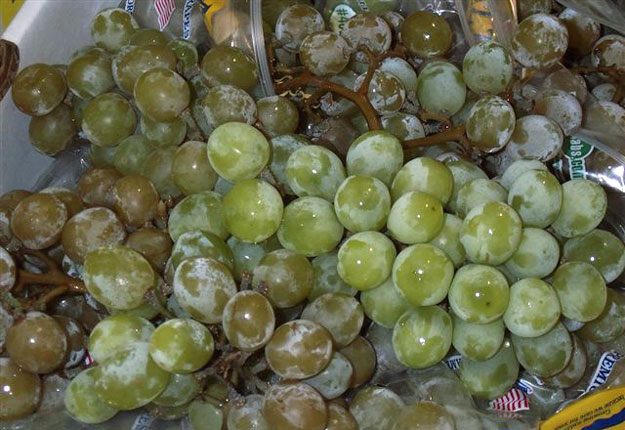
Previously frozen grapes do exhibit a distinct change in both color and texture. In my view, you’re splitting hairs with the 1% vs. 0% example. If the grapes are sorted after being subjected to freezing temperatures, with the selected grapes then being pressed unfrozen, then I’m not sure I would agree that you can make a case for Baumard’s process fairly being called cryo-extraction.

^^^ Can you spot the previously frozen grapes in the photo above?

Given the impending ban on currently approved cryo-processing, perhaps Baumard will decide to invest in a Bucher Vaslin Delta Vistalys Optical Sorter or Pellenc SA Selectiv’ Process Vision and put an end to all of this speculation. Until then, it looks like the discussion will be an ongoing one.

You have a thousands of grapes, say 20% are wholly frozen, 20% are wholly unfrozen, and 60% are partially frozen. (Let’s assume he’s found a way to freeze the grapes individually so they’re not clumped in big frozen bunches. That seems a big enough problem as it is, but not insoluble, I suppose they can be spaced out on a moving belt or tray.) How do you pick out only the unfrozen grapes? They don’t weigh any different. If only the inside is frozen, they don’t feel any different. Maybe you can shine light through them? Remember, if he’s pressing grapes of which ANY portion is frozen, that’s cryo-extraction. Anyways, I think I’ve made my point, and await Baumard’s description of the masterfully innovative machinery he’s designed to do this.

Z, parting out your responses the way you have seems, to me, more indicative of failed “debate” (though I’d suggest that’s not what most were looking for, probably more of informative discussion, and that distinction may go a long way to my understanding if the positions you’ve taken) than Jim’s statement. Your responses imply the technique of trying to seem obvious, though when strung together they seem rather desperate and tenuous. I for one lack the time or desire to address each of your points, though I clearly disagree.

He’s our very own SIr Bedevere.

I have to say I agree with Michael, and I don’t have the time or energy to respond to all the issues involved, sorry about that, and I’m afraid picking apart the debate and fracturing it into multiple micro-arguments for me misses the point of the debate (as I keep saying, but as I also keep saying feel free to carry on).

One thought I do have is that the arguments supporting (probably not the best choice of word, but I am struggling to think of one better) the Baumards in this issue seem more fervoured and based on dubious faith than anything presented by Jim Budd (who did not write an ‘atta boy’ on my blog, but simply commented “A very clear exposition of the issues involved - Thanks”). At least he has some evidence to back up his beliefs, regardless of how unfounded some people insist on finding them to be.

I’m happy to leave this as it is until further evidence comes to light despite your desire to cast me as the Che Guevera of some pitch-fork-carrying anti-Baumard league. Nevertheless, I am sure that, looking at the factions and the strengths of the beliefs held, not even solid evidence or open admission will be enough to quell the arguments in some corners.

I have to say that I find it extraordinary that you and Michael Powers feel it is OK to walk away from this debate. This isn’t just a harmless discussion that has no consequence. You have participated and actively promoted a debate that may have (if it hasn’t already) a huge negative impact on the reputation and therefore the livelihood of a wine producer and his family. I think it is incumbent upon you to stay involved and not bow out just because you don’t have ‘the time or energy’. This isn’t a game.

I think Simon has misunderstood just how much impact this will have on sales of Baumard wines. A tiny handful of you may no longer buy any wine, but there are, quite literally, millions of wine drinkers who don’t care and will either continue or begin to buy Baumard wines.

There are also people that would buy a Baumard “Ice Wine” if it was produced from the QdC vineyards. He could even charge a premium!

Welcome to the Forum, we’re so glad to have you here! We look forward to your future contributions!

[snort.gif]

Peter, I agree with you btw. Personally, I might even consider buying Baumard again if he were to create his own proprietary brand rather than pretending any sort of fidelity to the appellation style (much less the INAO rules). :slight_smile:

Whether or not it is “okay” is not really the question. At some point everything there is to say has been said and to simply add more content, is really to subtract from the strength of your argument. I’ll still check in and monitor for development, but just because Z chooses to deconstruct this discussion line by line and craft each sentence as an individual debate does not in any way require that I follow down the rabbit hole. If you’re getting something out of that minute deconstruction good for you (and if so I have some literary theorists you can read, you’ll love it) but I think the last original thing was said in this thread some time ago. That could change of course.

He could brand it “Q” wine as a nod to its source in the QdC. Throw on a sweet label with just “Baumard” across the top and big, ol’ “Q” in the center and watch the sales figures climb.

Cynical, I know, but true.

Mark Angeli couldn’t get AOC for his Rose d’Anjou some years ago, so he created a Vin de France wittily-entitled “Rose d’un Jour” instead:

No last name?

As far as I can see this topic is already being debated in the UK, USA, Ireland and France so how many people have to stop buying Baumard wines before it is deemed that his business has been affected?

Tom, When I registered it appears I didn’t have to give a surname but if that’s a problem for you it’s Tyrrell and yes I know Florent and his family personally and yes I import his wines in Ireland.

Simon

I’m very happy to continue on with a debate if it continues to look at the issue at question here, which for me is (again!) the use of cryo-extraction in the 2012 Quarts de Chaume harvest, and how that might or might not fit with the Quarts de Chaume regulations.

I’m not interested in getting dragged into fractured mico-arguments about the rights, wrongs, meanings or science of cro-extraction, as I believe this is just intended to cloud the issue, which concerns the 2012 harvest. There is nothing incumbent upon me to help you or Z to continue to confuse the real issue here - which is, to be clear, the 2012 Quarts de Chaume harvest, and how it fits with the legal requirements of the INAO - with such circular debate, like those you have also posted on Jim Budd’s blog (here: Jim's Loire: Baumard's frozen 'miracle'), exhausting the argument, going round and round in circles, to the point where I believe he gave up adding your comments to the blog.

We need more data to addresss the issue at hand. I have asked Florent Baumard twice, and received none. Perhaps, Simon, you would like to furnish some data to settle the debate, rather than going round in circular arguments about cryo-extraction? As you are Simon Tyrrell, of the Irish wine company Tyrrell & Co, and you list Domaine des Baumard among your producers (website here: http://www.tyrrellandcompany.com/) you could probably ask for us. I’ve had all my asks you see; if I ask a third time I have to get a pitchfork tattoo on my butt.

It is my opinion, by the way, that such a relationship should have been declared when you posted, as it is clearly relevant to the debate. Please don’t forget to add an “ITB” to your posts in future as well. It’s common courtesy to let people know what context you are talking from on a discussion forum such as this.

(Edited to make this comment: cross-posted with above post)

Dear Chris,

My apologies for not being up to speed on the required language of the discussion board and I’m not sure what an “ITB” is.

Yes I am indeed Florent’s importer in Ireland although I’m not sure what effect that has on this debate and yes I have asked him about the 2012 vintage. The answer I got was that he did not harvest under ripe grapes.

I am in complete agreement with you that the crux of this argument is not about cryo per se but about whether or not the grapes were harvested at the right sugar level on the vine and then cryo was used.

For me the use and techniques of cryo is another story altogether. I put it in the same camp as other techniques for making wine that have evolved over the years. The use of the word ‘industrial’ in relation to wine making is nonsensical in my opinion. Small, medium and large scale would be better, otherwise at what point do you start to describe wine as industrial - with the use of tractors and sprays in the vineyard, stainless steel tanks and filters in wineries? We will only continue to go forwards with techniques that help produce consistently good wines. People may not like it but they shouldn’t be naive about how many tools are available and are used in the production of wine, even by very small producers.

If the real debate is about the ripeness of the fruit we have to start off by making it clear that in Quarts de Chaume, 18.5% potential alcohol is the average level at which the grapes have to come in. Therefore it is possible to have one part of your vineyard where there are grapes at say 19-20% and others at 16-17% - I think we all agree on this. My problem with Jim Budd’s argument is that he took photos on the 9th October (I think that was the date) and then appeared to claim that the first trie was done on the 15th or 16th. What I would like to know from Jim is does he claim to know that it was the same bunches in his photos that were harvested on the 15th/16th. Given that the Baumards are the largest landowners in QdC at 6 hectares I think it is only fair that he be more precise in his accusations. As I said previously, this is a man’s livelihood we are all talking about.

I don’t think Budd gave up on posting my comments because the argument was going round and round and I certainly take exception to comment that you claim I was trying to confuse the issue. Only posting what suits you or only allowing the debate to be conducted on your terms strikes me as being somewhat one sided don’t you think? Is Florent not allowed to have people supporting his side? Budd appears to have plenty of people coming in on his side and vice versa (which is what I think Z may have been referring to with his “atta boy” comment). The comment of mine that Budd did not post was in relation to the photos he took in the Vignes Larges parcel. This piece of vineyard covers 2.5 hectares and Budd says his photos were taken over a period of roughly 3 and bit minutes (I can go back and find the exact time if it’s felt that’s it’s needed). My problem with this refers to my previous paragraph as to how representative the photos actually were. In the time he took his photos I calculated that he covered at the very, very best a distance of 200 metres and most likely a lot less. Therefore in my opinion he cannot claim to have given us definitive evidence of the state of ripeness of the grapes in a parcel that covers 2.5 hectares. If you were asked to do a random grape sampling before harvest by a vineyard owner and you came back saying you had only covered 200 metres of a 2.5 hectare parcel then I think you could expect to find yourself in big trouble. If this is perceived as clouding the issue then I apologise but for me it is a simple point of accuracy that is employed in every vineyard in the world.

Part of my problem here is also that we seem to be heading down a road that argues that it’s only about the sugar or the lack thereof. It was stated in Budd’s posts that the grapes can only have been at between 11.5-13% P.A. If wine making was only about the potential alcohol then we wouldn’t ever need to taste a grape in the vineyard to assess its overall maturity. I think we all know that if you take out the aroma precursors, the amino acids, non-flavanoids and flavanoids we are just left with sugar, water, tartaric and malic acid (although obviously very little malic left in late harvested grapes, if at all). To make high quality wine we require all those elements to be present and in the right proportions. You cannot simply just harvest unripe grapes, extract the water and then make a high quality sweet wine - you will be missing all the other elements. Do we agree on this? If so I find Budd’s claims to be at best exaggerated and inflammatory.

I also asked Budd in the same post as to who accompanied him when taking the photos as I don’t believe he was alone. If we’re all being open about our identities and interests here maybe it would be fair if Jim revealed who he was with?

The problem from the very outset of this debate has been the lack of proof. Budd does not have and has never had absolute, definitive proof of the grape ripeness at the point of harvest in the vineyard or at the cellar door. In my book, but maybe I’m naive and don’t understand the rules of what can and cannot be said in a public forum, a man is innocent until proven guilty. Florent has not revealed at what P.A his grapes were at in 2012, maybe he should or maybe he doesn’t want to engage with someone (Budd) he perceives as being antagonistic to him. He also may not have the information. I make a small amount of wine in France (10,000 bottles) and am required to harvest at a minimum degree of alcohol but I don’t actually have to record the P.A on the vine because I am not required by INAO to record it. What I am required to do is record where the grapes came from, any additions (not subtractions) and to state the accurate alcohol level on the label to within half a percent. In all the wineries I worked during my wine making studies there was never any record kept except the wine making notes recording the specific gravity of the must at the start of ferment. If Florent has declared 77-79hls of QdC from the 2012 vintage it is because the wine reaches the standards required by INAO to produce it - no less, no more. If Budd doesn’t believe him and is getting no satisfaction then he should report his suspicions to the authorities but I imagine they will not be able to prove anything either because the wine is now in tank. The fact that INAO have not intervened is not because I imagine they are unaware of the story but because they too know there is an absence of proof. In my opinion if Jim had wanted to try and prove he was right he should have taken grape samples from a properly conducted random sampling at harvest time and not before.

Perhaps due to his frustration at not having this proof and possibly because Florent doesn’t want to engage with him, Budd appears to have made his attacks very personal which to me seems a shame as he does a lot of very good writing. But comments such as “It is now surely time for the Baumards to drop their absurd and grotesque challenge to Quarts de Chaume Grand Cru” would make one question his objectivity. “Grotesque” does not seem like the type of adjective used by a journalist giving a even opinion. Even his translation of Baumard’s initial response “Vous êtes manifestement inconscient de l’inconvenance de votre démarche et du ton que vous employez” was deliberately translated and posted on Jim’s site as “your approach and tone is insolent” making Florent out to be some arrogant, aloof wine maker. Not only is this translation inaccurate but you know him Chris and I think Florent is far from being either of those.

Regards,

Simon

Simon,
Please go to “user control panel” and add your last name to your signature line as well as a brief line about the nature of your business.

Look at a few other heads for examples