There is very little data on Ardea although it was talked about on this board awhile ago…
When you see it, and understand how it works, you have a hard time believing this isn’t better than cork in every way. The only way it isn’t is, unlike cork, it doesn’t impart any flavor to the wine…
Mac Forbes in Australia has been using them awhile too…so it’ll be interesting to see where these go…
Sounds interesting - but please illuminate us as to how it is ‘better’ than natural cork - other than there is no possibility of TCA? And why would a winemaker consider this type of closure over DIAM, sugar cane or screw caps?
No possibility of TCA. Consistent oxygen ingress you can specify. Adjusts to changes in temperature and humidity. Inert contact with wine.
It basically behaves exactly like cork including the head space…except no TCA and more consistent. The only thing it doesn’t do is give the flavor cork slightly imparts or even if it is something like minor phenolics…
From Diam - The new 30 year diams look really good. Diam is also held together by some sort of bonding agent…We don’t know what that will do to the wine or us later on. But they look good and being made of cork, will impart the same type of thing normal cork does to wine (mostly I would assume).
Nomacorc might be a very viable option as well and looks like it has worked out fairly well. I don’t think the way it adjusts to environmental changes is as advanced as Ardea…but I don’t think any real significant data has been collected to compare the two…
Screw Cap - I think screwcap is great…the difference though is the headspace so there may need to be adjustments as far as bottling is concerned. So far whites look like they age fantastically well…For reds the jury is still out…with age the wines still seem too fresh which is desirable in most whites, doesn’t seem so great in reds. Not sure if this is because of the headspace issue or because it doesn’t impart flavor from the cork…but Nomacorc would have this problem as well.
I think Diam is the closest to normal cork…and why you’re seeing producers go to them even at the very high end…mainly because the risk is lower…
Ardeas down side is the cost…I think they’re the most expensive alternative listed…They’re also the coolest looking in a space age type of way…
Mac Forbes - I’ve only seen it on their EB line…but not sure they still use AS…
Here is the previous Ardea Seal thread: Strange New Wine Closure..... - WINE TALK - WineBerserkers
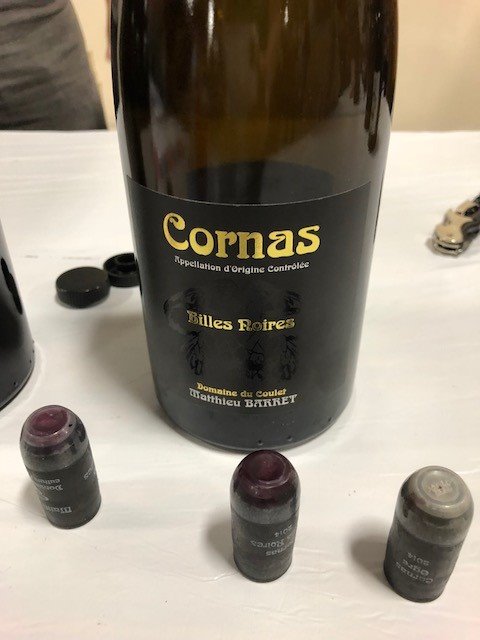
It references a few other producers using the closure, and as noted there, saw Matthieu Barret of Domaine du Coulet using it on his Cornas wines and handing out samples at Hospice du Rhone in Paso last April.
This notion that cork imparts some hard-to-define-but-good flavors to wine sounds like utter BS to me. Had anyone heard that contention before the last year or two, when closures like Diam and Ardea were gaining acceptance? I’ve been serious about wine for more than 30 years and I had never come across this claim until recently.
I think Alan’s question is the right one. Where’s the data? A cigarette lighter doesn’t show data under realistic conditions. It shows a single data point at a much higher temperature than you’d expect any wine to ever be exposed to unless something is really messed up in the supply chain.
I’ve had dead Monts Luisants from 2010 and 2011 - so if Ardea is supposed to be the panacea for pox - it’s not.
I’ve not had a 2008 Griotte since 2011 (08 was the first Ardea vintage chez Ponsot) - all mine collected in the Côtes - the 08 was a herby wine to start but lost that aspect with air - otherwise it was fine. I must check-in on that wine - maybe over the weekend…
Olivier Leflaive used them (Ardea) for a while, before jumping ship to DIAM…
Laurent also told me that he’d got a new formula for ‘the dot’ as the old one didn’t work properly - he changed that at the same time he started to incorporate NFC chips in the cases - something that Louis-Michel LB has also started doing, judging by my most recent cases from Liger-Belair…
Nothing behaves exactly like cork. Cork allows a tiny bit of oxygen into the bottle in the first few months, after which the best corks allow zero oxygen transmission until they fail many years down the road. If Ardea allows some consistent amount of oxygen transmission, then it definitely does not behave like cork. Ditto if it allows none.
I find this very interesting as it suggests that maybe the corks are not be the cause of, maybe not even a factor of, premox. Of course, it proves nothing, but the suggestion is there.
DIAM now has a variation that allows a bit of oxygen transmission, early on, first year or so as they put it. They actually recommend it for reductive state wines.
Well it is something I’ve noticed as well as others and then there was a study in 2017 where they found it does impart some phenolics to the wine…You can simply put a new cork into a glass a water and after awhile it’ll change color…it is doing something…