Sure, maybe $1000 now, but those in the know had it for $120 a pop before word got out, certainly was the case with me. Similar pricing to what X Omni Morgen Long goes for. So maybe a fair comparison after all.
1 Like
Isn’t this exactly what he said?
Not sure what value you feel you are adding in this thread by flexing about your prior purchases.
3 Likes
My comment was in response to the commentary that Oregon is superior to lots of white burg. That has not been my experience. That’s it. No need to take it further. Relax. No flexing here - like many on this board, I have relationships w local retailers that have been cultivated over many years who thus offer me allocation pricing.
Hold current market price constant and make that comparison. Same conclusion?
If you’re asking me whether I would pay secondary market pricing of $1000 for white burg vs $120 for Oregon Chardonnay, then sure maybe I pick the latter. And if circumstances change and I get dropped from their good graces, then sure I probably stop buying that particular burgundy.
But it doesn’t change the fact that, for my palate, the joy I derive from one often doesn’t match the other. And if the money leaving my pocket is the same, then for me it’s a no-brainer. YMMV.
My experience is that the Lamy HD wines are overhyped. They are very good, but the pricing is more a reflection of William Kelley’s scores than anything else. Not to take anything away from William’s palate, as he has an excellent one, but Morgen Long and Walter Scott are significantly better than you are giving them credit for. The same way people inflate the value of Burgundy based on a famous region/vineyard/producer/label/history, people devalue the Willamette due to the lack of a famous region/vineyard/producer/label/history. The top wines of the Willamette go toe to toe with top White Burg IMO - there are just very few wines that do so at this point in the Willamette’s Chardonnay history.
As someone who drinks predominantly white Burgundy, I feel like those who are in the know are the ones choosing to cellar case quantities of top Willamette Chardonnays at pricing that the top wines of Burgundy haven’t seen in 20 years.
3 Likes
I read exactly zero of WK’s reviews. My impression is formed solely from my own experience w the wine.
My brother that is literally what I said on the last line!
3 Likes
I know, I know. But to be sure, the lead up to it was heading in the other direction. I drink and own a lot of Oregon chard and I just cannot get to the same conclusion that, in general, it is “superior to lots of white burg.” That’s what I’m commenting on. Let’s do a blind when you come to Chicago in a few weeks.
I think a big part of this is a function of the availability of top shelf Oregon Chard with appropriate bottle age. The wines have improved dramatically in the last 10 years, so the wines that many think are punching high are still quite young. It’s much easier to find an aged example of White Burgundy. I’ll be curious to taste a 2021 X-Novo with 15 years of bottle age.
It’s also a question of palate preference. Hubert Lamy is pretty low on the new oak and generally not very reductive. Walter Scott is pretty high new oak and reductive, so if you are not a fan of that style, I could see why you would prefer Lamy. I poured an 18 and 20 en Remilly blind for several very experienced palates at my tasting group last month and most thought it was Chablis - loads of oyster shell on the nose and quite linear and chalky in style.
5 Likes
The 2024 Morgen Long single vineyard bottlings are hoky moly stunning right now. Life-changing.
1 Like
Since taste perception is significantly reduced at temperatures that low, and you prefer the wine that cold, I question whether you do in fact actually like the wine? 
I don’t know what it is about it. Just with raw seafood. It’s completely exhilarating!
Interestingly enough, we had a 2023 Lamy 1er Cru Saint Aubin in a blind tasting in June. It had a hard streak of reduction right down the middle of it. Not the flinty, biscuity type, just a hard edge of dirty diaper.
The wine underneath it seemed like it had a but of potential, but I wouldn’t open another bottle for another 4-5 years if I had one.
1 Like
Happy to open bottles with you anytime.
I’ve had some very solid white burgundy lately. But none of it has put the Oregon wines in the dust or been materially superior. We’ve matched vintages, so things have been even and focused on 14 and 17 to avoid the “solar” vintages for Burgundy.
YMMV is always a real thing, but I’m happy to taste good white Burgundy anytime and there’s plenty of WV Chardonnay that is of equal quality for less money.
4 Likes
My mind kept imagining the “sloppy steaks” skit as I thought about Morgen Long SVDs being served ice cold and straight out the freezer.
2 Likes
I’ve definitely had a similar experience with Lamy, and dirty diaper captures it well. It’s just not a consistent part of the style that seems purposeful.
That’s well said. I don’t think many winemakers would purposefully lean into that particular type of reduction. It happens soletimes, but it’s also not a permanent state for the wine and I expect that wine will be excellent at some point
1 Like
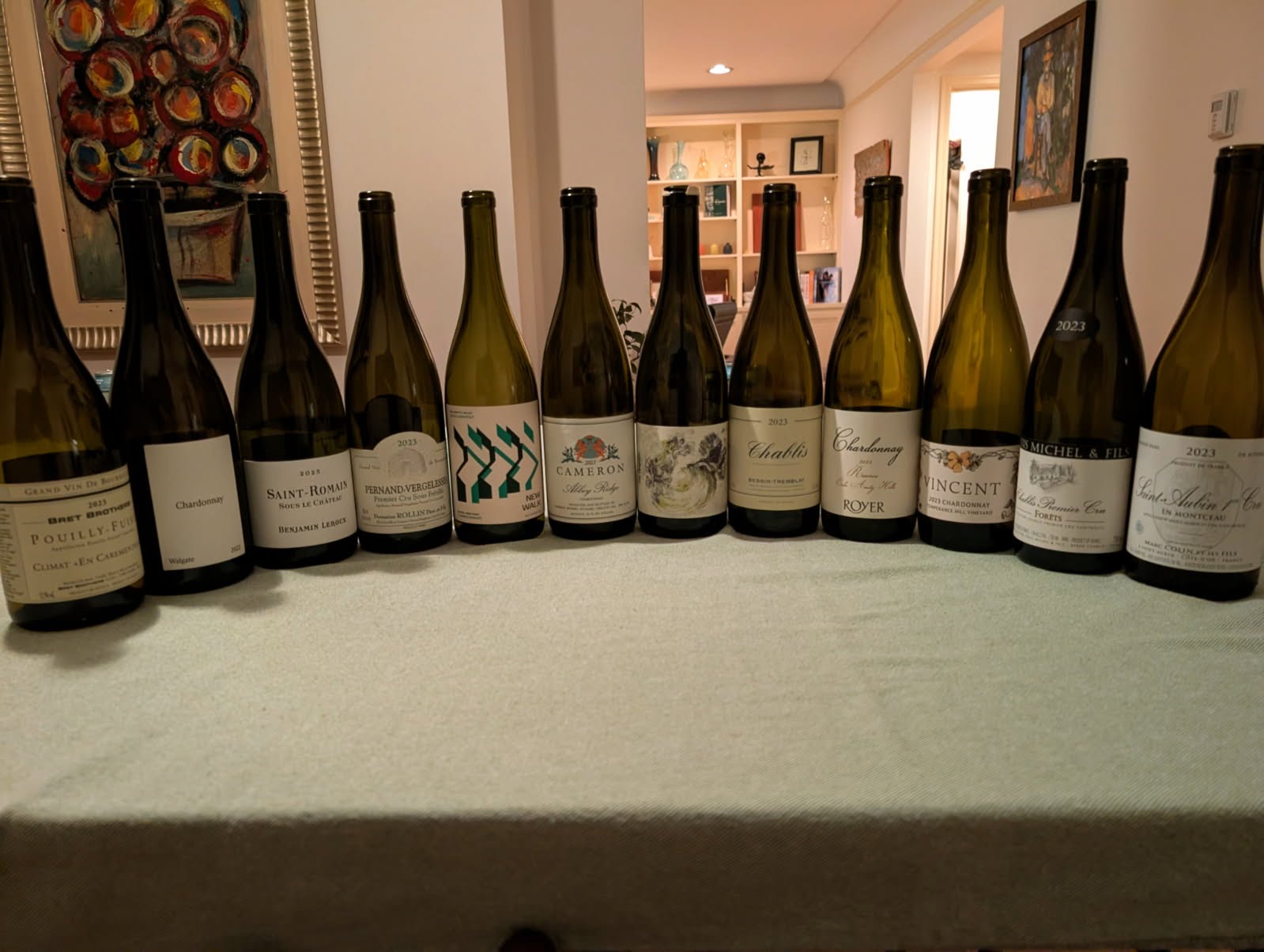
This seemed like a good place to note this–but this was a recent (blind) lineup in the tasting group that I sit in on fairly often. All we knew is that it was a mix of '23 Willamette Valley and '23 white Burg, and the high points of the night were Oregon bottles (and the Bessin-Tremblay). Whether WV wines stack up with the $200++ burgs is something that I can’t speak to on a meaningful basis, but the combination of Oregon winemakers absolutely finding their stride/vineyard+site+farming improvements and also warm years in Burgundy (that, frankly, I don’t think lots of Burgundian winemakers are handling well) means that I think under $100 I’d basically rather drink good WV wine any day of the week. And under $60? Not sure how close it is.
10 Likes
I find bottle-to-bottle comparisons the most meaningful, which is why I enjoy posts like Saul’s and others’ that describe tasting Oregon chard alongside white Burg. Of course, it helps if you broadly share the palate of the person making the comparison.
For those of us who don’t own money-trees, price-point comparisons (e.g. best region for chard under $60) are probably what we care about most. But these comparisons are complicated by the fact that prices vary from place to place for economic reasons–e.g. tariffs, distribution costs, relative scarcity. So the relative QPR of Oregon chard and white Burg depends on whether you are buying in Portland, London, or Lyon. There was a recent threat of a 200% US tariff on French wine. I don’t think that would ever happen, but if it did, then it’d be no contest for US consumers: buy all Oregon. That wouldn’t reflect badly on the quality of white Burg though.
I’m curious about a different point of comparison. @Wil_Raley noted that there’s limited top Oregon chard with a lot of bottle age, and I took him to particularly have in mind the contemporary reductive style like Walter Scott. Does anyone care to speculate whether this reductive Oregon chard will converge with or diverge from reductive white Burg with significant age?
5 Likes