Thanks for the recommendations, guys, I have the 2020 as well, but for some reason must have missed the 2019.
Flight 3: St. Julien – Leoville Barton, Leoville Poyferre, Langoa Barton, Branaire-Ducru
This St. Julien flight was a close second to the Margaux. These wines probably most strongly exemplified the vintage character as I’ve described it – the combination of very pure, ripe fruit tones with bright acidity and mineral edge, all joined by classic nonfruit aromas and flavors in the pencil, mint, leather, and earth registers.
Three of the four wines were fairly open, though all would benefit from 5-10 years sideways and then the fourth wine—the most structured of them—closer to 10+. (I’m circumlocuting a little bit here as to which of the wines I’m talking about because I have a sneaking suspicion that wines 1 and 2 may have been swapped at our table.) Generally speaking I had a very strong sense that one particular wine was Barton. The other three were a bit harder to parse; one wine seemed the plushest and least acidic to me and I put that down as Poyferre, and then as between the remaining two I called the slightly more ‘serious’ one Langoa and the prettier one Branaire based purely on estate stereotypes. Alas, I made a hash of it, such is blind tasting and particularly so where, as here, I’ve had limited exposure to several of the estates.
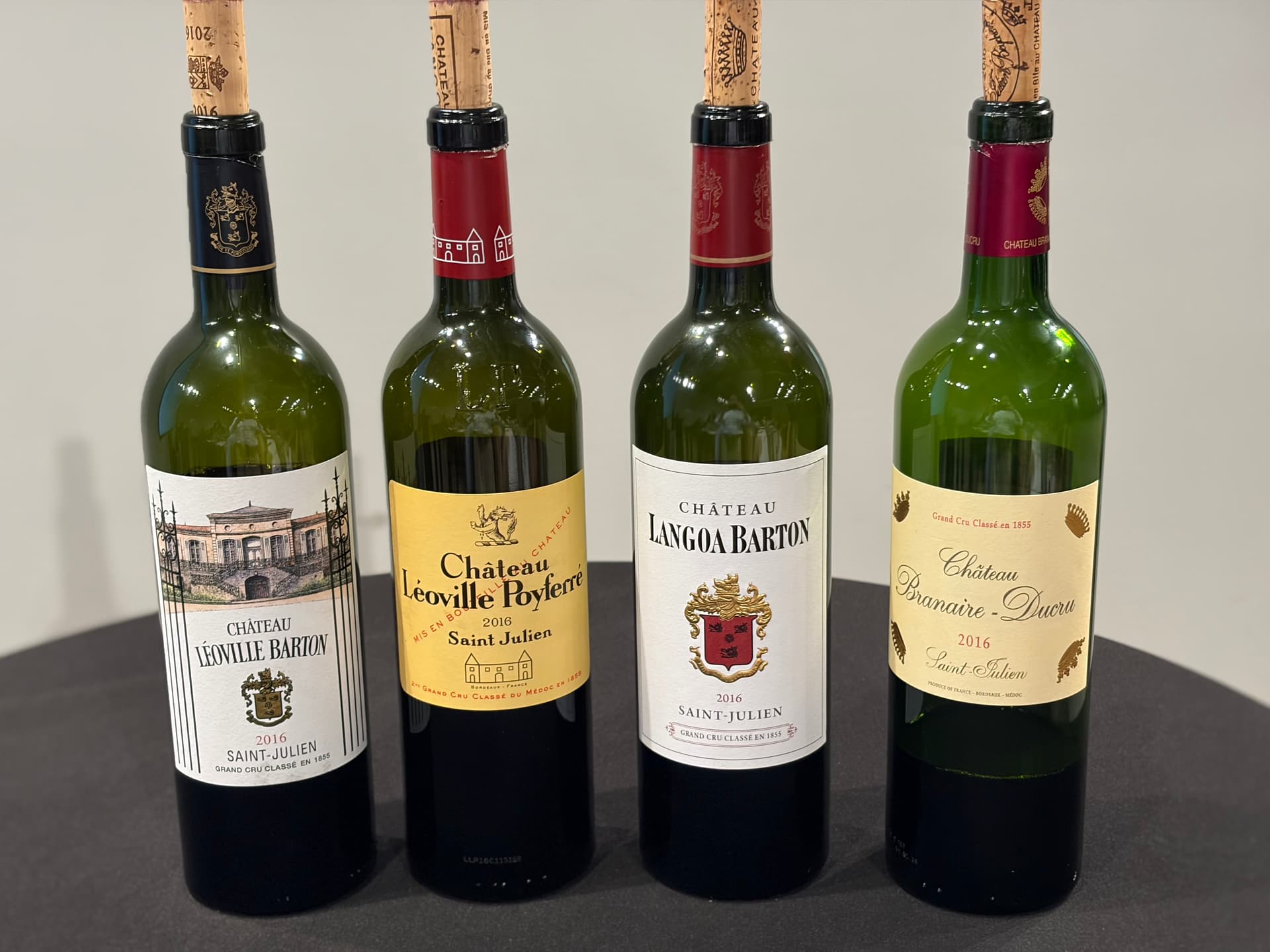
Wine 1: Leoville Barton*
Nose: Pretty and fairly open, less toasted coffee oak impact, florals, bright redder toned fruit. Pencil, mint.
Palate: Down the middle, red fruited, quite charming. A tiny bit warm alcohol perhaps, but nothing egregious. Generous but very well balanced. Fine tannins that do not overwhelm the fruit, which shows nicely at this point.
Guess: This was the more “serious” of the two lower-tannin but not lower-acid wines, so Langoa?
[Commentary below]
Wine 2: Leoville Poyferre*
Nose: Good amount of coffee/cocoa oak, cedar pencil and graphite, dark fruit, leather, mint, bit of an oceanic/estuarine twinge to the nose.
Palate: Dark, dense, and wound up at this point, the wine shows blackberry and cassis fruit and a saline twang; fairly stout albeit quite fine tannins; very well balanced though a bit austere. The wine has ample acidity, excellent balance, and astounding depth, it’s just a bit fierce at present.
Wine 2 was wine of the flight for me; it is a formidable wine with a very long future before it shows its stuff fully, but you can see the potential here and while a touch austere it is not unpleasant to drink today.
Guess: Leoville Barton
*Commentary on Wines 1 & 2: Obviously there is every chance that I simply messed up my evaluation of these two wines…. But, I think there is at least some possibility that Wines 1 and 2 were flipped at our table. Wine 1 was quite a lot softer and more open and giving with generous fruit, whereas Wine 2 was stern, classical, and imposing. Just based on the estate stereotypes, that makes me think Wine 2 is the better candidate to be the L-B. I’ve only tasted 2016 L-B once before but Wine 2 much more closely lined up with my recollection than did Wine 1. However, again, want to emphasize how possible it is that I just got my evaluation of the wine wrong—or that in 2016 Barton and Poyferre have played a little bit against type… or or or. In any event, both wines were very nice, and Wine 1 – if I’m right in my theory – did not (at least on the night) come across as an objectionably modern/Rolland styled wine. It was certainly ripe and generous but was not ponderous, bloated, over-oaked, or etc.
Wine 3: Langoa Barton
Nose: More voluptuous red fruit tone here, rosey florals, a generous nose, some menthol/eucalyptus type high toned coolness. Less oak impact.
Palate: Fairly ripe and sweet fruit tone, leaning red; certainly softer than 2 but still some respectable structure. Almost juicy acidity keeps the whole affair afloat and avoids any sense of flab.
Guess: This was the prettier of the two lower-tannin but not lower-acid wines, so Branaire-Ducru?
Commentary after reveal: I have had a lot less Langoa-Barton than I have its elder brother, I suppose due to the smaller volumes produced – you just don’t see it at auction nearly as much. (Or maybe people are drinking it up on the younger side?) So I can’t really speak to whether this played to type or not; however it was a lovely wine indeed and one that I am happy to own.
Wine 4: Branaire-Ducru
Nose: Lower oak impact here, this showed a soft, charming, and generous nose of minty red and dark berries, cigar wrapper, and roses.
Palate: The plushest wine of the flight, not the least tannic but on the lower side as far as the acid profile, with a full body and generally the ripest fruit tones of the wines in the flight. Not bad and not flabby, but distinctively less fresh and lifted than most of the other wines.
Guess: Leoville Poyferre?
Commentary after reveal: I don’t know if I’ve ever had a Branaire-Ducru - it isn’t expensive at auction but it seems to command a higher premium than many of its price-bracket mates, such that it is priced nearer to e.g. Leoville Barton than its release price would suggest. Certainly the estate has gotten a lot of positive critical notice over the last few vintages (though I’m not sure if it reaches back to ’16). I was a bit surprised that this was it, given its lower acid profile. Not a bad wine but not one I’d chase either.
Next up, the inscrutable St.-Estephes.
8 Likes
A Fronsac I bought for 13 EUR that matches up to most 2016 Crus Classées.
Pleasant surprises in this realm are always so exciting!
2 Likes
I’ve had the 2016 Segla, the second wine. It was much more ripe, darker and bolder than I was expecting. Also not much floral notes on the nose, but big cassis. Seems the opposite of the main wine. Would be curious to hear your thoughts if you’ve tried both.
2 Likes
back on track in september:
17 out
12 in (the annual Lauer package)
Thanks for the notes, Justin! Really hated to miss this one.
1 Like
Flight 4 St. Estephe – Ormes de Pez, Cos d’Estournel, Lafon-Rochet, Montrose
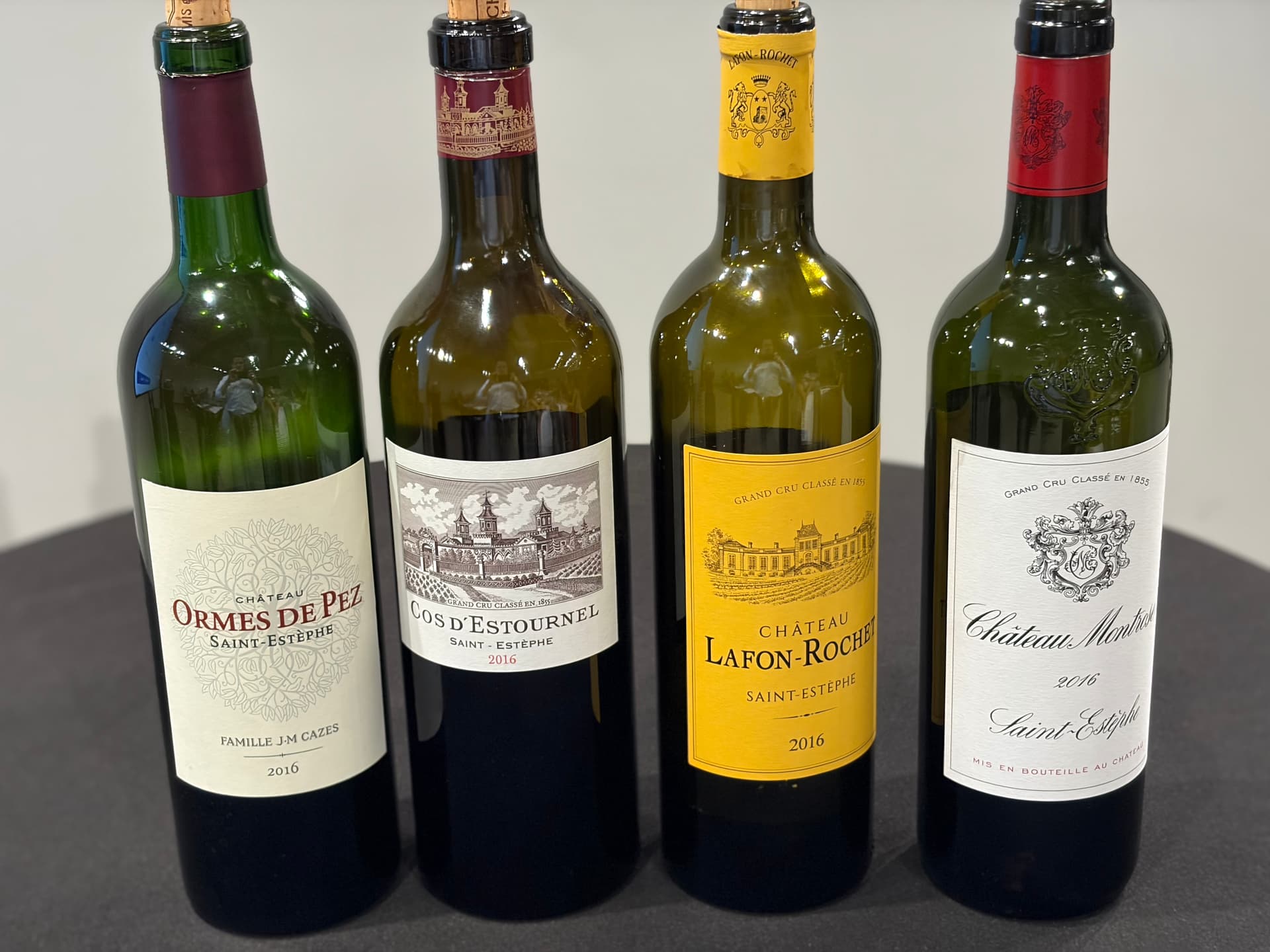
This flight was a real head-scratcher for me. Partially that is due to time compression—this was when I figured out I was sitting across from Robert’s dad, as a result of which we spent a few minutes yakking on that subject. Between that and the organizers trying to gain back a bit of time after the first few flights predictably took a bit longer than allotted, I had less time with this flight than the others by a stretch.
But time compression can’t explain all of it, and I don’t think I could have gotten that much better of a read with more time. I just really could not make heads or tails of these wines. They all tasted pretty much the same: big, burly, dark fruited, and that was about it. Where the prior flights were highly differentiated, this flight was something of a study in monolithic monochrome. Making things more difficult still, St. Estephe is not a commune I have spent much time either tasting or reading up on and so I did not even have a good sense of estate stereotypes to fall back on, with the result that my calls on the identity of the wines were basically at random and, well, I guess I performed at statistical probability.
Wine 1: Ormes de Pez
Nose: Deep, dense black fruit; quite a ‘serious’ profile with a bit of estuarine funk.
Palate: The wine is fairly round and forward, showing generally ripe fruit tones; it is robust and tannic; quite saline. A bit of alcohol warmth.
Guess: Ormes?
Commentary: This was the darling of the Southwold 10YO tasting this year, to the extent that they snuck it into at least one (maybe more?) extra flights to make sure the scores it was receiving held up. I don’t disagree that it is a very nice wine. While I did find this a bit more forward than some of the other members of the flight—which I suspect helped its performance—it was not by any means out of place with its flightmates. While the US price appears to have ticked up fairly sharply on the news, if you bought this at release or near-release pricing you’ve done well.
Wine 2: Cos d’Estournel
Nose: This showed a riper, rounder profile than wine 1, with more of a blue fruit tone; lots of pencil, dirt, licorice.
Palate: Slightly lower acidity than the others; a touch more texturally forgiving than some of its burly and tannic flightmates. A bit monolithic.
Guess: Lafon?
Commentary: Nothing of consequence to say on this one.
Wine 3: Lafon-Rochet
Nose: Again quite dark fruit tones; this stood out mainly for the heightened degree of inky, seaweedy, maritime tones that stood alongside the fruit.
Palate: Following the nose, the wine shows quite marine and savory, with some meaningful depth. As prior the tones are all quite dark. There is some almost smoky-meat character to the wine, which makes me wonder whether there is a touch of brett.
Guess: Montrose?
Commentary: As prior, nothing much of consequence to say here. The savory marine character stood out here the most of any of the wines in the flight, but that is about all that I picked up on as a distinguishing feature. Really these wines all tasted approximately similar to me.
Wine 4: Montrose
[Didn’t get good notes on the nose]
Palate: Deep blackberry, floral, salty, savory.
Guess: Process of elimination… Cos?
Commentary: Not extraordinary for me, frankly a bit blocky and not showing much by way of fireworks. I have no doubt it’ll be fantastic in 15 years or perhaps 20, but it is not blowing my hair back today. As I noted above, on revisiting the Montrose after the reveal I got more of a sense of depth, length, general seriousness, but it remained a bit foursquare. Who knows!
10 Likes
Great notes, Justin! Thanks for taking the time and effort to put all of these together. Looking forward to the Flight #5 notes!
1 Like
Flight 5: Pauillac – Pichon Comtesse, Pontet-Canet, Lynch-Bages, Grand-Puy-Lacoste
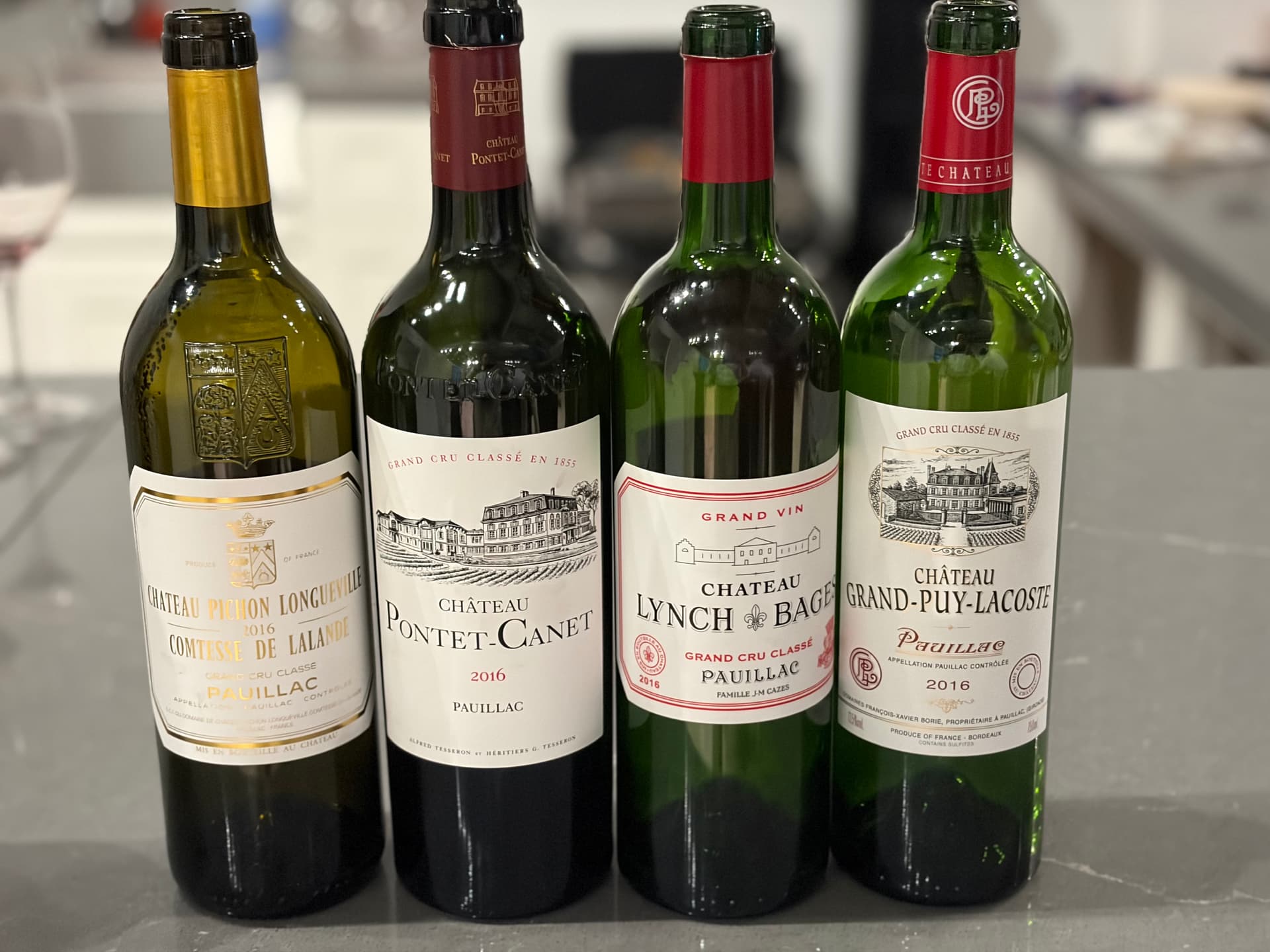
This Pauillac flight probably suffered a bit from being staged in the closer position, particularly right after the fairly burly St. Estephe flight. However, it was at least for me an uptick both in legibility and enjoyment despite a bust on the Pichon Comtesse which, on paper, was a likely favorite.
The Lynch-Bages was certainly my favorite of the flight, although it was simultaneously the most backward and surly of the wines in front of me (and certainly up there, perhaps tied with [what I thought was] Leo-Barton, for the most wound-up wine of the evening). Nonetheless it showed the proper Pauillac regal character, with a profound sense of depth.
While the Pichon Comtesse’s poor outing was the biggest surprise of the flight, the next biggest was how much I liked the Pontet-Canet, which is a wine that, in ’14-15, had a very distinctively softer and more open style vs. this more typically Pauillac iteration.
Wine 1: Pichon Comtesse
Nose: Bright fruit tones, lots of cassis, some leafy character, pencil and cedar.
Palate: Surprisingly sweet and ripe, bleh. A bit fatiguing and heavy frankly. Not much pep or energy.
Guess: Pontet-Canet?
Commentary: Well there you go. I called this the Pontet-Canet due to my impression of the ’14 and ’15 as similarly plush wines (see below commentary). I was pretty surprised on the reveal.
I haven’t had much by way of either of the Pichons, but it was still quite surprising to me that a wine I’ve seen much adored by the respectable critics and on this board landed so entirely low for me. Again there is the problem of the large panel tasting – and particularly the last flight of a large panel tasting – but at least at this point in the night the wine was just totally fatiguing and unwelcome. Adding insult to injury was the pivot from a very attractive nose to a very unattractive palate – probably the largest divergence of the tasting. (I try not to place too much emphasis on panel tasting results like this, but this does make me a bit nervous about the case of the 2022 that I bought as a wedding anniversary wine, as if anything I’d imagine that is going to be a touch richer!)
Wine 2: Pontet-Canet
Nose: This is very cabbish, showing lots of pencil, tobacco leaf, and tomato stem/green pepper pyrazine in addition to the fairly attractive mid-toned ripe fruit.
Palate: This shows fairly sweet fruit tones as with many of these wines, but it has a much brighter tone and more acid than wine 1. This has some fairly stout chalky tannins and a general mineral sensibility to the palate feel.
Guess: GPL?
Commentary: This one also surprised me on the reveal. I called it GPL based on the general stereotype of GPL as a fairly classic Pauillac profile. Pontet-Canet is an estate that I am pretty sure I have only tried in the context of these AOC annual tastings. In both prior tastings of the ‘14s and ‘15s, the Pontet-Canet was quite distinctly more open, friendly, soft, and generous than the surrounding Pauillacs. Indeed, in the ’14s tasting, it was tied for the most ‘ready’ wine of the evening with, coincidentally, the other biodynamic Pauillac on offer, namely Haut-Bages Liberal. This ’16 by contrast was dramatically more structured and ‘serious’-seeming than the softer and friendlier ’14-15 iterations. Put differently, this ’16 seemed like a Pauillac!
Wine 3: Lynch-Bages
Nose: This is not showing a ton, really ultra severe, showing more cedar pencil, green pepper, and leaf and charred tobacco. The fruit is fairly muted by contrast, showing a bit of red and dark berry plus cassis.
Palate: More showing on the palate than on the nose, there is deep and dark berry fruit and cassis; there is a mineral sensibility. The acid is higher than wine 1, similar to wine 2; tannins are massive and fairly fine textured although not in the plush modern microox sense. The wine shows quite profound depth and energy, with a sense that there is something massive coiled below the surface.
Guess: Lunch bags?
Commentary: This was quite statuesque; not much hedonistic joy for drinking now but very enjoyable to consider and analyze in the intellectual, architectural sense. Enormously impressive and I suspect in the future will be a really monumental wine that shows the imperious and regal archetype of Pauillac in spades. WOTF for me, more on the strength of its potential than its immediate drinking appeal.
Wine 4: Grand-Puy-Lacoste
Nose: Dark and deep fruit, oak, coffee, licorice, mint.
Palate: This is equally dark-toned as on the nose. The wine is pretty plush, with lower acidity than wines 2 or 3. There is plenty of tannin but the wine seemed more in the generous mode than the more austere middle pair of wines.
Guess: Pichon Lalande?
Commentary: I called this the Pichon Lalande because it seemed more structured than 1, but plusher and more inviting than 2 and 3. Haven’t had GPL unless it was in the 2014 iteration of this tasting (for which I didn’t take electronic notes). So no real view on how this showed etc. – not an estate I’ve done the dive on.
4 Likes
HM$ lives in Dallas, Arv.
1 Like